
Best Polymarket Copy Trading Bots For Automated Prediction Market Trading in 2026


Fast-moving prediction markets reward speed, and the best Polymarket copy trading bots are built for exactly that job. They watch on-chain wallet activity, react through an API, and mirror trades into your own wallet with rules for sizing and risk so you do not have to sit in front of the screen all day.
Polymarket has become a busy venue for trading real-world outcomes, and the pace can be surprisingly sharp during headline-driven events. I have long read blockchain data a bit like GIS layers on a map. One isolated point means little, but a pattern across time tells you where the signal really is. That same idea applies here because a copy bot lives or dies on the quality of the wallet data it follows.
The real value of this software agent is fairly simple. It lets you track skilled traders more closely, respond faster than manual clicking allows, and keep your exposure inside rules you set in advance. To do that well, the bot needs reliable automation and a stable runtime.
This page mainly covers the infrastructure side of running a Polymarket copy bot rather than reviewing a long shortlist of named bots. The only specific bot implementation addressed here is OpenClaw, and PolyFocus is included as a separate platform worth checking for support claims.
What a Polymarket Copy Trading Bot Does
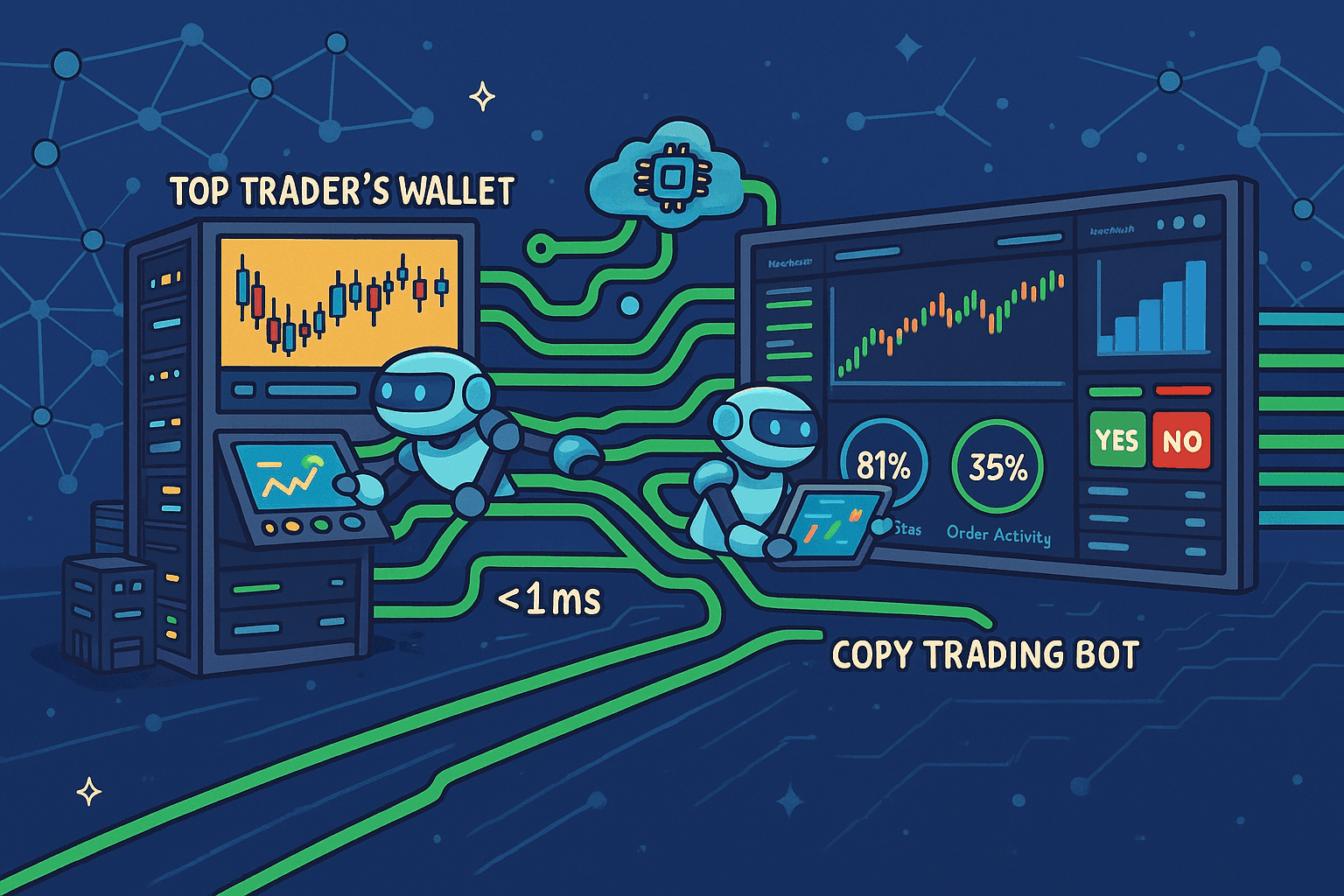
A Polymarket copy trading bot is an automated system that follows selected trader wallets on the blockchain and reproduces their activity in your own wallet. Instead of checking markets by hand and arriving late, the bot watches target accounts continuously and places corresponding trades for you.
In practice, that means it picks up fresh orders, adjusts size according to your settings, and keeps a record of how the mirrored positions behave over time. That can be useful if you want exposure to experienced traders or model-driven accounts without managing each move manually.
The execution flow is usually straightforward. The bot listens for wallet activity, checks whether the trade matches your rules, then sends the follower order through the API. After the entry, it keeps watching for adds or exits so your copied position stays in sync.
How Copy Trading Works on Polymarket
Most copy trading bots on Polymarket follow a repeatable workflow. The system first monitors one wallet or a small set of wallets that you decide to follow. These are usually chosen for steady performance or a recognizable edge in a specific market type.
The monitoring layer scans blockchain activity at short intervals, so the bot can see when a trader opens a position or starts reducing one. On an active prediction market, even a short delay can change your fill quality. In my own testing of similar systems, a difference of a second or two is enough to make copied entries feel noticeably less precise.
After that, the bot translates the leader trade into your own sizing model. A good setup does not blindly clone the same dollar amount. It usually scales your order as a share of portfolio balance or applies a risk-adjusted rule tied to market conditions and available liquidity.
More advanced systems keep syncing after the first trade. If the trader adds to a position or exits, your bot updates the follower position as well. Think of it like keeping two map layers aligned. If one layer shifts and the other does not, the whole picture becomes misleading.
Whale copy trading is a narrower version of the same process. Instead of following a broad pool, the bot tracks one large wallet whose order flow can move sentiment or reveal conviction early. That approach can work, though it is more sensitive to slippage because a whale entry may leave worse prices for followers a moment later.
How to Find Suitable Wallets to Copy
The hardest part is rarely the code. It is choosing whom to follow. Public blockchain data gives you a usable starting point, but the best signal usually comes from consistency rather than one spectacular win.
| Benchmark Signal | Recommended Value |
|---|---|
| Closed position history | At least 50 |
| Track record length | More than 6 months |
| Win rate | Above 55% |
Look at a wallet’s historical P&L and its win rate, then compare that with trading volume and the number of closed positions. A stronger candidate usually has enough history to judge properly. I look for enough time on the record to separate a repeatable signal from a lucky run.
Position behavior matters too. Some wallets handle exposure carefully, while others size aggressively and rely on a few large swings. I would also check whether the trader sticks to one niche or drifts between unrelated themes. Specialization can make the data easier to read because you are following a repeatable method instead of random activity.
| Warning Signal | Description |
|---|---|
| One-market track record | Most gains came from a single event or contract |
| High volume with weak net progress | Activity looks busy, though edge is hard to see |
| Suspicious news timing | Entries cluster right before major headlines |
Core Features in Modern Copy Trading Bots
Strong Polymarket trading bots tend to share the same backbone. They need near real-time trade detection and dependable order handling. Without those two pieces, copy trading becomes slow imitation rather than useful automation.
Position sizing is another core piece. Better bots scale orders to your balance and keep exposure within limits you define. That helps the strategy stay usable as your account changes over time instead of becoming too large or too timid for current conditions.
| Risk Control | Purpose |
|---|---|
| Single-market cap | Keeps one contract from dominating the account |
| Portfolio exposure limit | Stops total copied risk from creeping too high |
| Gas or slippage filter | Skips poor execution windows |
| Leader stop rule | Pauses copying after sustained underperformance |
Performance tuning sits in the background, but it matters. A polished bot may rotate RPC endpoints or retry failed requests with backoff logic. It may also time transaction submission more carefully so fewer trades are missed during heavy activity.
Most serious systems store trade data in a persistent database such as MongoDB. That gives you a clean audit trail, and it makes troubleshooting much easier after a few days of runtime. I usually consider logging a basic requirement because you cannot improve what you cannot inspect.The wallets you follow and the risk rules you enforce matter more than any marketing claim around copy trading automation.
The wallets you follow and the risk rules you enforce matter more than any marketing claim around copy trading automation.
OpenClaw Polymarket Copy Bot
OpenClaw is the only named Polymarket copy trading bot this page clearly fits. It is an open-source style bot concept built around wallet monitoring, rule-based position sizing, and automated order submission to Polymarket.
Its workflow follows the same basic path described earlier. OpenClaw watches a leader wallet on Polygon, checks your copy settings, then sends the follower trade through the API when the signal qualifies. After that, it continues tracking the leader so reductions or exits can be mirrored as well.
From a feature standpoint, the useful pieces are practical rather than flashy. You want adjustable sizing, wallet allowlists, and persistent logs so copied trades can be audited later. If those parts are weak, the bot may still run, though it becomes harder to trust in live conditions.
PolyFocus Support for Copy Trading
PolyFocus is better described as a Polymarket analytics and monitoring layer than a dedicated copy bot in this article. Its role is to surface wallet data and market activity that traders may use before deciding what to mirror.
Whether PolyFocus supports direct Polymarket copy trading depends on the version or workflow being used. Based on the scope of this page, it is safer to treat PolyFocus as a research tool unless its live automation support is clearly documented inside the product itself.
If PolyFocus does claim copy trading functionality, the relevant claims would usually center on wallet tracking and trade alerts. Those features can support a copy workflow, though they are different from full hands-off execution.
What Setup Is Required to Build a Copy Bot
Building a Polymarket copy bot starts with a small technical stack. You need a wallet dedicated to automation, API access for trade execution, and a runtime that stays online without interruption.
The software side usually includes a script or service that reads blockchain wallet activity and a database for logs. A VPS is the cleanest home for that process because local machines are more likely to sleep or drop network access.
The build sequence is usually handled in stages.
- Connect a dedicated wallet and store its key in environment variables.
- Set up blockchain monitoring for the leader wallet you want to mirror.
- Map leader trades to your own sizing and risk rules.
- Send follower orders through the API and log every action.
- Test with very small size before leaving the bot online.
That is the minimum workable setup. From there, most builders add retry logic and alerting so they know when the bot stops tracking cleanly.
Risks You Need to Understand
| Risk Type | Description | Mitigation |
|---|---|---|
| Key security | The bot can sign trades, so poor wallet handling creates direct account risk. | Use a separate wallet and secure environment variables. |
| Strategy drift | A trader you follow may lose edge or change behavior. | Review recent results and pause weak leaders. |
| Execution gap | Thin markets can give followers worse fills than leaders. | Use size limits and skip stale signals. |
| Software failure | Weak logic or API issues can break automation during active periods. | Run stable code and monitor logs. |
| Resolution risk | Prediction market settlement depends on platform outcome rules. | Keep exposure modest in markets with more ambiguity. |
Automation removes manual work, but it does not remove risk. Your bot needs permission to sign transactions, so private key handling has to be treated with real care. A separate wallet for the bot is usually the safest approach, and keys should be stored in secure environment variables rather than scattered across scripts or local notes.
Profit is never guaranteed. Even strong traders go through rough periods, and prediction markets can turn quickly after new information appears. A copied strategy may also lose its edge if the original trader changes style or starts taking more risk than before.
Execution risk is easy to underestimate. In thin markets, you may get worse fills than the trader you follow, especially during volatile windows. Liquidity can also trap capital in niche contracts, and on-chain trades are generally irreversible once sent.
There is also software risk. Open-source bots can be helpful, though they are not automatically safe. Weak logic, bad dependencies, or sloppy API handling can create problems during busy market periods. Rate limits are another practical issue, and during fast events they can break a bot at exactly the wrong time.
Polymarket adds a market-structure layer of risk as well. Settlement depends on the platform’s resolution process, so there is always some degree of oracle and outcome risk tied to the prediction market itself. That is part of the terrain, much like noisy GPS data that needs filtering before you trust the route.
Best Practices for Running a Copy Bot
- Start with preview mode or very small live size.
- Use a dedicated wallet.
- Apply exposure caps and a slippage filter.
- Ignore stale leader trades with a freshness rule.
- Review logs on a regular schedule.
- Avoid unstable local runtime environments.
Why Infrastructure Matters for Polymarket Trading
Latency and uptime have a direct effect on execution quality. A copy bot that sees a trade late or submits an order through a congested path is already behind. That gap can be small on paper, though it becomes obvious in fast-moving markets.
A purpose-built VPS helps because it keeps the bot online and close to the exchange infrastructure it relies on. Faster response times improve trade detection and reduce the chance of chasing a move after the price has shifted. In practical terms, that means cleaner mirroring and fewer frustrating misses.
I generally think of this like route optimization in mapping systems. The destination is fixed, but the path still matters. A shorter and more stable path usually produces more reliable results.
TradingVPS for a Polymarket Copy Trading Bot
For Polymarket automation, TradingVPS is positioned around low latency and stable uptime. The platform is built for trading workloads, which makes more sense than relying on a local machine or generic shared hosting.
The original Amsterdam deployment showed very low latency to Polymarket, with sub-1 millisecond response times in testing. That kind of proximity helps a bot react quickly when a tracked wallet makes a move.
There is an important update for 2026, though. Amsterdam has become less practical for some Polymarket users because of access restrictions around the website. API-based trading may still work, but the environment is less flexible than it used to be.
That is why the newer Dublin setup stands out. It is tuned specifically for Polymarket connectivity and is reported to deliver around 0.4 to 0.8 milliseconds to the API. For a copy bot, that tighter route can improve reaction time and make execution more consistent during busy periods.
TradingVPS also separates its plans by workload style. Ryzen plans are aimed at traders who want higher single-core speed and tighter execution performance. EPYC plans focus more on cost efficiency and stable long-running bot use. Both can support Polymarket automation well, so the right pick depends more on workload shape than marketing labels.
Security and uptime are the quieter part of the story, though they matter every day. An isolated VPS environment lowers the chance of resource contention and reduces the usual risks tied to always-on bot operation. If real capital is involved, that consistency is worth more than many people realize in the first week.
Final Thoughts
A Polymarket copy trading bot can make prediction market trading much more efficient by turning public blockchain data into actionable automation. The quality of the result depends on two things above all else - the wallets you choose to follow and the discipline built into your risk management rules.
Pair that with dependable infrastructure and the setup becomes far more usable in live conditions. From what I have seen, the software logic matters, though the runtime environment matters almost as much. If the bot is going to act for you, it needs a clean signal and a stable path.


