


Citi Gps Report on Bitcoin: Global Perspective on Trade And Finance


From a distance, this publication maps a fast-maturing corner of global finance. The citi gps report on bitcoin frames the asset’s role in global markets and provides clear insight for investors and institutions seeking a practical perspective.
A Well-Researched Study and Citi Insight
Contrary to the dismissive takes of years past, this analysis is rigorous and carefully argued by a six-person team with deep subject knowledge, complemented by input from leading operators — BitGo’s Nick Carmi and BlockFi’s Zac Prince among others. That blend of bank-grade research and industry experience gives the report a balanced view across business needs and market dynamics.
Serving as both primer and roadmap, Bitcoin at the Tipping Point recounts cypherpunk roots, the design choices attributed to Satoshi Nakamoto, and watershed moments that shaped adoption. Early traction, the authors note, leaned on resistance to censorship and open access — qualities that drew libertarian communities, security researchers, and, in a small share, bad actors. Today, transactions tagged as illicit are estimated at under one half of one percent, and the broader message is unambiguous: ignoring this technology can carry strategic and financial costs as the economy evolves.
Bitcoin Becomes an Institutional Play in Finance
Before roughly 2016, participation largely clustered around niche circles and high-risk traders. The boom spanning 2017–2018 introduced large swaths of retail through easier on-ramps, and, over the subsequent stretch, the infrastructure matured enough to welcome institutions into the market.
The authors emphasize that a new asset class only draws institutional capital once a dependable backbone can support efficient price discovery and liquidity. They highlight three pillars driving this shift.
1) Data — Two streams now matter: pricing feeds from venues and onchain indicators. Access to robust pricing and analytics expanded via specialized firms like Coin Metrics alongside more reliable exchange APIs. Onchain metrics, accelerated by the need to economize on rising network fees, have also advanced, aiding management decisions and investor focus.
2) Exchange and Trade Offerings — Modern platforms increasingly adopt the FIX messaging standard long used in traditional finance. The latest venues bear little resemblance to the fragile early sites. Listed derivatives at CME, Bakkt, and peers continue to grow in size and open interest, supplying familiar tools such as futures or options for risk management. A notable proxy for many investors has been Grayscale’s Bitcoin Trust, whose assets moved from about $2 billion at the end of 2019 to roughly $36 billion by April 2021 — an indicator of capital inflow and wealth allocation trends.
3) Custody — Regulatory frameworks often require qualified safekeeping before an institution can hold digital assets. Dedicated providers — BitGo, Anchorage, and Unchained Capital — helped bridge the gap, and the decisive turn arrived when incumbent trust banks entered the field. Northern Trust, Bank of New York Mellon, Nomura, Standard Chartered, BBVA, and DBS rolled out institutional custody solutions across 2020–2021, giving compliance teams and account management a direct path to adoption.
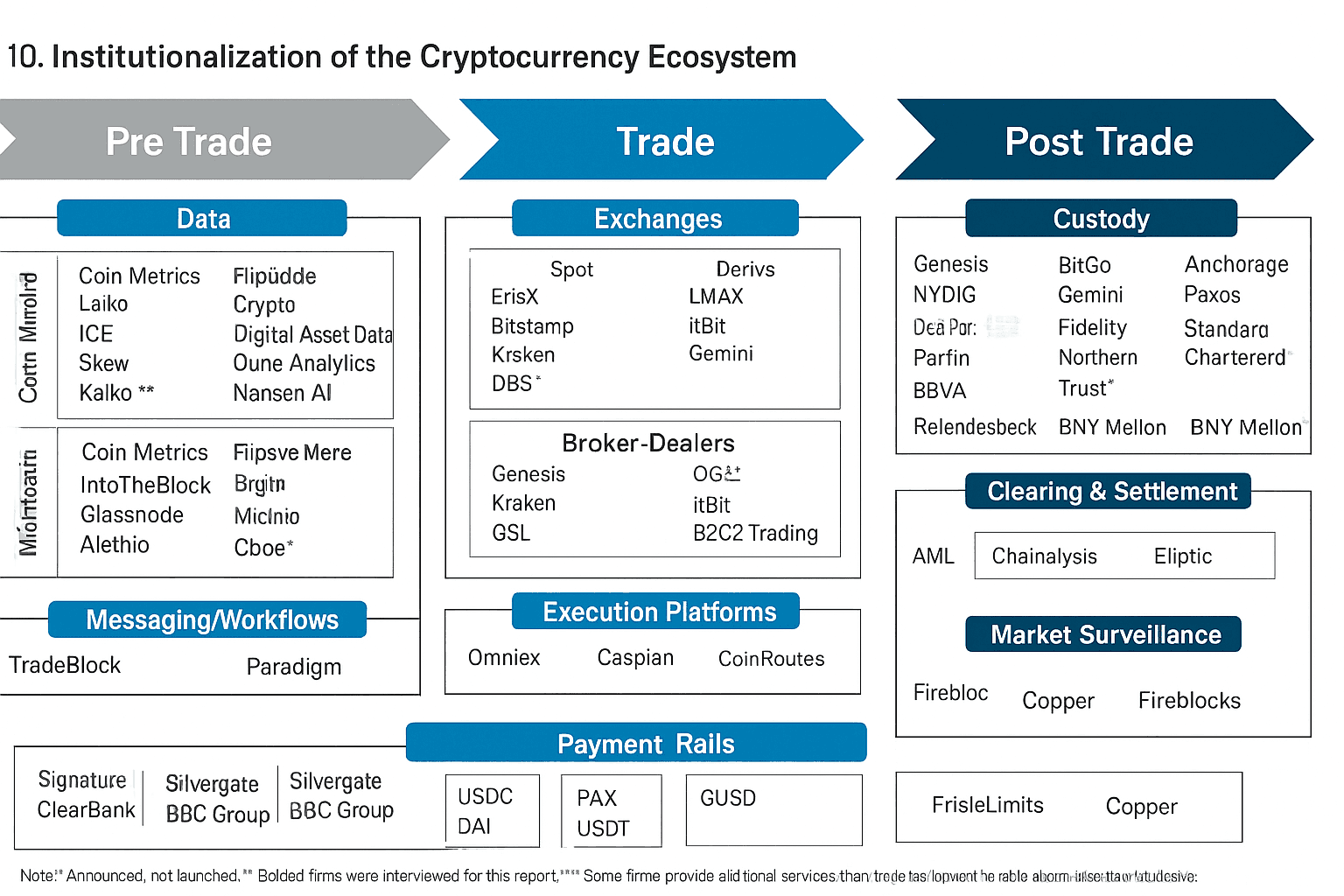
Source: Bitcoin at the Tipping Point, p.38.
Another drag on participation had been unclear rules. Over the last three years, guidance and agency statements reduced ambiguity across the financial sector. A pivotal U.S. development was the Office of the Comptroller of the Currency’s interpretive letter allowing banks to use blockchain networks and certain stablecoins for payments — a green light that opens new payment solution designs within regulated banking.
As to who is supplying institutional flows, the authors distinguish two profiles:One cohort targets pricing inefficiencies, compressing volatility and improving day-to-day liquidity; another brings large, patient capital, supporting pullbacks while building positions for long-horizon strategies.
One cohort targets pricing inefficiencies, compressing volatility and improving day-to-day liquidity; another brings large, patient capital, supporting pullbacks while building positions for long-horizon strategies.
The first group rarely grabs headlines but is essential for market microstructure and smoother rate discovery. The second — high-conviction allocators such as MicroStrategy and Tesla — has amplified the “store-of-value” frame and helped lead a narrative shift.
While value preservation matters in today’s policy landscape, the report argues that a second monetary role is within reach: acting as an international medium for payment and settlement across global markets.
Bitcoin as a Potential Global Trade Facilitator: Key Takeaways
Source: Bitcoin at the Tipping Point, p.5.
Looking ahead, perceptions may converge on two attributes: border-transcending reach and neutrality, both attractive in cross‑jurisdiction business.
Source: Bitcoin at the Tipping Point, p.83.
The central theme culminates in a trade narrative: over time, views progressed from “new payment rails” to “internet-native money,” then to “digital gold,” and now toward a possible worldwide value exchange network. That evolution reflects a broader market shift and the potential for a scalable settlement layer.
The case for this reframing rests on several points:
1) Borderless design — With no single government in control, neutrality can be decisive amid intensifying geopolitical frictions. For contracts spanning multiple countries, especially where local currencies are volatile, a neutral unit could streamline settlement and reduce business friction.
2) Reduced FX exposure — When parties agree on a common unit, multi-currency deals need not juggle exchange-rate swings, making complex arrangements simpler to manage across institutions.
3) Faster and, in many cases, lower-cost movement — Finality on the base network typically arrives within about ten minutes when fees are set appropriately, which is practical for larger transfers where total cost still compares favorably. On top of that, the Lightning layer enables near-instant routing with tiny charges for smaller payments — a flexible solution matching different transaction sizes.
4) Payment assurance — Once confirmations begin to accrue, reversals are not an option, and senders must control funds before initiating. That design removes chargeback risk and failed-payment uncertainty from the settlement process.
5) Transparent auditability — Every transfer is recorded on a public ledger, enabling analysis and programmable flows, from conditional disbursements tied to previous clears to triggers aligned with goods moving through a supply chain. The full business impact of this traceability is still emerging.
The authors also stress practical hurdles that must be addressed: capital efficiency limitations, questions around insurance and enterprise-grade custody, security management, and concerns about energy consumption — all of which require measured solutions.
Bitcoin at the Tipping Point: Citi Insight
From a fringe experiment to a cornerstone of a growing industry, progress has been swift — fast enough that central banks now evaluate their own digital currency initiatives. Given that trajectory, envisioning a meaningful role in world trade no longer feels far-fetched within the broader economy.
Yet “tipping point” implies two diverging paths. One leads to mainstream adoption; the other ends in a speculative unwind. A macro reset — for example, tighter policy and shifting risk appetite — combined with heavy-handed oversight that dissuades top builders could trigger the latter outcome. The balance will depend on investor behavior, market structure, and policy clarity.
As early as 2010, the project’s creator set expectations in stark terms:Two decades out, activity would either be massive or effectively nonexistent — little room in between.
Two decades out, activity would either be massive or effectively nonexistent — little room in between.
So far, transaction counts and value transferred have trended upward, and major banks such as Citi now track the space with sharper focus and more actionable insight.
Consider the network itself: it operates without borders, never pauses for holidays or weekends, and has no single owner. Unlike legacy payment systems housed on private servers, the ledger lives on thousands of nodes worldwide, and anyone can maintain a synchronized copy and verify their own payments and settlement.
Source: Bitcoin at the Tipping Point, p.17.
For the complete analysis and detailed takeaways, read the full Citi GPS report.


No comments yet. Be the first to share your thoughts.