


Bitcoin Cash Halving: What It Is And Why It Matters


This guide to the Bitcoin Cash halving explains the fixed issuance schedule, how miner payouts change over time, and the potential effects on price, hashrate, and the broader crypto market.Halving events matter because they mechanically slow new supply while forcing the network to reprice security through a changing mix of block subsidies, transaction fees, and miner participation.
Key Highlights
Block reward reduced by 50% at each halving.First BCH halving occurred in April 2020.Reward reductions can increase scarcity but may lower hashrate.
Similar to Bitcoin, Litecoin, and other Bitcoin-derived networks, the Bitcoin Cash protocol includes periodic block reward cuts. After 210,000 blocks are mined on the BCH chain, the per-block subsidy changes at a pre-set milestone; because blocks do not arrive at perfectly fixed intervals, the calendar date is typically an estimate based on average block cadence.
| Halving Number | Date | Block Height | Block Reward After Halving |
|---|---|---|---|
| 1 | Apr. 8, 2020 | 630,000 | 6.25 BCH |
| 2 | Apr. 4, 2024 (approx.) | 840,000 | 3.125 BCH |
That reduction occurred roughly one month before Bitcoin’s third halving on May 11, 2020.
Basic Bitcoin Cash Information:
- Launched in 2017 via Bitcoin hard fork.
- Uses proof-of-work consensus.
- Larger block size than Bitcoin.
- Focuses on on-chain scaling.
You can buy or sell BCH on major cryptocurrency exchanges.
Bitcoin Cash Halving Explained
If you have been following BCH news, you have likely seen discussion around the upcoming reward cut and its possible market impact. Here is a concise primer on how the mechanism works.
Bitcoin Cash follows a predictable issuance path. The total supply is capped at 21 million coins, and the mining reward steps down at each 210,000-block milestone—roughly every four years on average. In practice, the sequence works like this: miners find a valid block and include a coinbase transaction that pays the block subsidy (plus any transaction fees) to the miner; the protocol enforces the subsidy amount for that block height; once the chain reaches the next halving height, newly mined blocks simply start paying the lower subsidy automatically, with no vote or manual change required. Circulating supply is roughly 19.7 million BCH, which implies about 1.3 million BCH remain to be mined before the 21 million cap is reached.
The 2020 event was BCH’s first halving as a standalone digital asset. As a Bitcoin-derived network, BCH retained the same 21 million maximum supply and the same 210,000-block halving interval as Bitcoin, but it operates on a separate chain with its own difficulty adjustment and mining participation dynamics. Following the 2024 reduction, miners earn 3.125 BCH per block; the prior subsidy was 6.25 BCH per block.
How the Halving Can Influence Price
Investors often track block reward changes because they reduce new supply, a factor that can support price over time. That said, crypto markets are still young, and datasets remain limited—especially for BCH—so outcomes can vary based on broader market conditions, liquidity, and trader positioning into the event.
In the 2020 cycle, price action around the event underscored how sentiment and positioning can matter as much as the supply schedule: even if issuance tightens mechanically, the market can still react with short-term volatility, profit-taking, or risk-off moves that temporarily overwhelm the supply narrative. Looking ahead, post-halving scenarios often fall into a few buckets: a volatility-first path (sharp moves as miners and traders adjust), a gradual repricing path (demand keeps pace while issuance slows), or a weaker-demand path (issuance tightens, but price stays range-bound if adoption and inflows do not follow).
Could Network Hashrate Decline?
If the market price does not offset the 50% reward cut, some miners may power down unprofitable rigs. That can lower hashrate and, in turn, diminish security and censorship resistance until conditions normalize. A similar pattern was observed around Litecoin’s August 2019 reward reduction.
From a miner’s perspective, profitability is primarily a function of (1) the block subsidy, (2) transaction fees, (3) the coin price, (4) operating costs like electricity and hardware efficiency, and (5) network difficulty. When the subsidy drops, miners with higher costs are often forced to either shut down, seek cheaper power, or redirect hashpower to other proof-of-work networks where expected returns look better. Over the longer run, participation tends to stabilize as difficulty adjusts and the remaining miners capture a larger share of rewards, but the transition period can be choppy—especially if fees remain a small portion of total block revenue.
Data aggregators reported that the BCH halving visibly affected hashrate. After touching about 5 exahashes per second in February, hashrate trended lower into the event, then dropped sharply when the cut activated—sliding from roughly 3.6 EH/s to a trough near 1.5 EH/s.
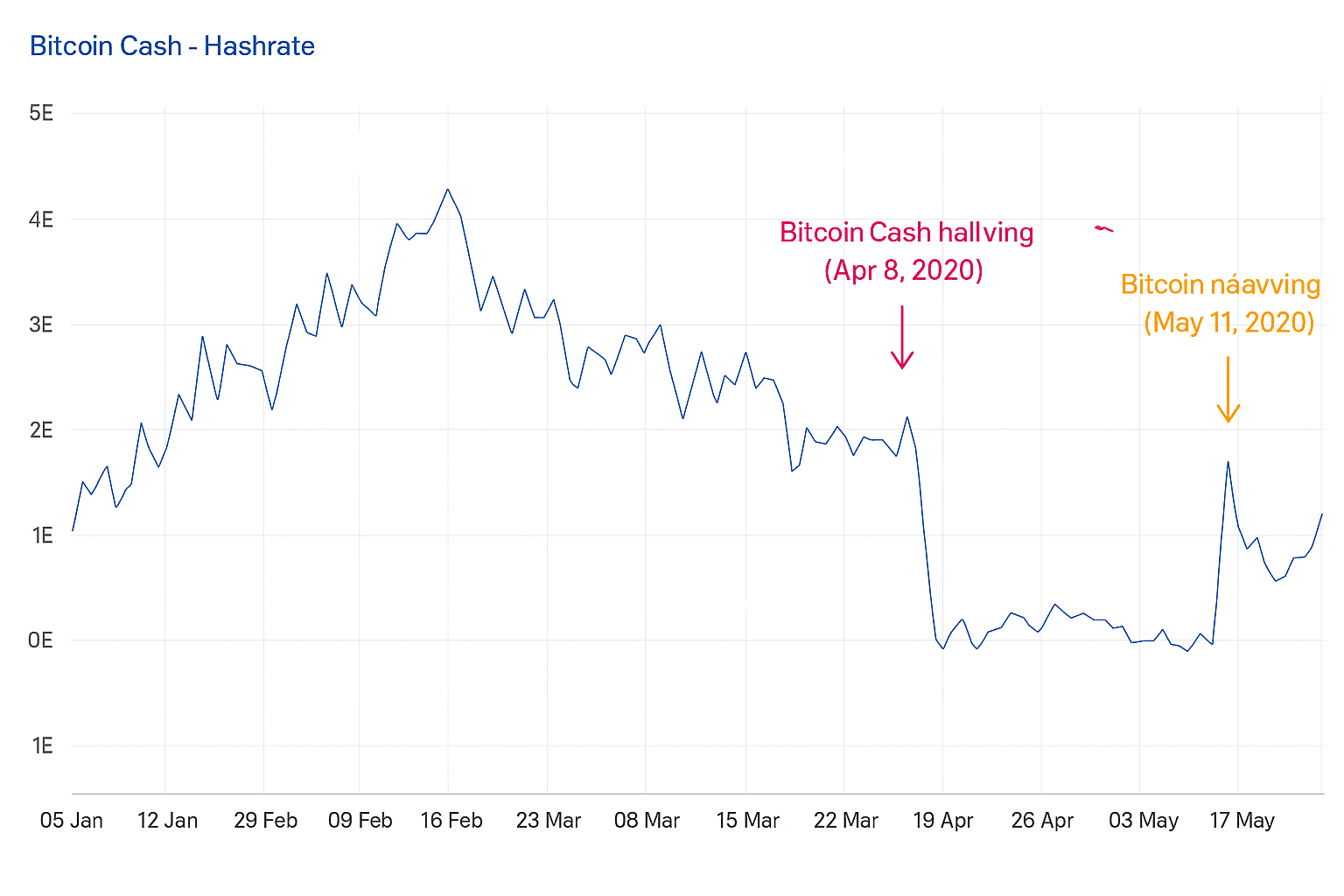
Bitcoin Cash hashrate chart. Image source: Bitinfocharts.
Hashrate briefly spiked following Bitcoin’s 2020 reward change, then eased again and stabilized around approximately 2.4 EH/s.
After the First Halving: What Did Price Do?
Following the inaugural BCH reward cut, price fell notably, a move consistent with “buy the rumor, sell the news” behavior. About six weeks later, the asset traded roughly 14% below its level at the time of the event.
Price activity for BCH from April 8, 2020, to May 27, 2020, referenced a post-halving decline relative to the event date.
Over the same window, the aggregate crypto market capitalization advanced by approximately 19.5%.
Halving in Review: Conclusion
Reward reductions are a key fundamental milestone for BCH, shaping issuance, miner incentives, and long-run supply dynamics. Beyond price, halvings can influence the broader Bitcoin Cash ecosystem by shifting the security budget (subsidy versus fees), changing miner behavior, and affecting user experience indirectly if network conditions tighten and fee pressure rises during periods of heavy activity. Watching how the market responds as issuance tightens—and comparing outcomes with other recent block reward events such as those on Bitcoin and Bitcoin SV—can offer useful context for investors and miners alike.
As for a Bitcoin Cash outlook in 2026, any forecast is inherently uncertain, but scenario-based expectations can help frame risk: in a bearish case (weak market liquidity and muted demand), BCH could remain under sustained pressure; in a base case (steady usage and a neutral-to-positive market tape), it could trade in a broad mid-range; and in a bullish case (stronger adoption, improving market conditions, and renewed interest in major proof-of-work assets), it could revisit substantially higher levels. Factors likely to matter most by 2026 include overall crypto risk appetite, exchange liquidity, miner economics after the latest subsidy change, transaction-fee contribution to miner revenue, and whether BCH sees meaningful growth in real-world usage and on-chain activity.


No comments yet. Be the first to share your thoughts.