


How Bitcoin Mining Works


Bitcoin mining is the method used to create new Bitcoin by solving advanced mathematics problems that confirm transactions on the network. To understand how Bitcoin Mining works, it helps to know that when a block is validated successfully, the miner receives a preset Bitcoin reward as an incentive and payment for supporting the system.
Bitcoin is one of the best-known forms of cryptocurrency, a digital currency that exists only online. It operates through a decentralized blockchain ledger made up of connected computers rather than a central bank. As each node in this networking system verifies transaction data under the Bitcoin protocol, newly issued coin rewards are released through mining. In simple terms, miners use computer hardware and software to process activity on the ledger and are compensated in Bitcoin.
Because Bitcoin and the broader cryptocurrency market have seen dramatic price gains in recent years, interest in mining has grown too. A miner currently earns 3.125 Bitcoin for validating a new block, equal to about $334,375 based on a mid-June 2026 price near $107,000. Even so, mining is usually a difficult investment for individuals because the cost, energy demands, and technical complexity are very high.
Below is a clear overview of the process and the main risks to understand before getting started.
How Bitcoin Mining Works
Bitcoin runs on blockchain technology, a public yet decentralized ledger that records every approved transaction. Blocks of data are grouped together and added to this chain by miners. You can think of the blockchain as an ongoing public record, almost like a digital receipt book. Mining is the act of appending the next block to that ledger while helping the network reach consensus in computer science terms.
To do this, miners select pending transactions from the mempool and assemble them into a candidate block. They then attempt to solve a proof of work puzzle. The process involves choosing a cryptographic nonce, a number that is combined with block data and passed through a cryptographic hash function based on SHA-2, specifically the SHA-256 algorithm. This use of cryptography helps secure the system against fraud, including double-spending. Proof-of-work makes it expensive to rewrite transaction history because an attacker would need enormous computing power to alter a confirmed block and then catch up with the rest of the network. That is one of the main reasons mining helps validate transactions and protect the blockchain.
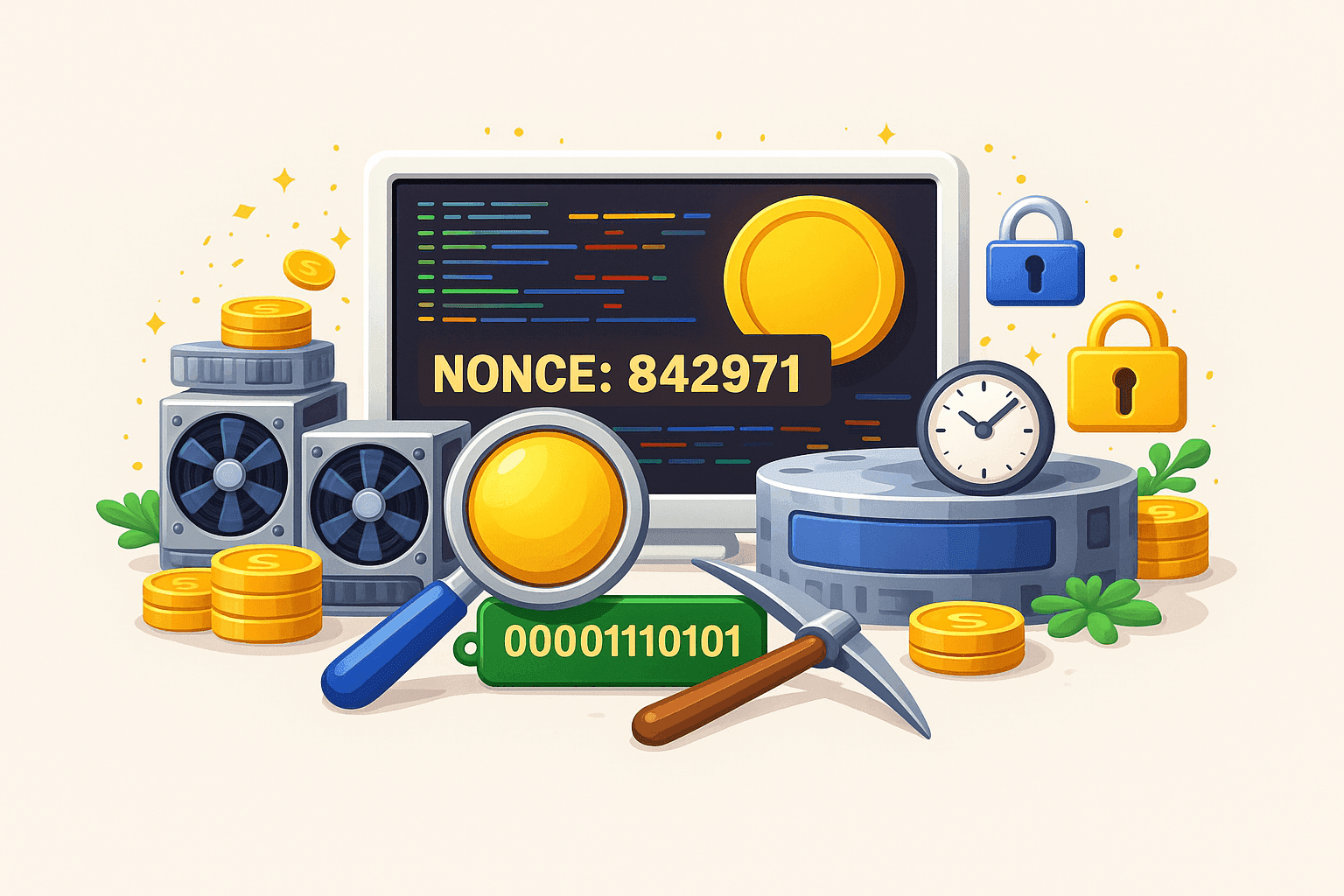
The objective is to generate a block hash that is less than or equal to the network target. That target determines mining difficulty. In other words, the hash function must output a word of bits that begins with enough zeros to satisfy the requirement. Since each bit affects the result, even a tiny change in the nonce creates a completely different output. Bitcoin adjusts mining difficulty every 2,016 blocks, or roughly every two weeks, so that new blocks continue to be added at an average pace of about once every 10 minutes. Without this adjustment, blocks could be mined too quickly when more computing power joins the network or too slowly when miners leave.
A simple way to picture it is a dice game controlled by probability. Imagine you are given a very low winning number and can succeed only by rolling that number or something smaller. In mining, the acceptable result is incredibly rare, so miners keep trying new nonces again and again until the puzzle is solved. That is why names of large numbers often come up in mining discussions: machines may perform billions or trillions of guesses.
This is where computing power becomes essential. Most serious miners use an application-specific integrated circuit, or ASIC, which is a specialized integrated circuit built for mining rather than general-purpose computing. One computer of this type can cost up to $10,000, and it consumes a great deal of electricity and energy. You could try mining with a regular computer such as a laptop, but the probability of earning meaningful rewards would be extremely low because the hardware is not competitive.
When a miner successfully adds a block, the reward is 3.125 bitcoins. That block subsidy is reduced by half roughly every four years, or every 210,000 blocks. With Bitcoin trading near $107,000 in mid-June 2026, that reward is worth about $334,375 before expenses such as electricity, fees, cooling, and equipment depreciation are considered. The block also includes a coinbase transaction, which is how new coin issuance and transaction fee rewards are assigned.
Risks of Bitcoin Mining
- Regulation:Many governments remain cautious about cryptocurrency because it operates outside direct state control. There is always a risk that officials could restrict or ban mining activity, as China did in 2021 over concerns about speculation, finance, and energy use.
- Price volatility:Bitcoin has experienced major price swings since its launch in 2009. Since January 2023, the asset has traded below $18,000 at some points and above $110,000 more recently. That volatility makes it hard for any miner to predict whether mining income will exceed total cost.
- Hardware failure:Mining machines run continuously under heavy load, which can shorten their lifespan and lead to expensive repairs or replacement.
- Cybersecurity threats:Wallet theft, malware, and attacks on mining infrastructure can reduce earnings or result in lost funds if systems are not protected properly.
- Cooling requirements:ASIC miners generate substantial heat, so operators may need ventilation, fans, or additional cooling equipment to avoid overheating.
- Environmental impact:Mining uses large amounts of electricity, and in some areas that raises concerns about emissions, power-grid strain, and sustainability.
How To Start Bitcoin Mining
To begin mining, you generally need the following:
- Specialized computer hardware: An ASIC miner such as the Antminer S19 or Whatsminer M30S.
- Mining software: Programs such as CGMiner or BFGMiner to manage the mining process.
- Reliable electricity access: Power costs are a major part of profitability.
- Internet connectivity: A stable connection is needed to communicate with the network or a pool.
- Cryptocurrency wallet: A wallet is required to receive mining rewards.
- Mining pool membership: Many miners join services such as Foundry USA or Antpool to combine resources and smooth out payouts, although rewards are shared among participants.
Bitcoin Mining Statistics
| Statistic | Value | Source/Date |
|---|---|---|
| Annual electricity use | About 184.4 terawatt-hours per year | Cambridge Bitcoin Electricity Consumption Index |
| Bitcoin price range | $4,107 in 2020 to an all-time high of $111,970 in May 2025; around $107,000 by mid-June 2026 | Market data, 2020 to mid-June 2026 |
| Largest mining locations | United States: 37.8 percent; Mainland China: 21.1 percent; Kazakhstan: 13.2 percent | Cambridge data, December 2021 |
Taxes on Bitcoin Mining
Taxes can have a major effect on mining results, so miners should pay close attention to how rewards are treated. As digital asset prices have risen, tax authorities have increased scrutiny of cryptocurrency owners, traders, and miners. Our editorial team believes these are the main issues to keep in mind.
- Business vs. hobby:If mining is operated as a business, some expenses may be deductible. Revenue is generally based on the fair market value of the Bitcoin received. If the activity is merely a hobby, deductions are usually much more limited.
- Mined Bitcoin is income:When you receive mined Bitcoin or even Ethereum from similar network activity, the fair market value at the time of receipt is typically taxed as ordinary income.
- Capital gains:If you later sell the asset for more than its value when received, the difference is generally treated as a capital gain, similar to the tax treatment applied to stocks or bonds.
Anyone involved in mining should track payment dates, market value, wallet transfers, and fees carefully so records are available if needed.
Is Bitcoin Mining Profitable?
Sometimes, but not consistently. Even when mining is technically successful, profitability is far from guaranteed because the upfront investment in machines is large and the ongoing electricity bill can be substantial.
Globally, Bitcoin mining consumes more electricity than Poland, a country with 36.7 million people, according to Cambridge research. That highlights how energy-intensive the process has become.
As mining difficulty has climbed, the required computing power has increased as well. The network now demands enormous amounts of mathematics-based processing, which means miners must keep upgrading hardware if they want to stay competitive.
One way to reduce individual variance is to participate in a mining pool. A pool lets miners share computing resources and split rewards more regularly. The trade-off is that each participant receives only a portion of the payout. Because the Bitcoin price can move sharply, it is still difficult to know whether the final money earned will justify the risk.
How Long Does It Take To Mine 1 Bitcoin?
Bitcoin is mined in blocks rather than in single-coin units. At the current block subsidy of 3.125 Bitcoin, one successful block already contains more than 1 Bitcoin before transaction fees are added.
In practice, the time it takes to mine the equivalent of 1 Bitcoin depends on the block reward, overall network hash rate, mining difficulty, whether you mine solo or through a pool, and how powerful your equipment is. The Bitcoin network is designed to produce a new block about every 10 minutes, but an individual miner receives only a share of that output based on how much computing power they contribute.
For a solo miner using one machine, earning a full 1 Bitcoin could take a very long time and may never happen on a predictable schedule because rewards arrive only if that miner finds a block. For a miner in a pool, payouts are usually much smaller but more regular, so reaching the equivalent of 1 Bitcoin might take months or much longer depending on the machine's hash rate, electricity costs, and the pool's share of total network activity.
Does Bitcoin Mining Give You Real Money?
Yes. Mining rewards are paid in Bitcoin, and that Bitcoin can be exchanged for fiat currency such as U.S. dollars through a cryptocurrency exchange, subject to market prices, fees, and local regulations.
That means mining can produce real monetary value, but the amount you actually receive in cash depends on the Bitcoin market price at the time you sell, as well as any taxes or withdrawal restrictions that apply where you live.
Is Bitcoin Mining Legal?
Bitcoin mining is legal in some places, restricted in others, and banned in certain jurisdictions. Rules vary by country, state, province, or local utility area, so legality depends on where the mining activity takes place.
For example, mining is allowed in many parts of the United States, while some countries have imposed restrictions or outright bans. China banned cryptocurrency mining in 2021, while other regions have limited mining because of electricity demand or licensing requirements.
Before starting, check local laws, energy rules, zoning requirements, and tax obligations to make sure mining is permitted in your area.
Bottom Line
Mining may sound attractive, but in practice it is expensive, technically demanding, and uncertain. High equipment cost, volatile Bitcoin price, regulatory risk, and huge electricity usage all make profitability hard to achieve for the average miner.
It is also important to remember that Bitcoin is a speculative asset rather than something with intrinsic output. It does not generate cash flow on its own, and its value depends on what another buyer is willing to pay. For that reason, anyone considering mining should weigh the technology, encryption security, digital signature verification, and network benefits against the financial risk before committing capital.


No comments yet. Be the first to share your thoughts.