


Best Crypto Leverage Trading Platforms


High gearing can turn a small crypto move into a much larger trading result, so picking from the best crypto leverage trading platforms matters far more than chasing the highest ratio on the screen. The stronger choices in 2026 balance usable leverage with solid infrastructure, decent market liquidity, and tools that help traders keep an eye on margin, price swings, and liquidation risk.
The broker side of this market still appeals to traders who want exposure through CFDs, while exchange-based platforms suit users who prefer a fuller Cryptocurrency exchange environment with spot, futures, and wallet features in one place. I looked through the structure a bit like overlapping GIS layers, where the headline leverage is only one layer and the fee model plus usability tell the real story.
Zornitsa Stefanova prepared the original analysis behind these platform selections.
Best Brokers for High Leverage Crypto Trading
Below are the brokers that stand out for leveraged crypto access, platform quality, and overall trading conditions.
Fusion Markets
Fusion Markets has operated since 2017 and remains a practical pick for newer users as well as experienced traders. Its crypto CFD lineup covers 13 instruments tied to major coins against the US dollar. Traders can take long or short positions without paying a separate crypto CFD commission, and the broker lists BTC trading fees at 0.06%. Minimum spreads for BTC and ETH are shown at 14.24 and 2.42. Access is available through MT4 and MT5, along with TradingView and cTrader.
Leverage limits at Fusion Markets depend on residence, client classification, and the regulated entity handling the account. Under the FSA and VFSC arms, Fusion Pro users can reach 1:10 on crypto. Under ASIC, retail clients are restricted to 1:2. During my pass through the site, the platform pages loaded quickly and the leverage disclosures were relatively easy to find, which is more useful than it sounds when comparing brokers.
FP Trading
FP Trading offers crypto CFDs without requiring a wallet, which keeps the process simple for traders who only want price exposure. The broker supports well-known digital assets such as Bitcoin, Litecoin, Cardano, and ETH against USD. With more than 10 actively traded coins, it gives users enough room to spread exposure without becoming cluttered.
Retail clients registered through the Mauritius, South Africa, or Saint Vincent entities can access leverage up to 1:50 on crypto CFDs. The broker pairs that with zero commission and support for MT4, MT5, plus cTrader. That makes FP Trading one of the clearer answers to the question of the best broker-based option if your focus is CFDs rather than direct exchange trading.
BlackBull Markets
BlackBull Markets operates under regulation in New Zealand and Seychelles and has continued expanding its crypto CFD range. In mid-2024, the broker announced that LMAX Group had acquired a minority stake, a move intended to strengthen its crypto offering. At present, users can trade more than 40 coins through CFDs.
Orders can be placed through cTrader or MT platforms, and TradingView is also available. The broker uses ECN pricing, so spreads float with market conditions. For traders seeking 100x leverage or more, BlackBull is one of the broker options that reaches 1:100 on selected markets such as BTC/USD and ETH/USD. Other pairs sit lower. XRP, ADA, and Dogecoin are capped at 1:50, while SOL against USD is limited to 1:10. That market-by-market structure matters because high leverage is rarely uniform across every asset.
XTB
XTB has been active for more than two decades and now serves over 2 million clients across multiple jurisdictions. Its group entities are supervised by regulators such as the FCA, CySEC, and KNF. The broker offers more than 40 crypto CFDs, including BTC, ETH, and Dogecoin, and combines that with a strong reputation for payments processing and general platform stability.
Its xStation 5 platform is well suited to both casual and advanced use, with live performance data and a clean layout. BTC/USD spreads start from 0.22% of market price, while retail users under the CySEC entity are capped at 1:2 leverage on crypto in line with ESMA limits. So XTB will not suit traders chasing large ratios, though it does fit users who value regulatory compliance and a more conservative setup.
easyMarkets
easyMarkets has been operating since 2001 and puts heavy emphasis on protective account features. The broker is regulated by CySEC and offers standard safeguards such as negative balance protection. On its web platform, app, and TradingView integration, users can also access guaranteed stop loss with no slippage.
The broker charges no account maintenance fee and no commission across supported account types. Its crypto range includes 20 instruments, while retail leverage under the CySEC entity is capped at 1:2. Contract size minimums depend on the coin, and BTC/USD fixed spreads are listed at 85 on several account interfaces. easyMarkets also includes dealCancellation and Freeze Rate, which may appeal to traders who care more about risk control than raw leverage.
ActivTrades
ActivTrades has more than 20 years in the market and offers a broad list of tradable instruments. Crypto CFDs are available to most clients except those signing up through the FCA and BACEN entities. Users can trade over a dozen crypto contracts on MT4, MT5, and ActivTrader.
BTC/USD and ETH/USD can reach leverage up to 1:20 for clients under the Bahamas and Mauritius entities, while some pairs such as BCH/USD and DOGE/USD are capped at 1:10. In the EU, professional clients may also access 1:20 on crypto CFDs. That puts ActivTrades in a middle ground, with more leverage than EU retail rules allow but less than the most aggressive offshore offerings.
Comprehensive Comparison of the Top 6 High Leverage Crypto Trading Platforms
| Platform | Account Minimum | Regulators | Max Leverage | Crypto CFDs Offered | Key Features |
|---|---|---|---|---|---|
| Fusion Markets | $0 | ASIC and VFSC | 1:10 | 13 plus | Several account types and negative balance protection |
| IC Markets | $200 | ASIC and CySEC | 1:5 | 23 | Raw spread and standard accounts |
| FP Trading | $60 | FSCA and FSASVG | 1:50 | 12 | Zero commission crypto CFDs and retail protection |
| Global Prime | $0 | ASIC and VFSC | 1:5 | Around 40 | Pro access and broad crypto CFD range |
| easyMarkets | $25 | CySEC and ASIC | 1:2 | 20 | Built-in negative balance protection |
| XTB | $0 | FCA and CySEC | 1:2 | More than 40 | Standard account structure and retail safeguards |
Best Exchanges for High Leverage Crypto Trading
On the exchange side, the main appeal is broader coin coverage and deeper derivatives markets. This is also where traders asking which platforms offer 100x leverage or more will usually find the strongest answers.
| Exchange | Tradable Coins | Wallet Type | Max Leverage | Payment Methods | Regulators |
|---|---|---|---|---|---|
| Bybit | More than 2,350 | Self-custody support | 1:200 | Bank transfer and cards | SCA and CySEC |
| OKX | More than 350 | Non-custodial | 1:100 on futures | Cards and bank transfer | VARA and MFSA |
| MEXC | More than 2,500 | Wallet service | 1:200 | Cards and crypto | Seychelles and Estonia registration |
| Kraken Pro | More than 560 | Self-custody support | 1:50 | PayPal and wire transfer | Several major jurisdictions |
| KuCoin | More than 1,000 | Custodial wallet service | 1:100 | Card payments and bank transfer | Seychelles and India links |
MEXC
MEXC launched in 2018 and has grown into a large centralized exchange serving close to 40 million users across more than 170 countries. The platform offers a very broad Cryptocurrency market, with roughly 2,700 spot pairs and well over 1,500 futures markets. Maximum leverage reaches 1:200, which places it near the top end for mainstream access.
Spot maker fees are promoted at 0.0000%, while taker fees usually start around 0.05%. Futures maker fees are also listed at 0%, with taker fees at 0.02%. The exchange says deposits are free, and it also supports savings products for users who want to earn on idle assets. From a usability angle, the interface is busy, though after a few clicks it becomes manageable if you stay within one market area at a time.
Bybit
Bybit started in 2018 and has grown quickly, with a large global user base and substantial daily trading volume. Oversight includes regulators in Dubai and Kazakhstan, and in 2026 the group also holds a MiCAR license through Bybit EU GmbH for service across EEA markets. That compliance progress is worth noting because leverage platforms are under more scrutiny than plain spot venues.
The exchange uses a tiered fee system tied to asset balance or 30-day volume. For standard accounts, Bybit lists 0.0200% maker and 0.0300% taker fees on spot, while perpetual and futures contracts carry 0.0200% maker and 0.0550% taker fees. Leverage can reach 1:200 on selected products. In practice, Bybit remains one of the clearest choices for traders who want high-ratio derivative finance exposure without wrestling with a clumsy interface.
KuCoin
KuCoin, founded in 2017, serves more than 40 million users across over 200 markets and territories. It supports Bitcoin and a large number of altcoins in a fairly approachable trading environment. The interface is customizable, and the mobile app is one of the better ones I checked for quick market switching.
One of KuCoin’s stronger sides is its earning ecosystem, with staking on more than 40 coins and flexible savings products alongside liquidity mining. Active traders also benefit from tiered fees based on VIP level and 30-day volume. Alongside spot markets, the exchange supports margin and futures trading, giving users access to leverage while keeping a broad coin selection.
Kraken Pro
Kraken Pro is the top recommendation on this page for traders who want leverage without giving up a measured operating setup. It does not chase the highest ratio in the group, topping out at 1:50 on Kraken Futures, but it earns the lead through stronger regulatory compliance, a stable interface, and fee transparency that is easier to verify than on many higher-leverage venues.
Kraken has been operating since 2011 and supports more than 10 million clients across over 190 countries. It offers more than 560 crypto assets and has long held a reputation for strong operational discipline. From what I have seen, that balance matters more than an extra 50x or 100x on paper, especially for traders who care about execution quality and platform trust.
Its case for the top spot comes down to two practical advantages. First, the exchange is one of the steadier names in the field for security and compliance in major markets. Second, Kraken Pro gives active users a cleaner trading workflow, broad asset coverage, and leverage that is still meaningful without pushing every user toward the edge of liquidation.
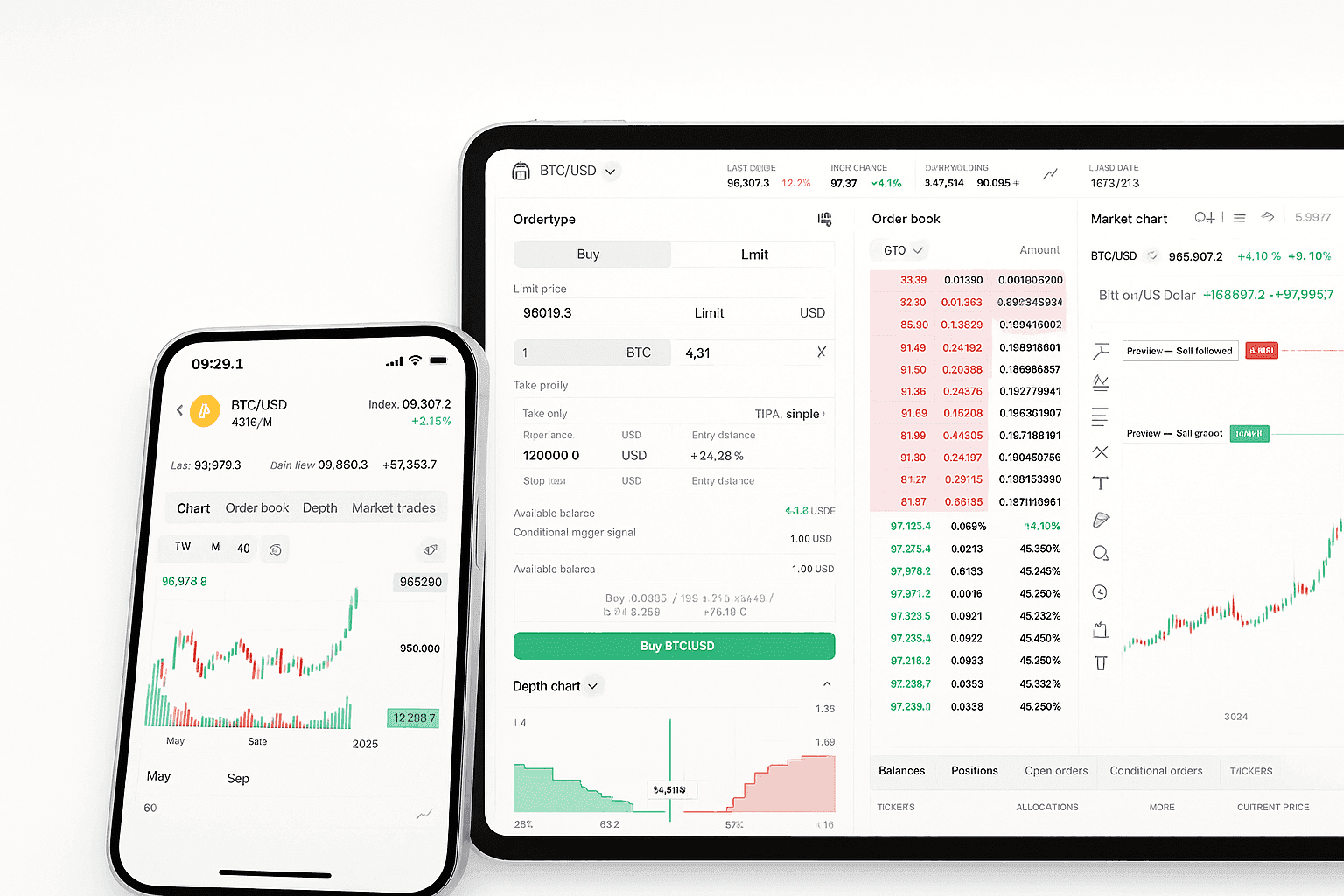
OKX
OKX was established in 2017 and serves users across more than 180 regions, excluding the United States and several restricted markets. It supports a large range of spot, margin, and derivatives products, and the exchange leans toward advanced users with algorithmic orders, high-grade liquidity, and API access.
A notable strength is the TradingView integration, which lets traders place crypto orders directly from charts while using technical overlays. Regular users at the entry fee tier pay maker fees of 0.080% and taker fees of 0.100% on certain markets. OKX offers up to 1:100 on futures and 1:10 on spot margin, so it sits firmly in the group of crypto exchanges for leverage trading that combine strong infrastructure with serious derivatives access.
Fee Snapshot Across Major Platforms
| Platform | Spot Maker Fee | Spot Taker Fee | Futures Maker Fee | Futures Taker Fee |
|---|---|---|---|---|
| MEXC | 0.0000% | 0.05% | 0% | 0.02% |
| Bybit | 0.0200% | 0.0300% | 0.0200% | 0.0550% |
| OKX | 0.080% | 0.100% | Varies by contract tier | Varies by contract tier |
This gives a quick way to compare exchange trading costs. Broker pricing in this article is quoted more often as spreads than maker and taker fees, so the fee models are not perfectly aligned side by side.
How Leverage Works in Crypto Trading
Leverage lets a trader control a larger crypto position than their own capital would normally allow. The borrowed portion comes from the platform, while the trader posts margin finance as collateral. With a 1:10 ratio, each dollar in margin controls ten dollars of market exposure. If the trade moves in the right direction, gains scale faster. If the price moves the other way, losses also accelerate.
That is why high ratios deserve caution. A very small move against the position can erase the posted margin. On some venues, BTC and ETH receive the highest leverage limits, while smaller altcoins get lower caps because their volatility finance profile is less stable. By 2026, some platforms also adjust leverage by position size and client classification, so the headline number on the homepage may not match the limit available on your actual order ticket.
People often ask about the best leverage for crypto trading. There is no universal setting. Lower leverage usually gives a trader more room to absorb noise, while aggressive ratios leave almost no margin for error. As a rough rule, newer traders usually stay in the 1:2 to 1:5 range, while more experienced users may work with 1:10 if the setup is tight and the position size is modest. Higher levels can suit short-term professionals, but only when risk limits are already defined before the order goes live.The right leverage is the one that still leaves room for risk control after normal market noise shows up.
The right leverage is the one that still leaves room for risk control after normal market noise shows up.
Margin in Crypto Markets
Margin is the capital required to open and maintain a leveraged position. It is closely tied to leverage, though the two terms are not identical. Leverage is the multiplier, while margin is the amount you have to lock up to use it. A 1:10 position means 10% initial margin, and a 1:50 position means 2% initial margin.
Across the brokers and exchanges covered here, leverage spans from 1:2 up to 1:200. Traders need to understand what that means in practical terms. At 1:50, each unit of account equity controls fifty units of market exposure. If losses reduce available margin too far, the platform may issue a margin call or force liquidation. Those events are especially common during sharp moves in futures markets, where a futures contract can reprice in seconds if liquidity thins out.
Risk Management for High Leverage Trading
Leverage amplifies both opportunity and exposure, so control tools matter. A trader using high ratios should start with proper market research and a realistic view of the asset’s behaviour. In crypto, sentiment can shift fast, and a chart that looks orderly for an hour can become noisy like unfiltered GPS data soon after.
- Use a defined stop and profit target before entering.
- Keep leverage low enough that normal volatility does not force an early exit.
- Check the venue's liquidation rules and margin thresholds.
The main risks deserve to be stated plainly. The biggest ones are liquidation and margin calls. Fast losses during volatile moves are close behind, and regulatory differences matter because leverage limits and protections can change sharply across jurisdictions.
Excessive leverage is the weak point for many users. A 100x position sounds attractive on paper, yet even a modest adverse move can wipe it out. The platforms in this article that reach 100x or more are BlackBull Markets at 1:100 on selected CFDs, Bybit at 1:200, MEXC at 1:200, OKX at 1:100 on futures, and KuCoin at 1:100 on futures. The headline figure is a capability, not a requirement.High leverage gives you less time to be wrong, so risk controls have to be in place before the trade starts.
High leverage gives you less time to be wrong, so risk controls have to be in place before the trade starts.
How to Pick a Platform for Crypto Leverage Trading
- Fee structure - spreads for brokers, or maker and taker pricing for exchanges.
- Asset coverage - larger-cap pairs or a broader stablecoin and futures ecosystem.
- Account setup - client tiering, demo access, and KYC speed.
- Security - visible KYC standards and multi-factor authentication support.
- Reputation - platform help quality and recurring user complaints.
The fee structure works a bit like a route network - the visible path looks simple, but the real cost appears at each stop along the way. I also pay attention to account rules and the time needed to complete identity checks, since those details can affect actual usability as much as the leverage number itself.
Spot Versus Derivatives
Crypto can be traded through spot markets or through derivatives such as CFDs, futures, and an option finance contract. Spot trading involves owning the underlying asset at current market value. It is usually simpler, and in many cases it uses little or no leverage. Some exchanges do allow spot margin, though the costs are often higher than traders first expect.
CFDs let traders speculate on price movement without holding the underlying Cryptocurrency. That can be useful for short selling and for avoiding wallet management. Futures work differently, since a futures contract sets terms around a later transaction, while options give the right to buy or sell at a preset level without forcing execution. Each derivative finance product supports leverage finance in its own way, so the best fit depends on strategy and risk tolerance.
Pros and Cons of High Leverage Crypto Trading
- Pros - higher market exposure with less capital.
- Cons - losses and liquidation pressure increase quickly.
Regulatory differences also shape the trade-off. In the EU and Australia, retail crypto leverage is often capped at 1:2, while offshore venues may advertise much higher limits with very different compliance standards.
The strongest names in this article break down into two groups. Kraken Pro stands out for balanced leverage, compliance, and trading experience on the exchange side. Bybit and MEXC appeal more to traders who want maximum ratios, while OKX and KuCoin sit in the middle with deep derivatives access and broader ecosystems. On the broker side, FP Trading stands out for higher CFD leverage, while XTB and easyMarkets fit traders who put tighter controls ahead of raw ratio.
For most users, the best crypto leverage trading platforms are the ones that pair usable leverage with sound controls, reliable execution, and enough transparency that you can read the platform like a well-made map rather than a noisy screen full of signals.


No comments yet. Be the first to share your thoughts.