
Iridium Communications Moves to Buy Aireon


No audio is available for this article.
Iridium Communications has signed a definitive deal to purchase Aireon, folding the remaining business into its own operation. The move gives Iridium tighter control over a system already riding on its satellite constellation and pushes its aviation safety plan into a more complete form.
Aireon runs the world’s space-based Automatic Dependent Surveillance-Broadcast air traffic surveillance network. By bringing that capability fully in-house, Iridium is aiming to combine surveillance, communications, PNT services, and operational data on one global architecture. From what I’ve seen, that kind of consolidation matters in aviation because separate systems often create the same kind of friction you get from misaligned map layers.
“Aireon has always been part of Iridium’s aviation safety strategy. We founded it in partnership with the world’s leading Air Navigation Service Providers because we believed space-based aviation safety was a generational opportunity,” said Matt Desch, chief executive officer of Iridium. “The aviation industry is now entering an era of growing air traffic and denser airspace. Bringing Aireon fully inside Iridium better positions us to build what’s needed to support the future of aviation, including more innovations like the future introduction of space-based VHF communications.”
“Aireon has always been part of Iridium’s aviation safety strategy. We founded it in partnership with the world’s leading Air Navigation Service Providers because we believed space-based aviation safety was a generational opportunity,” said Matt Desch, chief executive officer of Iridium. “The aviation industry is now entering an era of growing air traffic and denser airspace. Bringing Aireon fully inside Iridium better positions us to build what’s needed to support the future of aviation, including more innovations like the future introduction of space-based VHF communications.”
Platform for Aviation Safety
The transaction joins Aireon’s surveillance and aviation data products with Iridium’s communications satellite network and PNT capabilities. That includes services designed to help GPS-dependent systems keep working during GNSS jamming or spoofing events, which is becoming a more practical concern across contested airspace.
A practical example is oceanic traffic management. With Aireon surveillance data linked to Iridium communications and timing support, controllers can maintain live awareness over remote routes and react faster when an aircraft changes course or loses its expected position signal. Iridium is also leaning on Aireon’s existing certification from the European Union Aviation Safety Agency, which gives the combined platform a regulatory base already accepted in live operations.
- Aircraft tracking
- Pilot communication support
Iridium also ties those functions to timing protection and operational analytics for air navigation service provider customers. In effect, it is trying to turn one satellite architecture into a single aviation layer that helps keep routes safer and day-to-day decisions more efficient.
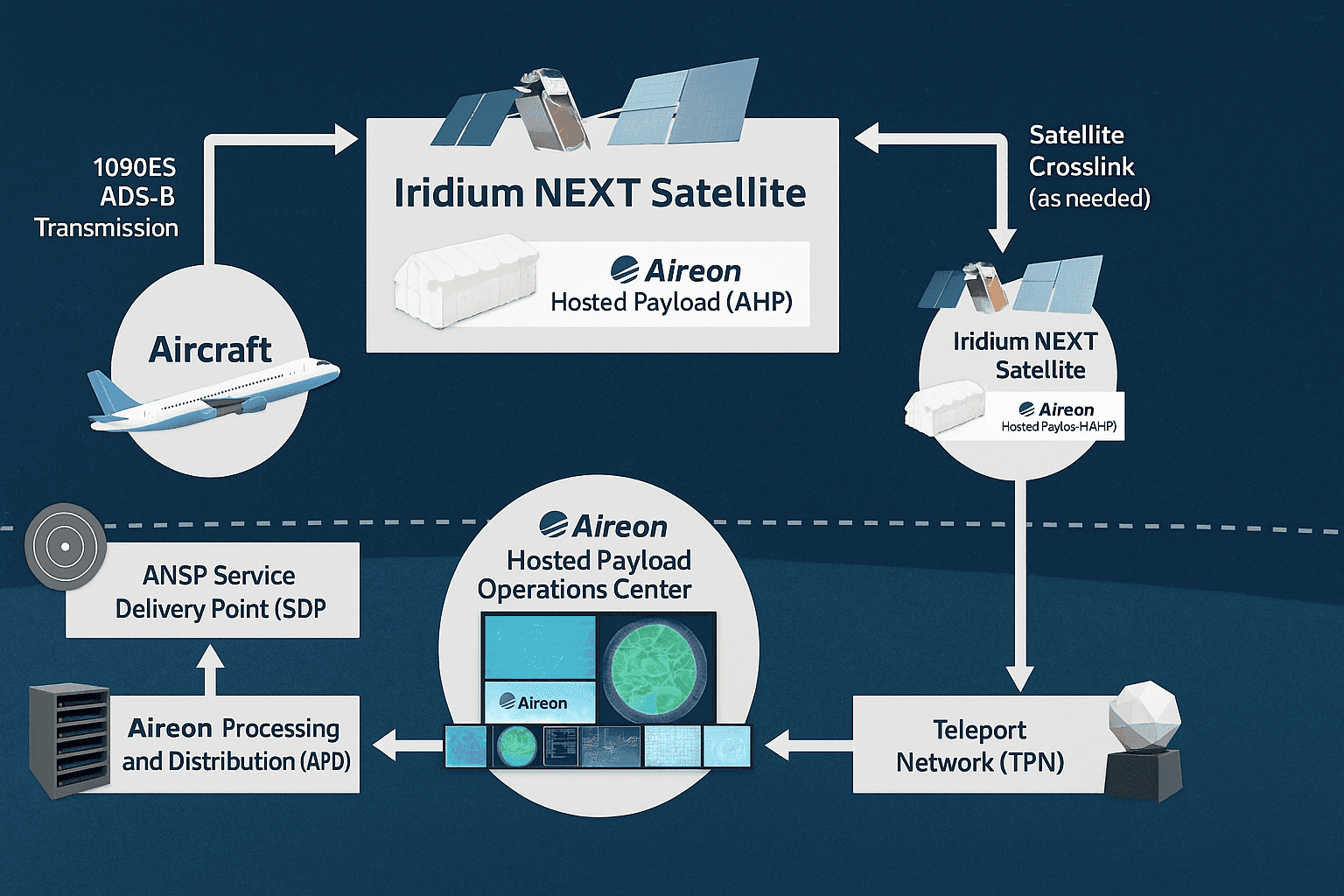
Aireon’s system holds certification from the European Union Aviation Safety Agency and operates as a payload on the Iridium satellite constellation. The network monitors about 190,000 flights on an average day. Commercial aircraft transmit details such as identity and altitude, and Aireon captures that information in real time with full global coverage.
Air navigation authorities responsible for more than half of the world’s airspace already rely on Aireon surveillance data. In practical terms, that means controllers can keep better visibility over remote routes and oceanic corridors where ground infrastructure has always been thin.
Several founding investors helped bring the service from concept to working infrastructure.
- Nav Canada
- NATS Holdings
Additional backing came from ENAV, AirNav Ireland, and Naviair during rollout and early validation. Nav Canada and NATS were first to activate the service over the heavily used North Atlantic Tracks between Europe and North America, a region where surveillance gaps once had real operational consequences over the Atlantic Ocean.
As part of the acquisition, Nav Canada and NATS will extend their data services agreements through 2035 and later. Those agreements also leave room for joint development work on space-based Very high frequency communications and other future capabilities.“Aireon and Iridium have been partners since day one, and that partnership is the reason we have been able to build the world’s only space-based air traffic surveillance system and a fast-growing aviation data services business alongside it,” said Don Thoma, chief executive officer of Aireon. “Becoming part of Iridium is a natural next step for our team, our customers, and our roadmap, particularly as our data products expand into new areas like turbulence detection and aviation data analytics. Together, we are building the foundation for the future of global aviation.”
“Aireon and Iridium have been partners since day one, and that partnership is the reason we have been able to build the world’s only space-based air traffic surveillance system and a fast-growing aviation data services business alongside it,” said Don Thoma, chief executive officer of Aireon. “Becoming part of Iridium is a natural next step for our team, our customers, and our roadmap, particularly as our data products expand into new areas like turbulence detection and aviation data analytics. Together, we are building the foundation for the future of global aviation.”“NAV CANADA is proud of our foundational role in establishing Aireon’s world-first technology,” said Mark Cooper, president and chief executive officer of Nav Canada. “This sale sharpens our focus on our core expertise: keeping Canada’s skies safe. As a fellow founding partner, Iridium is the ideal owner to guide Aireon’s continued commercial growth. We wish the entire team continued success and look forward to our ongoing relationship as a customer.”
“NAV CANADA is proud of our foundational role in establishing Aireon’s world-first technology,” said Mark Cooper, president and chief executive officer of Nav Canada. “This sale sharpens our focus on our core expertise: keeping Canada’s skies safe. As a fellow founding partner, Iridium is the ideal owner to guide Aireon’s continued commercial growth. We wish the entire team continued success and look forward to our ongoing relationship as a customer.”“We have been proud to be a part of Aireon’s successes, most notably making real-time aircraft surveillance over the Atlantic a reality for the first time in history, enabling even safer operations across the North Atlantic,” said Martin Rolfe, chief executive officer of NATS. “As a shareholder for the past eight years, it is now the right time for us to divest. We are confident Aireon is well positioned for the future and wish the team every success in the next stage of its development.”
“We have been proud to be a part of Aireon’s successes, most notably making real-time aircraft surveillance over the Atlantic a reality for the first time in history, enabling even safer operations across the North Atlantic,” said Martin Rolfe, chief executive officer of NATS. “As a shareholder for the past eight years, it is now the right time for us to divest. We are confident Aireon is well positioned for the future and wish the team every success in the next stage of its development.”
The Next Shift in Space-Based VHF
Iridium also pointed to space-based VHF communications as a major opening in aviation infrastructure. The idea is straightforward. Extend pilot-to-controller VHF coverage into oceanic and remote airspace where ground stations do not reach, while avoiding extra equipment changes on the aircraft side.
The company compares that path to the way Aireon’s surveillance service works today. Airliners already carry ADS-B transceivers, so the space-based layer can collect the signal without requiring broad fleet retrofits. I read that as a fairly efficient engineering decision, the same way a well-placed overlay can add value without rebuilding the base map.
Aireon’s Expanding Data Business
Outside its surveillance role for air navigation agencies, Aireon has been building a broader data business aimed at airline operators, airport users, aerospace companies, and government customers. It sells both real-time information and historical data, and that side of the company has been growing quickly.
- Turbulence detection
- GPS interference monitoring
Aireon is also developing analytics tools tied to safety and operating efficiency as the aviation environment becomes more crowded and more dependent on resilient data feeds.
Iridium said this data segment is already one of Aireon’s strongest growth engines and should become a meaningful contributor to its own aviation revenue in the combined company.
Terms of the Transaction
Iridium already owns part of Aireon and will purchase the remaining 61 percent equity interest for about 366.7 million dollars from the other owners. Half of the price is due at closing, with the rest scheduled for the one-year anniversary of the deal. Iridium will also take on Aireon’s outstanding debt, which is expected to be about 155 million dollars when the transaction closes.
| Seller Group | Equity Percentage Sold | Payment Timing | Amount USD | Debt Assumed USD |
|---|---|---|---|---|
| Other Aireon owners including Nav Canada and NATS | 61 percent | Half at closing - half after one year | 366.7 million | About 155 million at closing |
The companies are targeting an early July closing, subject to customary closing conditions and required approvals. Iridium did not outline unusual operating restrictions in its announcement, but transactions of this type generally remain tied to final consents and standard covenant compliance until closing.
On the financial side, Iridium said the deal supports its growth outlook. Aireon’s revenue has risen at a 10 percent compound annual growth rate over the past three years. Iridium expects the acquisition to add at least 100 million dollars in annualized service revenue and 30 million dollars in annualized OEBITDA on a consolidated basis.
Iridium has not given a specific earnings-per-share target tied to the purchase. It has, however, framed the deal around revenue expansion and tighter control of aviation services already built on its network. The company also said its long-range leverage target remains in place and indicated no change to the paused share repurchase program, which suggests capital allocation priorities are broadly unchanged for now.
The company plans to fund the purchase using existing market liquidity, including credit drawn from its revolving credit facility, along with future cash from operations. After closing, leverage is expected to move to about 4.0 times OEBITDA during the third quarter of 2026. Iridium then expects leverage to work back toward current levels over the following 12 months. Its long-range target of 2.0 times OEBITDA by the end of the decade remains in place, and that outlook assumes no change to the paused share repurchase program.
In the near term, Aireon is expected to continue operating on a business-as-usual basis, with no immediate shift in strategy. The companies are targeting an early July closing.
Evercore acted as financial adviser to Iridium, with Cooley and Milbank serving as legal counsel. PJT Partners advised Aireon financially, and Hogan Lovells served as legal counsel on that side.


