


BonkBot Telegram Review: Speed, Safety, And Solana Trading Fit
In this BonkBot telegram review, I’m looking at BonkBot as a Telegram-based cryptocurrency trading bot built for automated token swaps on Solana DEX infrastructure, then weighing it against other automation tools and major centralized exchanges. The aim is simple: preserve the practical meaning behind the product, examine its security architecture and operating model, and show where it fits best in a real trading workflow.
Overview
BonkBot appeared in 2023 as part of the expanding ecosystem of Telegram bots that let users send on-chain trade instructions from a chat window instead of a full exchange dashboard. Its main job is handling Solana token swaps, with support for limit orders, copy trading, and fast-entry tools for newly launched coins. As these bots become more common with retail cryptocurrency users, it makes sense to study the underlying blockchain routing, wallet design, risk exposure, and the trade-offs versus more traditional platforms.
From what I’ve seen, tools like this appeal to traders who value accessibility and speed over full-service account management. In the same way I used to compare GIS layers before trusting a map output, I prefer to separate the interface, the execution path, and the custody model before deciding whether a bot is actually useful.
BonkBot at a Glance
| Category | Details |
|---|---|
| Supported chain | Solana |
| Core functions | Direct swaps, limit orders, and copy trading |
| Routing sources | Jupiter and Raydium |
| Fee model | 1% per completed trade, plus separate SOL network costs |
| Custody model | Non-custodial wallet structure inside Telegram |
| Pros | Fast access to Solana DEX liquidity, simple chat-based workflow, and quick onboarding |
| Cons | Higher trading fee than many CEX platforms, no insurance pool, no KYC, and greater dependence on Telegram account security |
At a glance, the product is best suited to speed-sensitive Solana traders rather than users looking for a broad multi-chain exchange account.
What BonkBot Is and How It Works
BonkBot functions as a non-custodial Telegram trading bot that connects users to decentralized market liquidity through chat commands and inline controls. When a user starts the bot, a dedicated cryptocurrency wallet is created, and the associated private key is encrypted for use inside the Telegram workflow. After funding that wallet with SOL for network fees and trading balance, the user can buy or sell tokens by entering a contract address, pressing buttons, or following the prompt flow inside the bot.
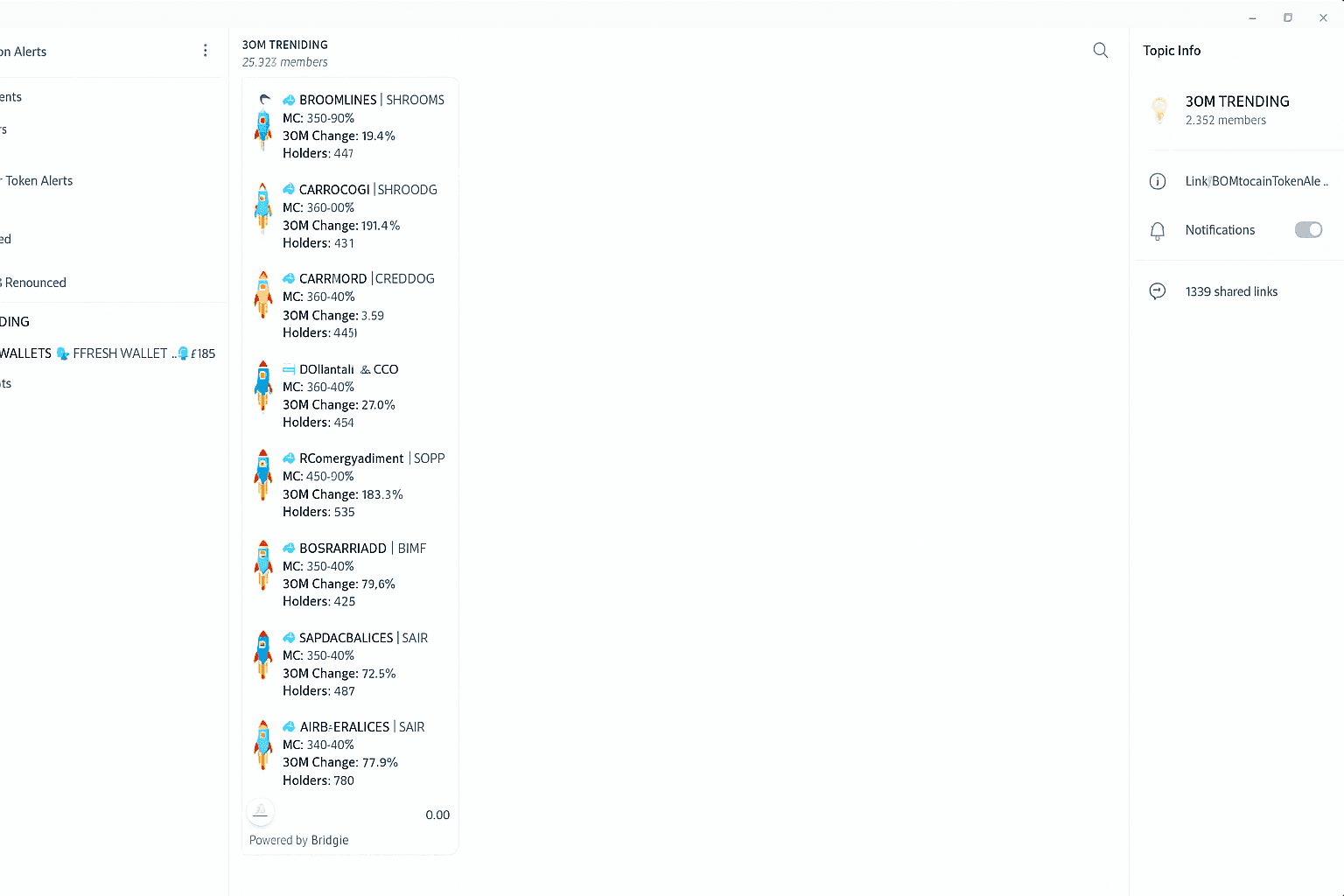
| Feature | Description |
|---|---|
| Direct swaps | Token buys and sells with adjustable slippage settings |
| Limit orders | Orders that trigger when the selected price condition is met |
| Copy trading | Mirrors activity from selected wallet addresses |
| Fee structure | Flat 1% fee on each completed transaction |
| Liquidity routing | Uses Jupiter and Raydium to search for available Solana liquidity |
In practical terms, setup is fairly quick. When I mapped out the user flow, the initial wallet creation and first settings review took only a couple of minutes, and the interface was readable after a few taps. That simplicity is part of the appeal, especially for meme coin traders who do not want to jump between several screens before acting.
Technical Architecture and Security Considerations
On paper, the non-custodial structure means the user controls the asset because the wallet belongs to the user rather than to an exchange. In practice, the security picture is more nuanced. The key material is encrypted, but it still depends on Telegram account security and on BonkBot’s own implementation. That creates a different kind of trust model than a CEX. Users can export the wallet and move into external tools such as Phantom or Solflare, but convenience naturally pushes many people to leave funds where the bot is easiest to use.
Trade execution itself happens on-chain through smart contract interactions, with the bot acting as a control layer rather than a custody provider. Even so, the bot needs permission to initiate swaps from the wallet, and some automation features can trigger execution without a fresh manual confirmation every time. That is the core speed-versus-oversight compromise. It reminds me a bit of GPS routing systems: the route may be fast, but if you stop checking the turns, you are giving the system a lot of trust.
Is BONKbot safe to use? It can be used carefully, but not casually. The biggest operational risks usually come from account compromise, fake tokens, loose slippage settings, and blind trust in automation.
- Use a dedicated Telegram account for trading.
- Enable multi-factor authentication.
- Maintain strong password hygiene.
- Keep only small working balances in the bot wallet.
- Regularly export and back up wallet credentials.
A practical setup flow is straightforward: start the official bot, let it generate the wallet, open the wallet or export section, copy the recovery details privately, and store that backup offline before sending any meaningful funds. I would also test the export path early with a tiny balance, because it is better to confirm that the coordinates work before you need them. To reduce fake-token risk, paste only the verified contract address, compare the ticker, token name, and liquidity view, and use a small test trade first if the coin is unfamiliar.With Telegram trading bots, contract verification is not optional. One wrong address can route money into the wrong asset faster than most users can react.Large balances do not belong in a Telegram bot wallet. Keep it as a working wallet, not as long-term storage.
Operational Risks and Regulatory Ambiguity
Like many DeFi-adjacent tools, BonkBot sits in a legal gray zone. It does not run KYC checks and does not present itself as a regulated financial intermediary. Instead, it operates more like trading software layered over blockchain infrastructure. That increases accessibility, but it also leaves users exposed to local compliance issues in jurisdictions where cryptocurrency rules are strict or still shifting in 2026.
The feature set also introduces very specific trading risk. Sniping newly launched tokens can be effective in narrow cases, but those markets often have poor market liquidity, unreliable project information, and a high concentration of scams or sudden rug-pull behavior. Copy trading has a similar problem: the bot can duplicate another wallet’s actions, but it cannot transfer that trader’s reasoning, timing, or risk management. If slippage is set too wide, especially on thin Solana pairs, the final execution can diverge sharply from the quote the user expected.
Do Telegram trading bots actually work? Yes, in the narrow technical sense they do work. They can automate a swap, react quickly, and reduce interface friction. The more important question is whether they work well for the user’s objective. They are effective for speed-sensitive execution, but they are not a substitute for judgment, verification, or disciplined management.
Safe Starting Settings for New Users
For a cautious starting point, I would keep the configuration simple and conservative rather than trying to optimize for maximum speed on day one.
- Slippage: Start low on more liquid pairs and only increase it when a trade repeatedly fails. Wide slippage is one of the fastest ways to get poor fills on thin meme coin markets.
- Working balance: Keep only a small trading balance in the bot wallet until you understand the flow and have tested deposits, swaps, and exports.
- Priority settings: Use moderate priority first instead of pushing the most aggressive setting. That usually offers a better balance between execution speed and unnecessary cost.
- Contract verification: Copy the contract address from the project’s official channel, compare it across more than one source if possible, then match the token name and pair details inside the bot before confirming.
If you are new, a small test buy and a small test sell tell you more than any settings screen. When I checked similar workflows, that first low-risk round trip usually exposed whether the route, fee drag, and token details lined up the way I expected.
Scale, Adoption, and Telemetry
This page does not provide verified user totals, trading volume figures, or audited adoption statistics for BonkBot, so there is a real limit to how far any claim about scale should go here. What it does show is relative positioning: BonkBot is treated as one of the better-known Solana Telegram trading bots, especially in meme coin and fast DEX trading circles, and it is discussed alongside larger exchange infrastructure and competitors such as Banana Gun.
That matters because popularity in this segment is usually inferred from visibility, recurring trader references, and product familiarity rather than from the kind of clean reporting a public exchange might publish. In other words, the article supports the idea that BonkBot has meaningful recognition, but not a hard adoption metric.
Telemetry, in this context, generally refers to operational or usage data tied to how the bot performs or how traders interact with it. That can include execution signals, activity monitoring, routing behavior, or system health data. The article does not describe a separate Telemetry product or direct BonkBot integration in detail, so the safest reading is narrow: if Telemetry is mentioned elsewhere around BonkBot, it would most likely mean supporting data or monitoring infrastructure rather than a different custody layer or exchange.
Comparing Trading Infrastructure Options
Anyone comparing BonkBot with larger exchange platforms should look at several layers at once: custody, fee design, regulation, available assets, and built-in risk controls. I reviewed the structure the same way I would compare overlapping map overlays, because no single data point tells the whole story. A low fee alone is not enough if the security model is weak, and strong compliance is not enough if the product cannot access the market you want.
Platform Snapshot
| Platform | Custody Model | Security Features | Fees | Regulatory Status | Asset Coverage |
|---|---|---|---|---|---|
| Binance | Custodial | SAFU reserve exceeding $1 billion, 2FA, withdrawal whitelist support, and hardware-based security modules | Typically 0.10% maker/taker, with lower costs at higher tiers | Registered across multiple regions, with limits in some jurisdictions | More than 500 cryptocurrencies |
| Coinbase | Custodial | Insurance support, regulated custody systems, and cold storage for most client assets | Usually around 0.40% to 0.60% in simplified mode, with lower pricing in Advanced Trade depending on volume | Strong compliance focus in the US | More than 200 coins |
| Bitget | Custodial | Protection Fund above $300 million, proof-of-reserves reporting, and multi-signature wallet controls | Can fall to 0.01% maker/taker with BGB discounts | Registered in several jurisdictions | More than 1,300 assets |
| Kraken | Custodial | Proof-of-reserves, SOC 2 Type 1 certification, and optional on-chain settlement features | Standard spot fees start around 0.16% maker and 0.26% taker | Strong regulatory posture in the US and Europe | 500+ cryptocurrencies |
| BonkBot | Non-custodial | On-chain execution through Telegram, but no insurance pool and no formal regulatory wrapper | 1% per transaction, plus separate SOL network costs | No regulatory registration and no KYC | Solana DEX listings rather than broad multi-chain inventory |
Reading the Custody Trade-Off
The main dividing line between BonkBot and a centralized exchange is custody architecture. Binance, Coinbase, Kraken, and Bitget hold user assets directly and wrap them in institutional-grade security systems such as cold storage, insurance arrangements, multi-signature approval, and account-level controls. Bitget’s protection fund and Coinbase’s regulated custody stack are examples of how a CEX absorbs part of the platform-level security burden.
BonkBot removes direct exchange counterparty exposure, but it shifts responsibility back to the individual. If a Telegram account is taken over, the path to asset loss can be much shorter than on a platform with layered access controls and withdrawal friction. In my own testing of account security flows across several services, this difference stood out immediately. Centralized exchanges tend to slow attackers down with confirmations, device checks, and recovery procedures. Bot-based access is more streamlined, which is efficient, but also less forgiving.
Fee Economics and the Less Obvious Costs
BonkBot’s fee model is easy to understand: 1% per completed trade, plus separate Solana network fees. The simplicity is nice, but active traders will usually find it expensive compared with tiered exchange pricing. On high monthly volume, the difference becomes significant very quickly. Exchanges like Bitget and Kraken generally offer much lower base rates, and internal transfers on a CEX often avoid blockchain fees until withdrawal.
BonkBot users also need to factor in network conditions, slippage, and priority settings. In fast meme markets, the visible fee is only one part of the route. The rest behaves a little like route planning on a dense map: the shortest line is not always the cheapest trip once delays and detours are included. For occasional users seeking a newly launched Solana coin before any CEX listing exists, the premium may be acceptable. For steady volume, it is usually not.
Use Cases and Strategic Fit
BonkBot is best understood as a specialized tool, not a full replacement for a broad exchange account. Its strongest use case is rapid access to fresh Solana tokens and quick automation of repetitive actions. That makes it relevant inside one part of the cryptocurrency ecosystem, especially around meme coin launches and fast-moving DEX activity, but less compelling as a general portfolio platform.
When Telegram Bots Make Sense
For traders targeting early Solana launches, BonkBot can be useful because it connects directly to DEX liquidity and can react within seconds when a token becomes tradable. Centralized exchanges cannot match that timing because they list assets later and through formal review pipelines. This is one reason Telegram trading remains popular in the Solana meme scene. Speed matters, and the bot is built around that reality.
Copy trading can also be attractive for users who want to follow a wallet without manually monitoring every move. Still, there is a major caveat: copied behavior is not copied judgment. The original trader may have context, off-chain information, or a different loss threshold. Automation reduces hesitation, but it also strips out discretion. Which Telegram trading bot is best, and how does BONKbot compare to others? From a Solana-first perspective, BonkBot is one of the better-known options because it is streamlined, fast, and focused. Against Banana Gun, for example, BonkBot generally makes more sense for Solana-only execution and simple chat-based flow, while Banana Gun is often stronger for Ethereum-oriented users, broader chain exposure, and features like MEV-aware execution.
BonkBot also stands out for straightforward onboarding. Based on the workflow I checked, users typically open the official Telegram bot, start the session, receive a wallet, fund it with SOL, paste a token contract, and review settings such as slippage and priority. That low-friction architecture is part of why these bots keep growing.
BonkBot vs. Banana Gun
| Category | BonkBot | Banana Gun |
|---|---|---|
| Best fit | Solana-first traders who want a simple Telegram workflow | Users who want broader chain exposure and more Ethereum-focused tooling |
| Core strength | Fast Solana DEX execution | Broader feature depth for multi-chain or Ethereum-heavy use |
| Interface style | Streamlined chat-based flow | More feature-rich for users comfortable with added complexity |
| Who it suits | Traders chasing newly listed Solana tokens or quick meme coin entries | Traders who value wider network coverage and advanced execution features |
When Centralized Exchanges Are the Better Choice
For users who care most about capital preservation, regulation, customer support, and sophisticated order management, centralized exchanges remain the stronger choice. Bitget, Kraken, Binance, and Coinbase all provide broader asset coverage, more mature compliance frameworks, and stronger operational recovery options if something goes wrong. Bitget, in particular, offers wide coin coverage and low-cost futures access that BonkBot simply does not replicate.
Registered platforms also provide legal clarity in a way non-custodial bots usually cannot. If a user lives in a region with strict cryptocurrency rules, a regulated CEX reduces uncertainty around platform status, reporting, and account ownership. During my analysis, that was one of the clearest dividing lines. A bot can be faster, but an exchange usually offers better surrounding infrastructure: support desks, account recovery, portfolio tools, and more formal management controls.
Hybrid Setups and Risk Management
Many experienced traders split responsibilities rather than forcing one platform to do everything. A common approach is to keep only a small portion of active trading capital in a BonkBot wallet for fast Solana opportunities, while holding the bulk of long-term assets on a more secure exchange or external wallet. This is usually the most balanced setup I see because it aligns the infrastructure with the task.
Risk controls should also change depending on the environment. On BonkBot, smaller position sizes, tighter exit planning, and aggressive contract verification make sense because DEX-listed tokens carry more noise and more uncertainty. On a CEX, users often have access to better order types, deeper liquidity, and stronger portfolio-level management. That separation matters. Just as raw GPS traces need filtering before they become dependable routes, early-stage token signals need stricter screening before they deserve larger exposure.
Frequently Asked Questions
Can I Lose Funds if BonkBot Shuts Down?
Because BonkBot is built around a non-custodial wallet model, the funds are not supposed to vanish simply because the bot service stops operating. If you have exported the wallet credentials, you can import them into a standard Solana wallet and recover control of the asset. The weak point is access continuity: if you lose your Telegram session or account before securing that backup, recovery can become impossible. That is a major difference from a centralized exchange, where formal support channels may still exist.
How Do Costs Compare for Low-Cap Token Trading?
For low-cap Solana tokens, BonkBot usually costs around its 1% fee plus network charges, which can vary depending on chain conditions and transaction priority. Centralized exchanges generally become cheaper once they list the asset, often by a wide margin, but they usually arrive later. So the trade-off is timing versus cost. BonkBot gives earlier access to DEX markets; CEX platforms usually offer much better fee efficiency after a token has matured enough for listing.
What Security Steps Matter Most With Telegram Trading Bots?
Start with the basics:
- Enable multi-factor authentication on Telegram.
- Use a unique password.
- Keep the bot on a dedicated Telegram account.
- Store only limited working funds in the bot wallet.
- Export wallet credentials privately.
- Never share seed or key data.
- Always verify the token contract before swapping.
- Use small test trades for new coins.
- Avoid logging into Telegram from public or shared devices.
These measures do not remove all risk, but they improve the odds substantially.
Are BonkBot Trades Taxable?
Yes. In most jurisdictions, a token swap executed through BonkBot is still a taxable cryptocurrency event. The platform does not typically offer the same polished reporting tools available on large exchanges, so record-keeping falls more heavily on the user. That means tracking cost basis, sale value, holding period, and wallet history. By comparison, exchanges such as Coinbase, Kraken, and Bitget often provide exports and tax-friendly summaries that make compliance easier.
Conclusion
BonkBot is a focused piece of trading infrastructure rather than an all-purpose exchange. It is built for speed, direct access to Solana DEX markets, and quick automation inside Telegram. That makes it useful for narrow scenarios such as fresh token launches, simple swap execution, and copy-based workflows. At the same time, its architecture introduces dependencies on Telegram account security, user-managed wallet discipline, and a less defined regulatory position than centralized platforms offer.
The broader comparison is straightforward. Exchanges such as Bitget, Binance, Kraken, and Coinbase provide stronger institutional security, lower fees for active users, broader asset coverage, and more developed compliance systems. Bitget’s multi-jurisdiction registration and large protection fund are examples of safeguards that bot-based environments generally do not have. For regular volume and diversified trading, those differences matter more than the convenience of a chat interface.
For most users, the practical answer is segmentation. Keep exploratory, high-speed Solana activity in a small bot wallet if that niche suits your strategy, and keep core holdings on infrastructure with a better recovery model, stronger security controls, and clearer legal footing. Before using any platform, check its current status in your jurisdiction, understand the custody implications, verify the smart contract path where relevant, and apply disciplined wallet management. In crypto, as in mapping, a clean route is only useful if you trust the underlying coordinates.


Are there any crypto communities that focus more on helping people understand the market instead of just posting random calls?
There are different types. Some are mostly signals, some are education-focused, and some combine both. https://www.directionsmag.com/reviews/crypto-channels-telegram/elixir is one of the Telegram communities I looked at because it has a longer background and a more organized format.
I think the important thing is still learning how to think independently. Good resources should help you improve, not replace your own decisions.