


Trading Groups on Telegram: A Practical Guide For 2026


If you spend any time around active traders, one pattern shows up quickly: most serious trading groups on Telegram rely on it because the platform is fast, stable, and easy to use across desktop and mobile. In my own testing, alerts arrived within seconds on both devices, which matters when a trade setup appears outside regular hours and timing affects execution.
Why Traders Prefer Telegram
There is a reason Telegram keeps showing up in stock, cryptocurrency, and foreign exchange market circles. It was built for live communication, and that matches the way traders exchange information. Messages move with very little delay, notifications are dependable, and the app works well whether you are at a desk or checking a phone before sunrise.
Speed is only one advantage. Telegram can support very large communities, with groups that scale up to 200,000 members. That lets one telegram group hold a broad audience without forcing people into fragmented channels or duplicate servers. File handling is also generous. Charts, PDF notes, spreadsheets, market analysis clips, and clean screenshot images can be shared at sizes up to 2 GB, which is unusually useful when technical analysis depends on detail.
The bot ecosystem is another big reason traders stay. Telegram’s API allows admins and developers to build tools directly into the conversation flow. That includes price alerts, payment collection, signal formatting, portfolio monitoring, access management, and other forms of automation. From what I’ve seen, the less a member has to jump between apps, the better the retention and the cleaner the communication.
Privacy also matters more than many newcomers realize. Telegram lets people operate through usernames instead of exposing a phone number to every contact. It also offers stronger privacy controls and encrypted chat options. When people are discussing a trading strategy, position size, or risk management rules, they generally do not want that data treated like ad inventory.
How to Find Legitimate Trading Communities
Finding a worthwhile group is harder than it should be. The signal market is crowded with low-quality offers, recycled news, inflated win-rate claims, and outright scam operations. Some channels charge high monthly fees for information that is already available in public charting tools or on YouTube. The useful groups are still out there, but you have to filter carefully.
Start With Directories and Public Communities
The fastest entry point is usually a vetted directory or an active online community where traders compare notes. Reddit discussions, public Telegram listings, and trader accounts on X can all help surface options. I usually check several sources side by side, the way I would compare GIS layers for alignment, because one list alone rarely gives a reliable picture.
Look for communities that have some visible curation instead of raw invite-link dumps. Public analysts who post consistent market analysis are often easier to evaluate than anonymous admins making dramatic claims. If a trader publishes clear commentary on Bitcoin, Ethereum, Binance markets, DeFi, or broader blockchain activity before inviting people into a private room, that is usually a better sign than aggressive promotion.
Evaluate Before You Pay
Once you find a group that looks promising, avoid upgrading immediately. A credible operator will usually offer a free tier, trial window, or at least enough public content to inspect their process. Spend a few days observing how they work before committing your time or money.
Track record transparency.Ask whether they show complete history, not just winning trades. A useful record includes entry, exit, stop, target, and outcome. If you only see handpicked victories, you are looking at incomplete data.
Signal structure.Good signal groups use a repeatable format. That normally means asset, direction, entry range, stop loss, take profit levels, and stated risk. Vague comments such as “looks bullish” are not actionable information.
Community quality.Watch the interaction inside the group. Are members asking real questions? Does the admin reply? Is there learning, or just broadcast messaging? Strong communities usually mix signals with explanation, education, and management discipline.
Reasonable claims.If someone promises certainty, walk away. Real traders talk about drawdown, volatility, market liquidity, and losing streaks because those are part of every market. Guaranteed returns are one of the clearest fraud markers.
Check Engagement, Not Just Member Count
A large headline number means very little by itself. I have checked groups showing tens of thousands of members that felt almost empty after a few minutes of scrolling. If only a handful of accounts post each day, response times are slow, and the admin appears irregularly, the audience may be inflated or simply inactive.
Look at how many unique users speak, how quickly questions are answered, and whether activity follows a visible rhythm around market sessions or major news. Hard data is better than instinct here. If you are comparing several communities, engagement metrics tell you more than vanity numbers.
A Quick Checklist Before You Join
- Review free posts before paying for anything.
- Check whether past calls include losses as well as wins.
- Look for a consistent signal format with entries, stops, and targets.
- Watch how the admin explains risk and volatility.
- Measure real engagement, not just member count.
- Notice whether the group teaches anything beyond entries and exits.
- Be cautious if the sales pressure is stronger than the market analysis.
- Leave immediately if you see guaranteed returns or unverifiable performance claims.
Red Flags That Suggest a Scam
The barrier to entry is close to zero. Anyone can create a channel, borrow a few screenshots, and present themselves as an expert. That makes the space noisy. In some ways it reminds me of unfiltered GPS traces: until you clean the signal, the bad points can distort the whole route. These warning signs are the ones that matter most.In practice, the biggest mistake is confusing activity with credibility. A busy feed can still be a scam if the records are vague, the claims are extreme, and no one will show the full history.
In practice, the biggest mistake is confusing activity with credibility. A busy feed can still be a scam if the records are vague, the claims are extreme, and no one will show the full history.
Guaranteed Returns
No legitimate trader can guarantee results. Markets are probabilistic, whether the focus is BTC, altcoins, stock indices, or the foreign exchange market. A group promising fixed weekly gains or “risk-free” trades is not describing how real trading works. It is using certainty as a sales tool.
Paid Signals Without Verifiable History
If a premium plan is expensive but the operator cannot show even a few months of consistent, reviewable performance, that is a poor sign. Screenshots are weak evidence. They can be cropped, delayed, or fabricated with little effort. Stronger providers use independent journals, third-party verification, or at minimum a transparent internal log that includes losses as well as wins.
Pump-and-Dump Behavior
This pattern is especially common in low-liquidity cryptocurrency markets. The admin enters a small coin position first, then pushes the idea to the group with urgent language. Members rush in, price spikes, and the organizer exits into that temporary demand. By the time most people react, they are providing the other side’s liquidity.
- Repeated focus on micro-cap coin names
- Dramatic “buy now” messaging
- No stop loss
- No discussion of risk
- No visible record of failed calls
Constant Pressure to Upgrade
If the free area exists only to funnel people into a paid plan, with almost no useful information at the entry level, that tells you a lot. Solid groups give value at every tier. The premium version may be deeper or faster, but the free audience should still receive meaningful content, not nonstop sales copy.
Manufactured Social Proof
Be skeptical of recycled testimonials, suspiciously new accounts praising the admin, and oversized member counts with little real discussion. During my analysis of a few groups, I opened several user profiles and saw patterns that felt artificially arranged. If the praise looks staged, it often is.
Which Is the Best Telegram Group for Trading Signals?
There is no single best option for everyone, because the answer depends on the asset class, your language, the level of education you want, and whether you need a discussion group or a clean telegram channel for alerts only. The best trading signals group for one trader may be a poor fit for another.
What tends to separate the top options is not marketing but structure. The better groups usually share five traits:
- Clear signal formatting
- Transparent past results
- Realistic commentary on risk
- Timely market updates
- Educational breakdowns that explain why a trade exists
For crypto in 2026, many traders compare groups by whether they cover Bitcoin and Ethereum only, broader altcoin rotations, Binance futures, spot trading, DeFi sectors, or blockchain ecosystem news. Useful comparison points include whether the group is free or paid, the number of alerts, how the admin handles volatility, whether stop levels are included, and whether the community appears active rather than inflated.
A Shortlist of Notable Crypto Trading Groups
Because Telegram groups change quickly, I would not treat any list as permanent. Still, a practical shortlist can help if you want a starting map rather than a random search result. The names below are best treated as examples to investigate, not endorsements to join blindly.
| Group Name | Free/Paid | Asset Coverage | Signal Frequency | Admin Transparency | Educational Content | Engagement Level |
|---|---|---|---|---|---|---|
| Jacob Crypto Bury | Mixed | Bitcoin, Ethereum, major altcoins | Moderate | Medium | Strong market commentary and learning content | Usually active |
| Wolf of Trading | Mixed | Crypto futures and broader cryptocurrency setups | Moderate to high | Medium | Some educational context around setups | Active |
| Crypto Inner Circle | Paid-focused | Altcoins, swing trades, market rotations | Moderate | Medium | Moderate | Varies by period |
| Fed. Russian Insiders | Paid-focused | High-frequency crypto signals | High | Low to medium | Limited | Often busy, but needs careful verification |
| Crypto VIP Signal | Mixed | Bitcoin, Ethereum, altcoins | High | Medium | Limited to moderate | Usually active |
I would use a table like this only as a first filter. The selection criteria that matter most are simple: transparent records, realistic risk management, useful educational context, and visible engagement that looks organic rather than inflated.
If you are asking “What are the best crypto trading groups on Telegram?” the safer answer is that the best ones are the groups that stay clear on entries and exits, publish enough history to inspect, explain risk honestly, and remain active without turning every message into a sales pitch.
If you are asking “What are the best crypto signal groups?” the practical answer is to shortlist a few that fit your market, observe them for several days, and compare them side by side. Think of it like evaluating map overlays: no single layer tells the full story, but the pattern becomes clearer when several data sources line up.
Is Telegram a Good Platform for Trading?
Yes, in most cases it is. Telegram is a strong platform for trading communication because it combines fast delivery, broad device support, large-group capacity, solid file sharing, and flexible automation. Those basics make it well suited for time-sensitive signals, daily market analysis, educational posts, and community discussion.
That said, Telegram itself does not improve a bad trading strategy. It is simply the transport layer. A poor admin with weak discipline can still misuse a fast platform. In the same way that a clean map interface cannot fix bad coordinates, good communication tools cannot repair flawed judgment. Telegram is useful because it reduces friction. The quality still comes from the people and systems behind the messages.
Are Crypto Signal Groups Worth It?
Sometimes, yes, but only under the right conditions. Their value comes from convenience, speed, and access to a trader’s process. A good group can save research time, surface trade ideas quickly, and help newer members learn how risk management works in live conditions.
The downside is just as real. Quality varies sharply, scams are common, and many paid rooms offer little more than noisy alerts with no durable educational value. In my analysis, these groups are worth joining when they help you think more clearly, not when they push you toward blind execution.
- Worth it when:the group is transparent, explains setups, includes risk controls, and has a community you can evaluate before paying.
- Usually not worth it when:the record is unverifiable, the claims are exaggerated, or the entire model depends on urgency and upsells.
How Traders Receive Signals From Telegram Groups
Most traders get signals through one of two formats: a discussion group where alerts appear alongside commentary, or a broadcast-only telegram channel where the signal feed stays clean and easy to follow. The better setups often separate these functions so important alerts do not disappear inside chatter.
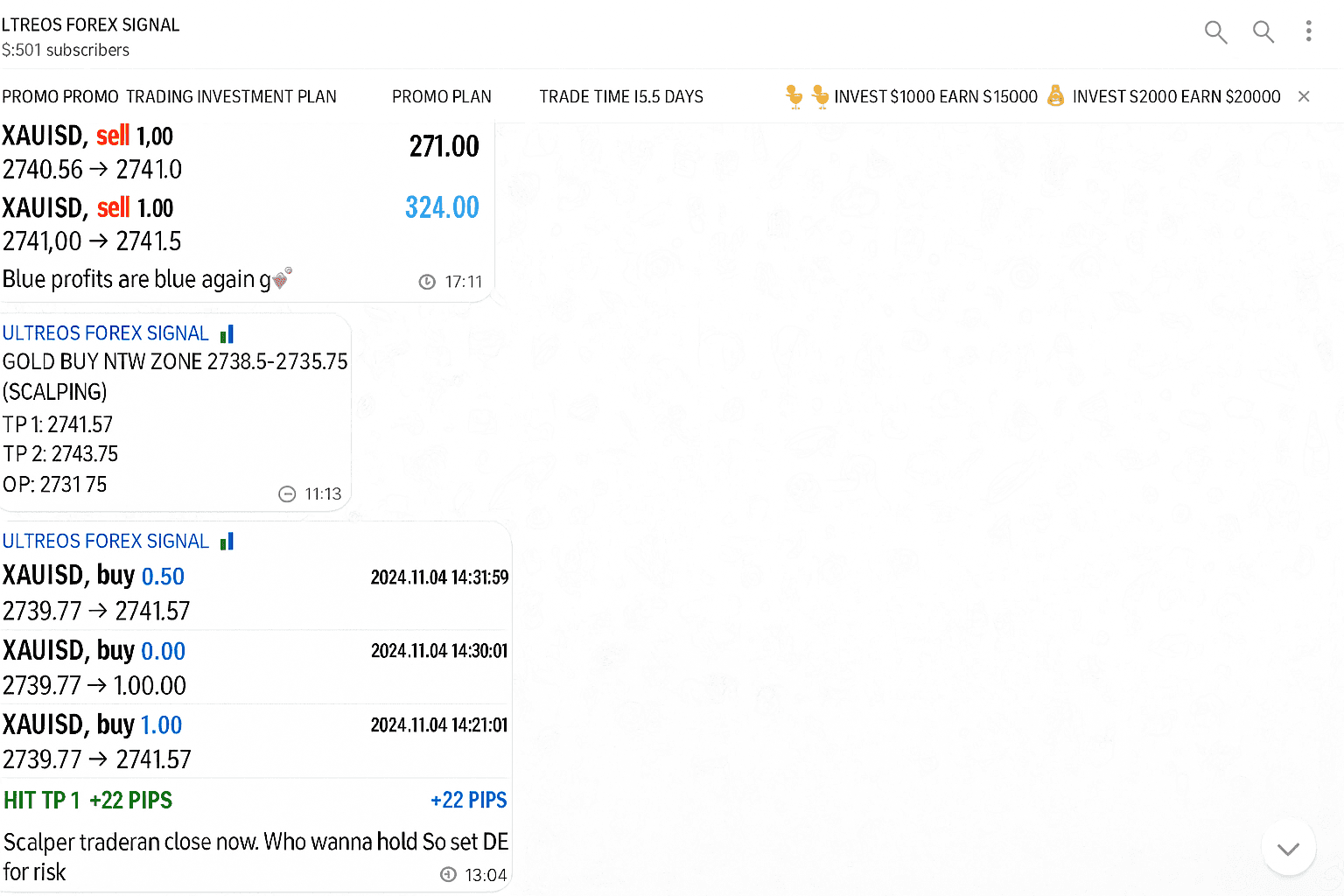
A typical signal usually includes:
- Asset being traded
- Intended direction
- Entry range
- Stop loss
- One or more profit targets
- A brief note on market conditions
- Risk level
- Timeframe
- Position management guidance
- The basis for the setup, such as momentum, support and resistance, order flow, or news
In practical terms, traders usually enable push notifications, pin the main channel, and monitor updates as they come in. Some also use bots for automation, especially if they want alerts reformatted, logged, or routed into a personal workflow. I tested a few group structures like this and found that simple separation between discussion and execution notes made the whole process easier to read within a minute or two.
How to Build and Run a Strong Trading Group
If you have a genuine edge, a Telegram community can be a good way to build an audience and package your knowledge. That edge might come from technical analysis, macro research, stock screening, foreign exchange market specialization, or a defined cryptocurrency trading strategy. The key is to design the group with clarity from the start.
Define a Specific Niche
“Signals” is too broad. Narrower positioning works better. That could mean swing setups in major forex pairs, intraday Bitcoin trades, options commentary on large-cap stock names, or altcoin momentum within the Binance ecosystem. The more specific the focus, the easier it is for members to know whether the group matches their needs.
Use a Multi-Channel Structure
Most well-run communities separate content into distinct streams:
- Main group:Questions, discussion, broader market commentary
- Signals channel:Trade alerts only, posted in a repeatable format
- Education channel:Learning material, strategy notes, and tutorials
- Results channel:Closed trades, reviews, and performance logs
This layout keeps the core signal feed clean while still giving members a place to talk, learn, and compare notes. In my own testing, this structure reduced clutter immediately and made older posts easier to review.
Standardize the Signal Format
Consistency builds trust. Every signal should be easy to scan and easy to execute. A clear template usually includes the following:
Asset:BTC/USDT
Direction:Long
Entry:A defined price zone
Stop Loss:The invalidation level
Take Profit 1:First reduction target
Take Profit 2:Secondary target
Risk Level:Low, medium, or high
Timeframe:The chart horizon being used
That removes ambiguity. Members know the idea, the risk, and the management plan without needing follow-up questions.
Offer More Than Signals
Signals alone are rarely enough for long-term retention. The communities that last usually explain the thinking behind a trade. Post market analysis, break down failed setups, comment on volatility, and teach position sizing, psychology, and trade management. People stay longer when they gain knowledge, not just entries.
A simple publishing routine helps. Daily market notes, weekly result reviews, and periodic educational content create useful habits for members. Consistency matters more than volume.
Moderate Early and Firmly
Trading groups attract spam quickly. Phishing links, fake accounts, impersonation attempts, and copycat signal sellers tend to appear fast. Strong join checks, anti-spam bots, approval workflows, and time-zone coverage from moderators are worth setting up from the start. One bad link can damage trust faster than weeks of good content can rebuild it.
Monetizing a Trading Community
Running a serious group takes time, and monetization is reasonable when the work is real. The main issue is choosing a model that aligns with member expectations and does not compromise credibility.
Subscription Tiers
The most durable approach is usually tiered access:
- Free tier:Market analysis, educational posts, and community access
- Premium tier:Real-time signals, deeper commentary, and faster support
- VIP tier:More direct guidance, reviews, and advanced strategy discussion
The free level is not wasted effort. It gives new people a way to evaluate your process. If the free material is thoughtful and consistent, paid conversion tends to happen more naturally.
Courses and Educational Products
Once a group trusts your work, structured learning products become a logical extension. Video modules, PDF guides, live workshops, and curated market analysis archives can all work if they are organized well. This is often a better long-term asset than chasing endless signal volume.
Affiliate Partnerships
Brokers, exchanges, charting services, and data platforms often offer referral income. That can be useful, but only if the recommendation is honest. Pushing weak tools because the commission is higher is one of the fastest ways to lose credibility.
Sponsored Analysis
As a group grows, vendors in the trading ecosystem may pay for exposure. If you use this route, keep sponsorships clearly labeled and relatively limited. Members join for analysis and communication, not for a feed dominated by ads.
Tools That Help Group Admins Operate Better
Trying to run a serious trading community without tools is possible, but inefficient. The right stack saves time and improves management.
Analytics and Metrics
You cannot improve what you do not measure. Useful analytics show when members are active, which posts attract engagement, how many users are truly participating, and where growth is coming from. I looked through several admin dashboards of this type and found that even 10 minutes of data review can correct a lot of bad assumptions.
Payment Automation
If access is paid, automated billing matters. Manual tracking becomes messy once subscriber counts start rising. Subscription tools that manage reminders and access changes reduce admin work and lower the chance of awkward errors.
Moderation Bots
Spam filtering is essential. Good bots screen join requests, block suspicious links, and remove obvious junk before it reaches the group. That baseline protection saves moderators from repetitive cleanup.
Signal Formatting Bots
Custom bots can standardize posts, calculate reward-to-risk ratios, log trades, and publish outcomes automatically once targets or stops are hit. That kind of automation makes the group feel professional and reduces manual repetition.
Content Scheduling
Scheduling helps turn a hobby project into a reliable publication. If daily news summaries, weekly market analysis, and education posts appear on a stable cadence, members know when to check in. In practice, predictable timing creates habit, and habit improves engagement.
Building Trust and Keeping Members
Trust is the core asset in any trading community. Without it, growth stalls and churn rises. With it, even a difficult stretch can be managed honestly.
Publish the Full Record
Share all trade outcomes, not just the attractive ones. Monthly summaries should include total trades, win rate, drawdown, and other basic statistics. Transparency is often more persuasive than polished sales language, because it gives people something real to evaluate.
Acknowledge Losing Trades Openly
When a setup fails, post the result and explain what happened. Members generally respect candor more than image management. Anyone with real market experience understands that losses are part of the process.
Build Interaction Beyond Alerts
Answer questions, run voice sessions, ask what members want to learn, and invite discussion around market trend changes. The groups with the strongest retention often are not the ones with the loudest claims. They are the ones where people feel involved.
Create Accountability
Shared watchlists, challenges, review threads, and member trade feedback can turn passive readers into active participants. When people contribute their own analysis and receive useful response, they become more invested in the community itself, not just their last trade.
Set Expectations Early
Your welcome message should explain what the group covers, how the strategy works, what level of risk is typical, and what members should expect during rough periods. Clear expectations reduce confusion and help attract the right audience from the start.
The Bottom Line
Telegram remains a natural home for trading communities because it combines speed, privacy, flexible bots, and strong communication tools in one place. But the environment is uneven. Alongside high-quality groups, there are weak operators, empty promises, and obvious scam setups aimed at beginners.
If you are looking for a community to join, slow down and evaluate it properly. Review the free content, compare engagement, study how the admin handles losing trades, and judge whether the information is structured or theatrical. A good group can save time, sharpen learning, and improve how you read a market.
If you are building one, focus on transparency, consistency, and useful management systems. Strong signals may attract attention, but trust, education, and steady execution are what keep a group healthy over time.
And if you are comparing active communities by category, language, niche, and overall positioning, treat the process like a data exercise. Check several sources, watch for alignment, and separate clean signal from noise. That approach works in mapping, and it works just as well here.


No comments yet. Be the first to share your thoughts.