


Funded Elite Review: A Practical Look at This Prop Firm
In this Funded Elite review, I’m focusing on what matters to an active trader: how the evaluation works, whether the firm appears legitimate, how flexible the account setup really is, and whether payouts are actually fast. After checking multiple sections of the site, comparing the rule structure across several pages, and reading through user feedback, the overall picture is of a newer proprietary trading firm with a flexible model, licensed platforms, and a few features that genuinely stand out.
About Funded Elite
Funded Elite gives traders access to funding of up to $300,000, paired with an automatic retry feature called Second Chance. The firm is officially licensed for MetaTrader 5 and TradeLocker, and it positions itself around quick payouts plus a high level of account customization.
Evaluation Program and Standout Features
The evaluation is designed as a one-step process, so traders can move toward a funded account without going through the more common two-stage obstacle course.
Automatic Free Retry
The Second Chance feature automatically grants a free retry if the first attempt fails. That safety net is one of the clearest differentiators here.
Flexible Account Settings
Traders can tailor the profit split from 60% to 95%, adjust leverage from 1:30 to 1:100, and choose payout intervals ranging from 3 to 21 days. From what I’ve seen, that level of configuration is rare in proprietary trading.
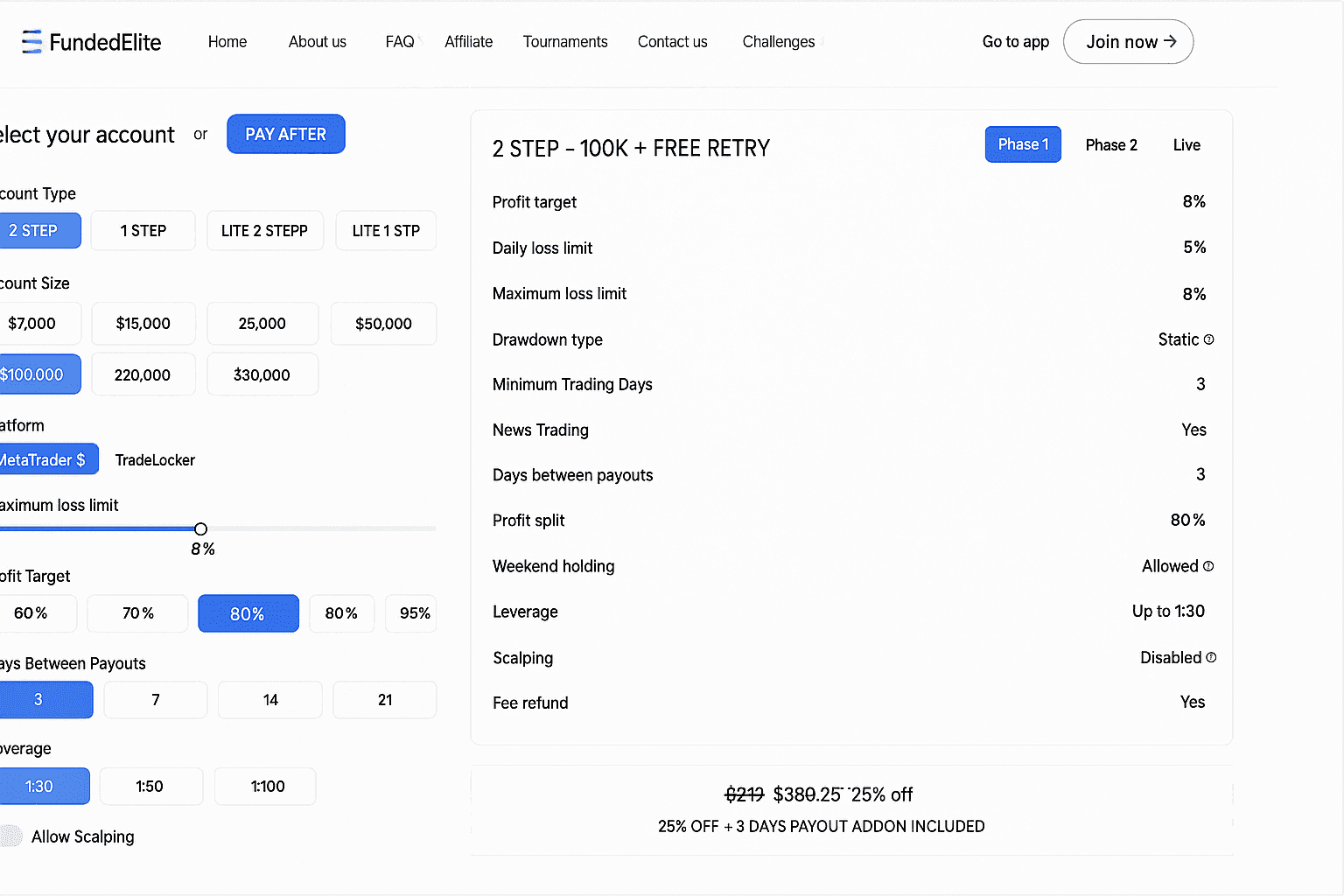
Funding Capacity
Accounts can be funded up to $300,000 at entry, with broader scaling potential highlighted elsewhere by the firm.
Licensed Trading Platforms
Funded Elite operates on officially licensed MetaTrader 5 and TradeLocker and advertises spreads starting from 0.01, which helps reinforce platform credibility.
Key Benefits
| Benefit | Description |
|---|---|
| Second Chance retry | Automatic free retry if the first evaluation attempt fails. |
| Funding scale | Access starts lower but can scale as high as $400,000. |
| Flash Activation | Entry option starting at $5 for traders who want a low-friction start. |
| Profit split flexibility | Configurable split ranging from 60% to 95%. |
| Leverage control | Custom leverage settings from 1:30 to 1:100. |
| Payout timing | Adjustable payout frequency from 3 to 21 days. |
| Platform access | Officially licensed MetaTrader 5 and TradeLocker support. |
| Spreads | Advertised spreads starting from 0.01. |
| Support | 24/7 support through chat and Discord. |
| Reported pass rate | Average pass rate of 34% according to the firm. |
Everything You Need to Know About Funded Elite
Is Funded Elite Legit or Just Another Short-Lived Operation?
This is usually the first real question, and rightly so. Anyone looking into a prop firm eventually wants to know whether the business is legitimate or just another fee-driven brand that may disappear. Funded Elite launched in 2023 in the United Kingdom, so it does not yet have the long operating history of older firms.
That said, several signals lean in the right direction. The company holds a strong Trustpilot score of 4.8, and reviewers frequently mention successful withdrawals, helpful support, and program flexibility. I looked through several review patterns the same way I would inspect overlapping GIS layers: one isolated point tells you little, but repeated alignment across many data points is more useful. In this case, the feedback trend appears broadly consistent.
Another positive sign is platform licensing. The use of officially licensed MetaTrader 5 and TradeLocker matters because unlicensed infrastructure has been a recurring warning sign elsewhere in the market. When a firm invests in legitimate software access instead of questionable shortcuts, that usually suggests a more serious operating model.
None of this proves the company will still look the same five years from now. No honest review can promise that about any prop firm. But based on the evidence available in 2026, Funded Elite appears to be a real operating business with functioning support, working payout systems, and infrastructure that looks more credible than many low-effort entrants.
How the Challenge Works in Practice
One of the more unusual aspects of Funded Elite is how much room it gives the trader. A lot of firms impose a rigid two-step evaluation with tightly fixed targets, minimum trading days, and countdown-style deadlines. Funded Elite moves away from that model.
Its evaluation is presented as a single-step process, and the time limit is effectively open-ended. That changes the psychology quite a bit. A trader is not forced to chase setups just because the clock is running down. In my own testing of the site structure, this was one of the clearest themes across the product pages: less pressure from artificial deadlines and more focus on meeting the account terms.
There is also no required minimum number of trading days. For traders who only engage when conditions line up well, that can be a meaningful advantage. The foreign exchange market, index products, and cryptocurrency markets do not always offer quality setups on a neat schedule, and a good evaluation should account for that reality.
The most notable feature remains the automatic free retry. If the first attempt fails, the system gives another try without an added fee. For anyone who has ever had a strategy derailed by a volatile news candle or a simple lapse in discipline, that kind of cushion has real value.
Funded Elite also offers Flash Activation, which allows a trader to begin for $5. That low-friction entry point makes it easier to explore the environment before committing to a larger evaluation purchase.
Drawdown Rules and Risk Parameters
This is one area where traders need to read carefully. Funded Elite does not present its drawdown framework in the same standardized format used by many competitors. Instead of one simple public label, the risk limits can vary depending on the account configuration selected.
That has both benefits and drawbacks. The upside is obvious: traders are not forced into identical parameters regardless of style. A high-frequency intraday approach and a slower swing method involve very different forms of risk management, and treating them as if they were the same has always been one of the weaker habits in this industry.
The downside is that the rules may take a few extra minutes to understand. When I checked the setup flow, it felt a bit like reviewing noisy GPS traces before filtering them. The information is there, but you need to slow down and make sure the signals line up. Traders who are used to a simple fixed drawdown label should review each account option closely before buying.
The safest approach is to read the configuration details in full and ask support to clarify anything unclear. Because the firm allows customization, one trader’s account conditions may not match another’s, even if the headline account size looks similar.
Profit Split Range: Competitive in Some Cases, Excellent in Others
Funded Elite lets traders set a profit split from 60% to 95%. At the lower end, that is not especially aggressive compared with firms that begin closer to 70% or 80%. If immediate take-home percentage is the only filter, some traders may view the entry tier as less appealing.
Where the model becomes more interesting is at the upper end. A 95% split is unusually strong by prop firm standards. Very few firms make that level available, and for a consistently profitable trader, the difference between a standard split and a top-tier one can materially affect how much money is retained over time.
The catch is that this higher split is tied to the broader account setup. Leverage, payout frequency, and related settings all interact. In effect, the firm lets the trader choose a route through the system. I tend to think of it like map routing: the destination may be the same, but the path changes depending on the constraints you accept. Traders who prefer lower leverage and less frequent payouts may be able to unlock stronger split terms.
That structure rewards patience and disciplined risk management, though it does mean traders should not judge the program only by the starting percentage.
What It Costs to Begin
Evaluation pricing starts at $89 for a $7,000 account and rises to $1,299 for a $300,000 account.
| Account Size | Evaluation Fee |
|---|---|
| $7,000 | $89 |
| $15,000 | $129 |
| $25,000 | $199 |
| $50,000 | $299 |
| $100,000 | $499 |
| $200,000 | $899 |
| $300,000 | $1,299 |
Those prices are generally in line with the broader market. They are not bargain-basement offers, but they are also not outliers on the expensive side.
The free retry changes the value calculation. Since a failed first attempt automatically leads to another chance, the effective cost per opportunity is lower than it first appears. That makes the pricing more competitive when compared with firms that charge once for a single shot and offer nothing if the first evaluation is lost.
The $5 Flash Activation option is also worth noting because it lowers the barrier to entry. For traders who want to inspect the workflow, test the interface, and understand the environment before spending more, that feature adds practical value.
Does the Firm Pay Traders, and Are Payouts Fast?
Payout speed is one of the clearest legitimacy signals in proprietary trading. A firm can market almost anything, but consistent withdrawals are where the model either holds together or starts to unravel.
This is the dividing line between a serious prop firm and a fee collection machine. Based on available evidence, Funded Elite does appear to pay traders. User reviews repeatedly mention completed withdrawals, and the company states that payout processing can happen within 24 hours.
That speed matters. In this industry, slow withdrawals can do more damage to confidence than almost anything else. A firm that handles payouts quickly usually has better internal operations and fewer bottlenecks. From what I’ve seen, the fast-payout claim is one of Funded Elite’s stronger selling points.
By default, payouts are bi-weekly, but traders can configure them from every 3 days up to every 21 days. There is a trade-off here. Faster access to money may influence other account settings, including the profit split. So yes, Funded Elite does offer fast payouts, but the exact setup depends on the package the trader chooses.
That flexibility is useful, especially for traders who want to balance cash-flow timing against overall account terms.
Bots, EAs, and Automated Trading
Anyone planning to use automation should verify the rules directly with support before purchasing. MetaTrader 5 supports Expert Advisors natively, and TradeLocker also has automation capabilities, so the platform side is capable enough. The real question is what the firm allows under its own policy.
That distinction matters because some prop firms allow standard EAs but prohibit specific forms of copy trading, latency-sensitive execution, or other strategies they view as abusive. The infrastructure may support the tool while the rulebook limits its use.
Given Funded Elite’s emphasis on flexibility, there is reason to think reasonable automated approaches may be acceptable. Still, this is not an area for assumptions. If algorithmic execution is central to your process, get written clarification before moving forward.
News Events, Overnight Trades, and Weekend Exposure
Rules around news trading differ widely from one firm to another. Some firms block positions around major releases, while others are much more permissive. Funded Elite’s broader model suggests flexibility, but traders should confirm the specific conditions tied to their chosen setup.
The same applies to holding trades overnight or through the weekend. The open-ended evaluation window and general freedom in the program imply that swing trading should be workable. If the firm imposed a universal end-of-day closeout rule, that would conflict with the rest of the product design.
Even so, account-specific restrictions may still apply. Weekend gap risk is a familiar concern in the foreign exchange market, indices, and cryptocurrency, and firms often manage that exposure differently depending on account type. Before carrying positions across sessions, confirm the exact limits attached to your configuration.
Can You Trade Other Prop Firms at the Same Time?
There is nothing inherently wrong with working across more than one prop firm. Many experienced traders do exactly that to diversify operational exposure and increase access to capital.
Funded Elite does not present itself as an exclusive arrangement. Its focus appears to be whether the trader follows the rules on its own account rather than what happens elsewhere.
The real challenge is operational discipline. Managing multiple rule sets at once can get messy. One account may allow a behavior that another forbids, and that sort of mismatch causes avoidable failures. I’ve seen this kind of confusion before in technical systems work, where two map layers use different coordinate systems and look aligned until you zoom in. Prop accounts can be similar: small rule differences matter more than they first appear.
What Happens if a Rule Is Broken?
If a trader violates the evaluation terms, the account is generally closed. That is standard in proprietary trading. These firms are managing risk, not offering unlimited discretion.
The important distinction here is the Second Chance mechanism. If the first attempt ends in failure, the trader receives another try automatically. That does not remove the need for disciplined risk management, but it does soften the cost of one mistake or one bad stretch.
If the retry fails as well, a new evaluation purchase is required. The firm reports an average pass rate of 34%, which is relatively solid by industry standards. That suggests the structure may be more achievable than many high-pressure alternatives, likely because traders are not being rushed by a short deadline.
Realistic Earning Potential
Earnings depend on account size, profit split, and actual execution quality. The infrastructure can create opportunity, but it does not replace edge, discipline, or sound risk management.
Funded Elite also states that capital can scale to $400,000, which expands the upside for traders who perform well over time. Combined with a high-end split, that can create meaningful income potential without requiring large personal capital at the start beyond the evaluation fee.
Still, it is important to stay realistic. Most traders will not produce strong, consistent results month after month. Drawdowns happen, and the foreign exchange market and cryptocurrency markets can change character quickly. A 34% pass rate also means most applicants do not make it through. The firm can provide access and structure, but the trader still has to bring the process, the consistency, and the risk control.
Is This the Best Prop Firm to Get Funded With?
There is no single best prop firm for every trader. The right choice depends on strategy, tolerance for rule complexity, preferred payout schedule, and how much customization you actually want. Some traders are better served by a very simple model with fixed limits. Others want something more adjustable.
Funded Elite is strongest for traders who value flexibility. The ability to adjust leverage, payout timing, and split structure makes it feel less like a one-size-fits-all challenge and more like a configurable operating environment. In that sense, it may be one of the better options for traders who dislike rigid evaluation templates.
To make that more concrete, it helps to compare it with a few well-known names. FTMO is usually stronger on long-term reputation and rule clarity, but its structure is less flexible and typically follows a more traditional multi-stage path. The5ers is often appealing for traders who want a reputation for steady payouts and a more established brand, yet its account design tends to be more predefined. Funding Pips is more aggressive on trader-friendly marketing and can be competitive on payout expectations, but it does not stand out in the same way on customization. From what I’ve seen, Funded Elite’s clearest edge is giving traders more control over leverage, split, and payout timing rather than forcing one standard configuration.
| Firm | Evaluation Process | Payout Speed | Account Customization | Reputation |
|---|---|---|---|---|
| Funded Elite | One-step model with open-ended timing | Advertised as fast, with processing that can happen within 24 hours | High: split, leverage, and payout timing can be adjusted | Newer firm with encouraging early feedback |
| FTMO | More structured and typically multi-stage | Generally viewed as reliable rather than unusually fast | Lower: rules are clearer but less customizable | Stronger long-term market reputation |
| The5ers | Structured model with a more predefined path | Known for dependable payouts | Moderate: less configurable than Funded Elite | More established operating history |
| Funding Pips | Competitive challenge-style evaluation | Often marketed around quick trader access and payouts | Moderate: competitive terms, but less tailoring of settings | Popular brand, though still judged heavily on execution consistency |
In my analysis, the comparison comes down to priorities. If you want the most established reputation, FTMO or The5ers may feel safer. If you want a more adjustable evaluation and account structure, Funded Elite is more distinctive. If a trader wants the simplest possible rules, the highest starting split, or the longest historical reputation in the industry, another firm might fit better. The best prop firm to get funded with is the one whose rules match your method closely enough that you do not have to distort your process to pass.
The Bottom Line
Funded Elite sits in an interesting part of the market. It is newer than many rivals and not the cheapest option available, but it offers a level of flexibility that is genuinely uncommon. Traders can set leverage from 1:30 to 1:100, adjust payouts from every 3 days to every 21 days, and choose a split ranging from 60% to 95%.
The free retry system lowers the sting of failure, the one-step evaluation removes some unnecessary friction, and the licensed platform stack adds credibility. Support availability and the active Discord presence also suggest the firm is trying to build an actual trading environment rather than just sell challenge fees.
For traders asking whether Funded Elite products are legitimate, the current evidence points to yes, with the usual caveat that the firm is still relatively young. For traders asking what the main benefits of Funded Elite are, the answer is clear: customization, a second-chance mechanism, fast payout options, and a more flexible evaluation model. In my view, that makes it a serious option for traders who want room to shape the account around their own method instead of forcing their method into a rigid template.


Everyone talks about passing prop challenges, but not enough people talk about becoming a better trader before buying another evaluation.
True. I think many traders focus too much on getting another account and not enough on improving their strategy. I was comparing different resources recently and found https://www.directionsmag.com/reviews/crypto-channels-telegram/elixir, but it's worth remembering that a trading community and a prop firm solve different problems.