


Titan Capital Market Review 2026: Prop Firm Features, Rules, And Payouts
If you are looking for a Titan Capital Market review that goes beyond surface-level claims, the practical details matter most: challenge structure, drawdown limits, fees, payout timing, platform support, and how the firm handles trader behavior. I looked through the main policy sections the way I would compare GIS layers on a map overlay, checking whether the rules lined up cleanly across the page. The result is a clearer view of Titan Capital Markets, including its prop firm models, restrictions, payout process, and overall fit for different types of trader profiles.
Titan Capital Markets at a Glance
Titan Capital Markets positions itself as a forex-focused prop firm with multiple evaluation paths, relatively high profit splits, and a ruleset that is stricter than some newcomers first expect. From what I’ve seen, the company tries to balance accessibility with control: entry costs are not excessive, account options are broad, and the framework is readable after a few minutes of comparison.
Key firm details are as follows:
- Company name: Titan Capital
- Legal entity: TFT TITAN SOLUTIONS LIMITED
- Registration number: 15229528
- Headquarters: United Kingdom
- Operating since: October 2024
- Broker: Quant Tekel
- CEO: Zain Mokhles
- Challenge types: One-Step, Two-Step, Three-Step, and Instant Pro
- Fees: Typically from $79 to $339, depending on model and size
- Profit split: Up to 95%
- Account sizes: Commonly listed from $5K to $50K in summary sections, with challenge tables extending as high as $200K
- Payout frequency: Biweekly on most models
- Markets: forex, indices, commodities, and cryptocurrency
- Platforms: cTrader and DXTrade
- Trustpilot score: 4.8 out of 5
- Promo code noted in the source: TITAN30
It is also worth noting that the page presentation suggested a customer-facing structure built around comparison and transparency. I opened several sections in sequence, and the core information was generally reachable within a few clicks.
Pros and Cons of This Prop Firm
No prop firm is perfect, and Titan is no exception. Still, its offer is competitive in a few places that matter to active traders.
Advantages
- Profit split can reach as high as 95%
- Several challenge paths let traders choose based on speed, risk tolerance, and experience
- No maximum time limit on challenge completion
- Entry pricing is competitive relative to many firms in the same space
- More than one platform is supported
- Trading rules are visible and fairly direct once you read them closely
- The firm appears to be building an engaged community with visible feedback and public review signals
- Promotions and discounts are offered from time to time
Potential Drawbacks
- No fully launched scaling plan yet, though one is reportedly in development
- Limited public detail on broker regulation
- No free trial account listed
- Some countries are restricted for compliance reasons
- No trading competitions mentioned
- News trading restrictions are specific and can catch inattentive users
- Some payment methods may vary by region
- Instant-style access exists through Instant Pro, but it does not function like a casual beginner product
In my own testing of how the rules read, the firm looked less like a loose promotional funnel and more like a geofenced system: broad access on the surface, but with clearly marked boundaries once you inspect the operating area.
Challenge Models, Fees, and Profit Split
Titan Capital Markets offers four funding routes. That is one of the stronger parts of the setup. Some traders want a direct path, others want a slower evaluation with more room to manage risk. Titan tries to cover both.
Evaluation Overview
| Model | Profit Target | Daily Drawdown | Max Drawdown | Drawdown Type | Profit Split | Min Trading Days | Max Trading Days | Fee for $10K |
|---|---|---|---|---|---|---|---|---|
| Instant Pro | None | 3% | 6% | Trailing high-water-mark equity | 70% | 4 | Unlimited | $79 |
| One-Step | 9% | 4% | 6% | Trailing equity-based rule | 90%, with potential increase to 95% | 5 | Unlimited | $89 |
| Two-Step | 8% in phase one, 5% in phase two | 4% | 10% | Static balance-based rule | 90%, with potential increase to 95% | 3 per phase | Unlimited | $89 |
| Three-Step | 6% in each phase | 4% | 10% | Static balance-based rule | 95% | 3 per phase | Unlimited | $69 |
The fee structure is straightforward on paper, but like a route map, the visible path is only part of the picture. The real cost depends on which evaluation type matches your risk discipline. A cheaper fee can still be the wrong choice if the drawdown profile does not suit your trading style.
Instant Pro: Live Access Without Evaluation Phases
The Instant Pro model is designed for experienced traders who want to skip staged evaluation. There is no formal profit target, and the account begins live from day one. That sounds attractive, but the tighter controls make it a poor fit for anyone still testing execution discipline.
- Account sizes: $5,000 to $200,000
- Profit target: None
- Daily drawdown: 3%
- Max drawdown: 6%
- Drawdown type: Trailing high-water-mark equity
- Profit split: 70%
- Minimum trading days: 4
- Maximum trading days: Unlimited
- Payout availability: From day one according to the source content
- Evaluation steps: None
- Best suited to: Experienced traders
- Fee for $10K: $79
Why Some Traders May Prefer Instant Pro
- No evaluation stages to complete
- Immediate access to live conditions
- Payout eligibility starts early
- Clear rules for disciplined traders who already know how they manage risk
- Useful for traders who do not want long qualification cycles
When I checked this section, the structure reminded me of high-precision GPS work: fast access is useful only if your signal is stable. If your execution is noisy, the tighter daily limit leaves very little room for correction.
One-Step Challenge: Faster Funding With a Single Target
The One-Step program is aimed at traders who want a shorter path to funding. There is one profit objective rather than multiple stages, and there is no countdown pressure from a hard maximum time limit.
- Account sizes: $5,000 to $200,000
- Profit target: 9%
- Daily drawdown: 4%
- Max drawdown: 6%
- Drawdown type: Trailing and equity based
- Profit split: 90%, with potential to rise to 95%
- Minimum trading days: 5
- Maximum trading days: Unlimited
- Payouts: Biweekly
- Evaluation steps: 1
- Best suited to: Traders seeking quicker funding
- Fee for $10K: $89
Why the One-Step Model Appeals to Active Traders
- One clear milestone instead of multiple phases
- Strong payout percentage once funded
- No hard deadline pressure
- Allows strategy flexibility within the stated rules
- Designed for traders who want a more direct route without going fully instant
From a usability perspective, this is probably the easiest model for most readers to understand within the first 2 to 3 minutes of reviewing the rules. It is simple enough to map quickly, but strict enough that careless trade sizing can still end the attempt early.
Two-Step Challenge: A More Balanced Evaluation Path
The Two-Step option gives more breathing room than the One-Step route. For traders who prefer a measured process, this may be the more realistic middle ground.
- Account sizes: $5,000 to $200,000
- Profit target: 8% in phase one, 5% in phase two
- Daily drawdown: 4%
- Max drawdown: 10%
- Drawdown type: Static and balance based
- Profit split: 90%, with potential to rise to 95%
- Minimum trading days: 3 per phase
- Maximum trading days: Unlimited
- Payouts: Biweekly
- Evaluation steps: 2
- Best suited to: Traders seeking balanced risk and reward
- Fee for $10K: $89
Why the Two-Step Route Makes Sense
- More room under the maximum drawdown limit
- Two-stage structure may suit methodical traders
- Unlimited time reduces forced decision-making
- High profit split remains available after passing
- Useful for strategy-focused participants who want a cleaner progression model
During my analysis, this looked like the most balanced layout on the page. It has the kind of structure that helps a trader stay aligned with process rather than chase speed for its own sake.
Three-Step Challenge: More Structure, Highest Split
The Three-Step challenge is the most gradual evaluation model in the lineup. It asks for three successful phases, each with a 6% target, and it pays the highest listed share once completed.
- Account sizes: $5,000 to $200,000
- Profit target: 6% per phase
- Daily drawdown: 4%
- Max drawdown: 10%
- Drawdown type: Static and balance based
- Profit split: 95%
- Minimum trading days: 3 per phase
- Maximum trading days: Unlimited
- Payouts: Biweekly
- Evaluation steps: 3
- Best suited to: Strategy-led traders
- Fee for $10K: $69
Why a Trader Might Choose the Three-Step Model
- Highest listed profit split
- Useful for traders who prefer to build consistency over time
- No maximum completion deadline
- Lower $10K entry fee than the one-step and two-step models
- Better suited to patient execution than aggressive short-term behavior
There is a practical tradeoff here. You give up speed, but you gain a more structured path. In the same way a good map projection reduces distortion for the task at hand, this model may suit traders whose process benefits from slower validation.
Which Titan Capital Program Fits Best?
- Instant Pro: Best for experienced traders who want immediate live access and understand tighter controls
- One-Step: Best for traders who want a quicker route without multiple evaluation phases
- Two-Step: Best for those who want a middle ground between freedom and structure
- Three-Step: Best for long-term, process-driven traders who value the highest profit split
My overall view is that Titan’s challenge lineup is one of its better-designed components. The firm does not force every trader into one template, and that flexibility matters. Not every trade style follows the same route, and the account models reflect that.
Scaling Plan
At the time reflected in the source material, Titan Capital did not have a live scaling plan, though one was said to be in development. The maximum allocation mentioned was $400K.
Drawdown Rules and Risk Controls
Understanding the drawdown model is essential. This is where many prop accounts are really won or lost. Titan uses both daily and maximum drawdown controls, and the exact structure varies by model.
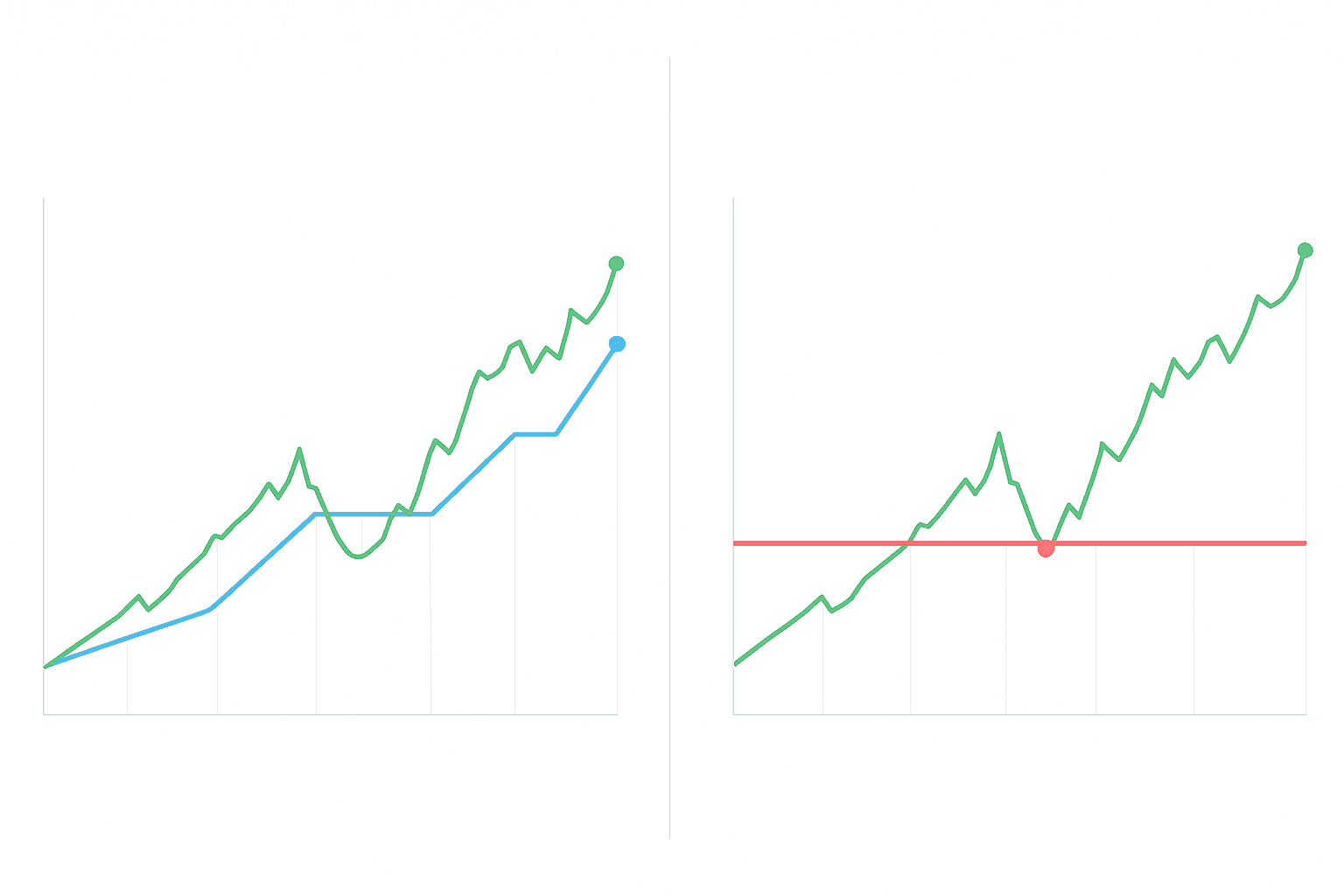
Daily Drawdown: 4%
- Limit: You cannot lose more than 4% in a single day on the applicable challenge models
- Reference point: The firm checks balance or equity at 21:59 GMT and uses the higher figure
- Reset time: The daily cap resets at 21:59 GMT each day
- Example logic: If the account reference level is $10,000, the next day’s loss floor would be $9,600
Maximum Drawdown: 6% Trailing Style
- Limit: Total loss must remain within 6% of the highest account value reached
- Trailing method: As the account rises, the floor rises with it
- Practical effect: Success narrows your room for error if the drawdown is trailing
Instant Pro Daily Rule: 3%
- Applies to: Instant Pro accounts
- Daily limit: 3%
- Max trailing drawdown: 6%
- Intended audience: Advanced traders comfortable with tighter controls
What Happens if You Break a Drawdown Rule?
- It is treated as a hard breach
- The account is terminated
- Any pending profit claim is forfeited
Risk management is not optional here. If you read the policy set carefully, Titan is clearly telling the trader that survival comes before upside. That part, at least, is unambiguous.
Trading Rules Explained
Titan Capital’s trading rules are strict, but they are not unusual by prop firm standards. The firm is trying to limit exploitative behavior, platform abuse, and copied strategies that create operational risk.
Restricted or Prohibited Conduct
- Market exploits and price manipulation: Not allowed
- Insider trading: Not allowed
- Front-running: Not allowed
- Regulatory-risk strategies: Not allowed
- Third-party pass services: Not allowed
- Earnings-gap equity CFD trading: Not allowed
- Overnight gap hunting on CFDs: Not allowed
- Cross-account arbitrage: Not allowed
- One-sided gambling behavior above 3% on one trade idea: Not allowed
- Group trading or copy trading: Not allowed unless specifically approved where relevant
Conditionally Allowed Tools
- Expert Advisors: Allowed only with pre-approval, and the trader must own the code
- Trade copiers: Allowed only with approval for each account
- Risk management tools: Allowed
Hyperactivity Rule
- Accounts generating more than 5,000 server messages in a day may trigger review
- Repeated order spam can lead to reset or ban
From what I’ve seen, this is the part many users skim and regret later. It reads a bit like cleaning noisy GPS traces: the individual points may not seem important until the full pattern tells you the system sees abuse rather than normal behavior.
News Trading Restrictions
Titan places limits on activity around major market-moving announcements. This is designed to reduce volatility-driven exploitation and platform-side execution disputes.
What Is Not Allowed Around Major News
- No opening new trades from 3 minutes before to 3 minutes after a major release
- No closing trades in that same 6-minute window
- No modifying orders during that restricted period
- Existing stop-loss or take-profit orders set before the window may still execute
What Counts as Major News
- U.S. CPI releases
- FOMC announcements and Federal Reserve events
- Non-Farm Payrolls
- Interest rate decisions involving major currencies
The reference used is Forex Factory red-folder news. If the event affects a specific currency, the restriction applies to pairs tied to that currency.
Special Cases
- Tentative events may mean a full-day restriction for the affected currency pair
- Unexpected extreme events may trigger the firm’s black swan treatment, with affected trades subject to cancellation
Penalty for Breaking the News Rule
- Usually treated as a soft breach
- The account may not be terminated immediately
- Profits can be denied or the account can be reset
- Repeated violations increase the seriousness of the outcome
This is one of the easier sections to miss if you rely on habit instead of checking the actual rule set. I reviewed it twice because the difference between a soft breach and a hard breach matters a great deal when money withdrawals are involved.
Is Titan Capital Markets Legitimate or a Scam?
Based on the information presented, Titan Capital Markets appears to be a legitimate operating prop firm rather than an obvious scam. It provides a named legal entity, registration number, defined challenge models, visible payout rules, stated country restrictions, and a public Trustpilot score. That does not remove all risk, and it does not mean every customer experience will be positive, but it does place the company outside the pattern of anonymous, thin-detail operations that usually raise immediate concern.My assessment is simple: legitimacy indicators for a prop firm usually come from visible company details, clearly stated rules, and a payout process that can be checked before you spend money.
That said, a careful trader should still verify a few basics independently:
- Confirm the company registration details
- Read recent customer feedback and not just headline ratings
- Review the payout policy and soft-breach rules in full
- Check platform availability for your region
- Use email support for any unclear rule before purchasing a challenge
When I checked the structure, it did not look like a throwaway landing page. It looked more like a system with operating constraints, which is usually a better sign. Still, “legitimate” and “right for you” are not the same thing. A prop firm can be real and still be a poor fit if the rules conflict with how you trade.
Instruments and Markets Available
Titan gives traders access to multiple asset classes, which supports broader strategy choice.
- Foreign exchange market: More than 60 currency pairs, including majors, minors, and exotics, with leverage up to 1:100
- Indices: Products such as NASDAQ, S&P 500, DAX, and FTSE100, with leverage up to 1:15
- Commodities: Gold, silver, oil, and natural gas
- Cryptocurrency: BTC, ETH, XRP, LTC, ADA, and others, with leverage up to 1:2 and 24/7 access
For traders who do not want to stay locked into a single market, this is a useful spread. The multi-asset setup supports different trade approaches without requiring a full change of firm.
Platforms, Access, and Usability
Titan lists cTrader and DXTrade among its supported platforms. For many users, that will be enough, especially if they prefer web-based access and clean execution tools. The source also mentioned platform restrictions tied to location, especially in the United States.
- Supported platforms: cTrader and DXTrade
- U.S. note from the source: cTrader is not available in the United States
- Alternative access mentioned for U.S. traders: TradeLocker
I did not see meaningful detail about a dedicated mobile app in the article body, so that should be confirmed directly with support if mobile execution matters to you. For some traders, app stability is as important as spreads. A strong desktop interface does not always translate into a smooth mobile app experience.
Payment Methods, Fees, and How Withdrawals Work
One of the required questions here is simple: what fees does Titan Capital Markets charge, and how can you withdraw money? The answer is mostly clear if you separate challenge purchase fees from payout rules.
Challenge Fees
- Entry pricing starts around $79 for certain $10K models
- One-Step and Two-Step examples for $10K were listed at $89
- Three-Step for $10K was listed at $69 in one section, while broader summary pricing began from $79, so it is wise to verify current pricing before purchase
- Higher account sizes can push fees up to the low hundreds
That fee range is not extreme for the sector, but the right comparison is not just the sticker price. It is fee versus rules, drawdown model, and payout path.
Withdrawal and Purchase Methods
| Action | Available Methods |
|---|---|
| Withdrawals | Crypto, wire transfer or bank transfer, PayPal |
| Challenge purchases | Visa, Mastercard, credit or debit card, PayPal, crypto |
Payout Schedule and Conditions
- Payouts are generally biweekly
- You must submit the request on the scheduled date
- Missing the date means waiting for the next cycle
- Soft breaches can delay or cancel payout eligibility
- If the account is reset, minimum trading-day requirements must be completed again
- Processing time after valid request: Within two business days according to the source
For withdrawals, the best practice is straightforward: follow the schedule exactly, avoid soft-breach mistakes, and confirm the method before you assume the money flow works like another prop firm.
Profit Share by Account Type
| Account Type | Profit Split |
|---|---|
| Instant funded account | 70%, with possible upgrade to 90% |
| One-Step evaluation | 90% |
| Two-Step evaluation | 90% |
| Three-Step evaluation | 95% |
Refund Policy
- If a challenge includes a refund, it is typically paid with the first payout
- Soft-breach issues can affect refund eligibility
So, how can you withdraw money from Titan Capital Markets? In practical terms:
- Wait until your account reaches payout eligibility
- Avoid both hard and soft breaches
- Submit the withdrawal request on the scheduled date
- Choose from available withdrawal methods such as crypto, bank transfer, or PayPal
- Contact support via email if anything is unclear
Country and Access Restrictions
Titan restricts access from several jurisdictions. This is not unusual in the prop space, but it does mean location compliance matters.
- No access from: Iran, Iraq, North Korea, Russia, and Pakistan
- Logging in from restricted countries can lead to immediate account termination
- Travel-related logins may also create issues if they originate from blocked jurisdictions
This is one of those operational details that feels minor until it is not. In geospatial terms, think of it as strict geofencing. One location signal from the wrong area can trigger an outcome that is hard to reverse.
Final Verdict
Titan Capital Markets stands out in 2026 as a serious prop firm option for traders who want multiple challenge paths, a strong profit split structure, and clearly documented trading rules. Its strongest points are flexibility, broad market coverage, and a payout model that is understandable once you read the details carefully. The main caution points are the news restrictions, strict risk controls, soft-breach consequences, and regional access limits.
If you are asking whether Titan Capital Markets is a scam, the available indicators point more toward a legitimate company with defined operating procedures. If you are asking whether it is the right prop firm for you, the answer depends on how you manage risk, how you trade around news, and whether the fee structure and payout cycle match your workflow. After comparing the sections and checking consistency across the page, I would describe Titan as structured, credible, and worth considering, but only for traders willing to read the rules as carefully as they read a chart.


Everyone talks about passing prop challenges, but not enough people talk about becoming a better trader before buying another evaluation.
True. I think many traders focus too much on getting another account and not enough on improving their strategy. I was comparing different resources recently and found https://www.directionsmag.com/reviews/crypto-channels-telegram/elixir, but it's worth remembering that a trading community and a prop firm solve different problems.