
Beyond Gravity Supplies Core Hardware For Esa’s Celeste Mission


Beyond Gravity has delivered major payload hardware for the European Space Agency’s Celeste program, a project designed to make existing satellite navigation services more accurate, responsive, and resilient. The first demonstration spacecraft went into orbit on March 28, and the company is using that work to broaden its role in the payload segment.
The European Space Agency is moving ahead with an in-orbit demonstration built around 11 satellites plus one spare to evaluate the value of adding a positioning, navigation, and timing layer in Low Earth orbit. The first two satellites were launched on March 28, opening the flight phase of that effort. In practical terms, this extra architecture is meant to strengthen Europe’s satellite navigation capability with better resilience, improved accuracy, and added protection when radio jamming or spoofing distorts the signal. Celeste is intended to work alongside Galileo, rather than replace it, by giving the wider satellite constellation another operating layer closer to Earth.
The first two spacecraft in the Celeste demonstration were launched on March 28, marking the opening phase of the mission.
According to Oliver Grassmann, chief operating officer at Beyond Gravity, the company is providing essential electronics for the Celeste payload. He said expanding payload work remains a central priority as the firm continues supplying high-performance technology for missions involving radio occultation, reflectometry, electronic signal intelligence, and positioning, navigation, and timing.
Kurt Kober, vice president of Electronic Solutions at Beyond Gravity, said the company’s contribution includes advanced digital signal generation systems and the clock used by the satellite instruments. Those elements support reliable navigation signal production along with the time stability and accuracy and precision required for this kind of infrastructure.From what I’ve seen in satellite navigation programs, the clock is one of those quiet components that rarely gets public attention, but it often determines whether the whole measurement chain holds together.
From what I’ve seen in satellite navigation programs, the clock is one of those quiet components that rarely gets public attention, but it often determines whether the whole measurement chain holds together.
Beyond the payload electronics, the company also supplied highly sensitive antenna systems. ESA selected Beyond Gravity as a key payload partner for Celeste together with GMV in Spain, serving as prime contractor, and OHB in Germany. Anywaves is also part of the Celeste supply chain, contributing antenna hardware under contract for the mission’s payload segment. In practical terms, its role is tied to the radio front end: antennas designed to support the transmission and reception environment that the demonstrator needs for positioning, navigation, and timing work in Low Earth orbit.
How Celeste Adds Protection to Galileo
The new spacecraft are meant to show how a Low Earth orbit layer at roughly 500 kilometers altitude can reinforce Galileo, whose larger satellites operate in Medium Earth orbit at about 23,000 kilometers. That difference in orbit matters. Signals from a lower-altitude satellite can offer another path for navigation, timing, and positioning when interference affects part of the system. In the same way I would compare map overlays in GIS, the extra layer is not there to replace the base layer; it is there to improve coverage, confidence, and autonomy when conditions get noisy.
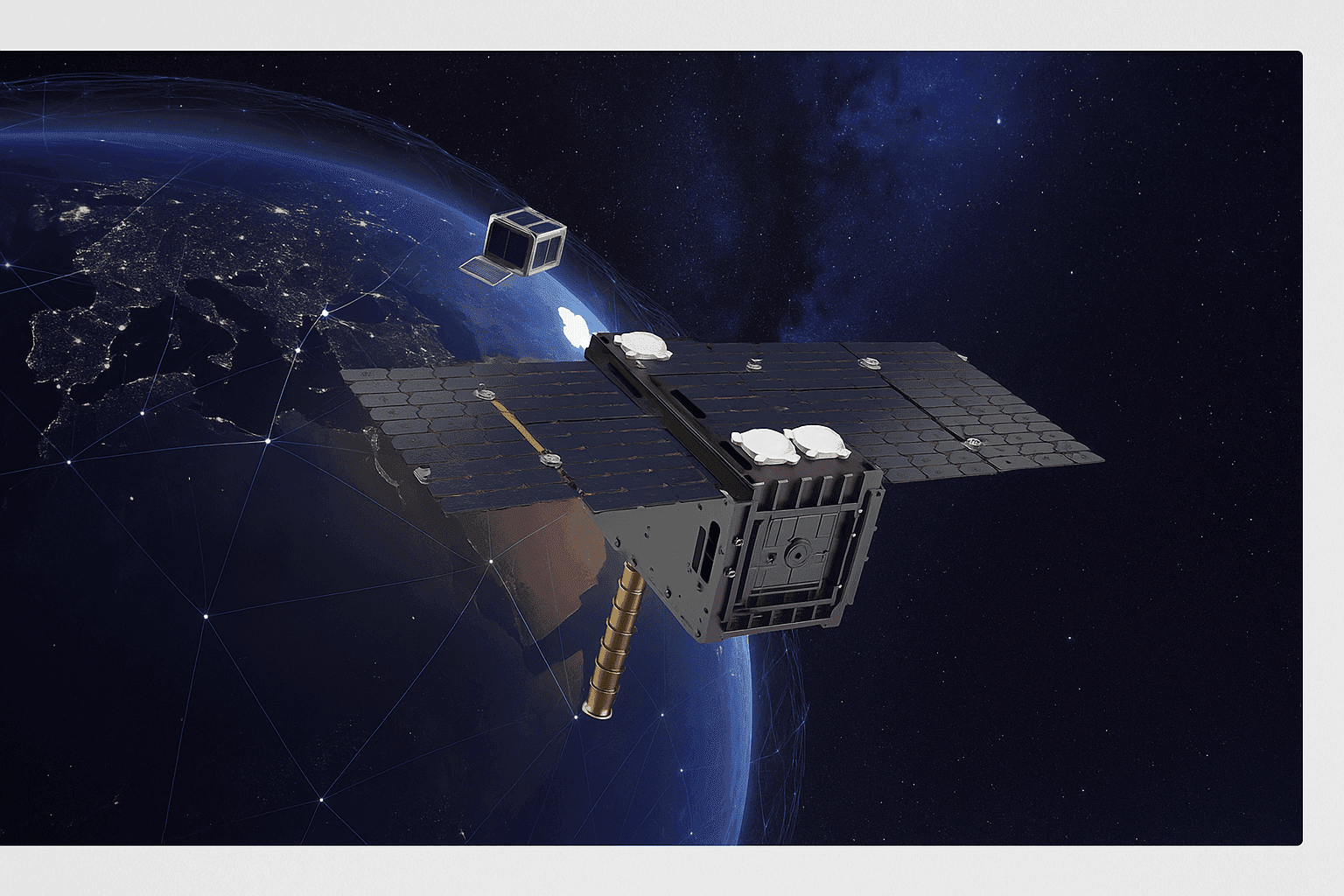
This program is known as Celeste, the European Space Agency’s first Low Earth orbit PNT initiative. It is a demonstration of how space-based navigation architecture in Europe can evolve beyond a single-layer model and become harder to disrupt, particularly for critical infrastructure and future user devices such as smartphones or connected 5G systems that depend on stable timing. For end users, the goal is not just another signal in space. It is a more dependable service layer that can help maintain positioning and timing performance when the radio environment becomes less trustworthy.
The in-orbit demonstrator phase is being carried out by two European consortium teams in parallel and will include 11 satellites plus one spare. GMV, one of the prime contractors, is responsible for the complete end-to-end mission for six of the demonstrator spacecraft, covering system definition, design, the space and ground segments, the user segment, and operations. The main objective of this phase is to prove that a lower-orbit PNT layer can integrate with existing European navigation infrastructure, improve service robustness, and generate enough technical evidence for decisions on a larger operational rollout later on. That is a wide brief, and when I checked the structure of the mission, it read much like a complex routing model: each node, segment, and interface has to line up or the full network loses efficiency.
Why the Payload Matters So Much
In any satellite, the payload is the part that performs the mission’s real work. For Celeste, that means generating and transmitting navigation signals across the required radio frequency bands with the needed stability, frequency control, and phase performance. Kober noted that Beyond Gravity has already delivered other satellite instruments, including radio occultation systems for weather applications and a reflectometry payload. The company also previously supplied payload elements related to signal generation for Galileo, and that experience has been carried directly into Celeste.
That matters because payload development is not just about assembling electronics. It is about making sure the spacecraft can create a clean signal, maintain time reference, and support reliable navigation under difficult operating conditions. In my own analysis, this is where experienced payload suppliers stand out. The platform can look solid on paper, but if the signal chain is unstable, the rest of the spacecraft is just structure around a weak core. For Celeste specifically, the payload story also includes modularity, signal reliability, time stability, and the ability to work alongside existing systems rather than in isolation.
Kober also described payloads as a strategic business area for the company’s future growth. The goal, in his words, is for Beyond Gravity to play a larger role in this core part of satellite design.
A Modular Platform for Different Mission Types
Beyond Gravity says its FoX electronics platform gives customers a modular way to host different payloads on the same underlying system. That flexibility opens the door to several mission profiles, including electronic signal intelligence payloads used to detect and characterize radar emissions, as well as PNT payloads for navigation and timing services.
| Payload Type | Function | Application |
|---|---|---|
| Electronic signal intelligence | Detects and characterizes radar emissions | Signal monitoring and intelligence missions |
| PNT payloads | Generates and supports navigation and timing services | Positioning, navigation, and timing missions |
| Radio occultation instruments | Measures atmospheric effects on radio signals | Weather and atmospheric observation |
| Reflectometry systems | Uses reflected signals for surface analysis | Environmental and Earth observation work |
| Optical payload | Captures high-resolution Earth imagery | Earth observation imaging |
The FoX electronics platform can also be integrated with Beyond Gravity’s multipurpose satellite platform. That spacecraft platform has already passed its Preliminary Design Review and is now in an intensive testing period. For operators and government customers across Europe, that modular approach could make it easier to match payload, spacecraft, and mission requirements without redesigning the whole architecture every time.
- France
- Germany
- Italy
- Spain
While Celeste is separate from systems such as the European Geostationary Navigation Overlay Service, it fits into the broader effort to strengthen navigation infrastructure across Europe. The mission also sits within a wider market where companies such as Thales Alenia Space and other industrial partners are helping shape the future of space technology. Over time, additional layers in orbit could support more resilient services for users on Earth, whether the application is transportation, timing for 5G networks, or protection of critical infrastructure from degraded signal conditions.
What Comes After the Demonstration
The longer-term roadmap for Celeste points toward a decision on whether the demonstrator should lead to a larger operational constellation. If the in-orbit results confirm the expected gains, the next step would likely be an expanded service layer built on the lessons from the first 11 satellites and the spare unit, with a focus on stronger resilience, broader coverage, and tighter integration with Galileo. In other words, the demonstration is not just a technology test. It is meant to show whether Europe should move toward a more permanent multilayer navigation architecture.
The program also appears to leave room for experimentation. As with many demonstration missions, the practical opportunities are most likely to come through institutional partners, research organizations, industrial teams, and user-segment testing activities tied to ESA and the mission contractors. That suggests organizations interested in experimenting with Celeste would most likely participate through pilot projects, technical trials, or consortium-based testing rather than open public access.
And although this mission is focused on Europe, its technical direction will likely be watched well beyond the region, including in places such as New Zealand, where dependence on accurate satellite navigation and timing is also growing. The broader takeaway is straightforward: a stronger navigation system is no longer just about one satellite constellation in one orbit. It is about layering spacecraft, signals, antennas, clocks, and operations so the whole network keeps working when conditions become less than ideal.


