
Elistair Supports Orion 2026 With Khronos Dronebox


No audio is available for this content.
Elistair took part in Orion 2026, the largest French military exercise in decades, bringing its Khronos automated tethered DroneBox into the field for ISR and tactical communication work. The core takeaway is fairly clear: the company used a tethered unmanned aerial vehicle system to provide persistent surveillance during a demanding military scenario.
National Exercise Scope
From February through April, ORION 2026 involved as many as 12,500 service members across France in a high-intensity setting that stretched across multiple operational environments. More than 1,200 drones were used during the exercise, which gives some sense of the scale and the weight now placed on airborne data and situation awareness.
Elistair was active during Phase O4 from April 7 to 30 after an earlier contribution in Phase O2 in February. That earlier phase was meant to show France’s ability to operate fully inside a NATO command framework during a collective defense scenario. In the week of April 27, troops carried out offensive follow-on actions and live-fire drills.
How Khronos Fits the Mission
In contested areas, forces need reliable intelligence and a stable overhead view even when satellite navigation is unavailable. Khronos is built to keep surveillance in the air from a fixed point or a moving platform without relying on GNSS or the short flight window that limits battery-powered free-flying systems. Its core strengths are fairly straightforward:
- automated launch from a transportable box, with setup in less than 2 minutes
- a secure tether that supports continuous power and protected data flow
I read that setup a bit like a GPS-denied mapping job where the tool has to hold position through its own reference method rather than waiting for a clean outside signal. According to our research, Elistair manufactures Khronos and operates from France and North Carolina.
The system launches from a transportable DroneBox in less than two minutes. It can maintain day and night camera coverage for as long as 24 hours under mission conditions that support continuous tethered operation, which makes it useful as a compact watchtower for tactical teams. In ISR work, that endurance matters because operators can keep the same viewing angle and sensor feed instead of rebuilding situational awareness after each landing.
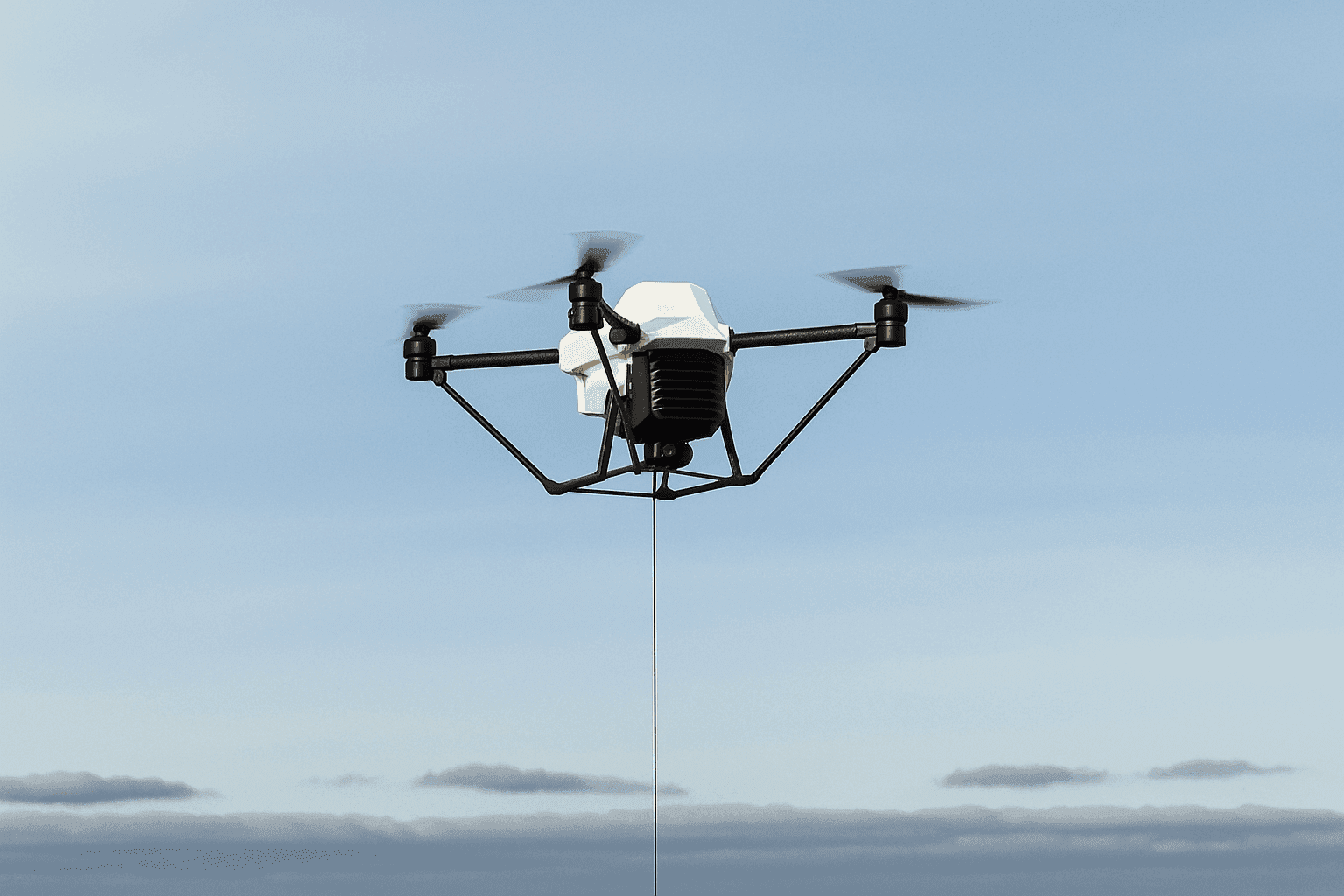
Payload support is described in broad operational terms rather than as a public catalog. In practice, a system like this is built around electro-optical and infrared camera payloads for surveillance, while exact payload weight limits are not stated here.
Operation in Denied Environments
The tethered aircraft is designed to keep flying in GPS- and RF-denied conditions by using a secure tether and an advanced positioning system. In practical terms, the tether handles power supply and data communication, while the onboard software supports stable flight and communication in difficult conditions. From what I have seen with field systems, setup time under two minutes is meaningful because crews rarely get a long quiet window during emergency or military deployments.Tethered systems like Khronos are most useful when teams need a steady overhead picture for hours at a time and cannot risk losing the feed to a short battery cycle.
Tethered systems like Khronos are most useful when teams need a steady overhead picture for hours at a time and cannot risk losing the feed to a short battery cycle.
Elistair serves armed forces and public safety users in more than 70 countries. Typical uses for a tethered UAV in that setting include border surveillance and disaster response.
| Sector | Example Application |
|---|---|
| Armed forces | persistent ISR support in field operations |
| Public safety | event monitoring or emergency overwatch |
Questions about licensing and legality depend on where the system is flown. In the US, tethered and autonomous drones still fall under FAA rules, so operators may need a Remote Pilot Certificate for many non-recreational flights, and autonomous functions remain subject to airspace and safety limits. Pricing is also not given here. Tethered drone systems are usually quoted case by case, and a specific public price for the Khronos DroneBox is not provided in this material.


