
Microchip Introduces Plug-in Timing Modules For Server And 5G Networks


Audio is not available for this piece.
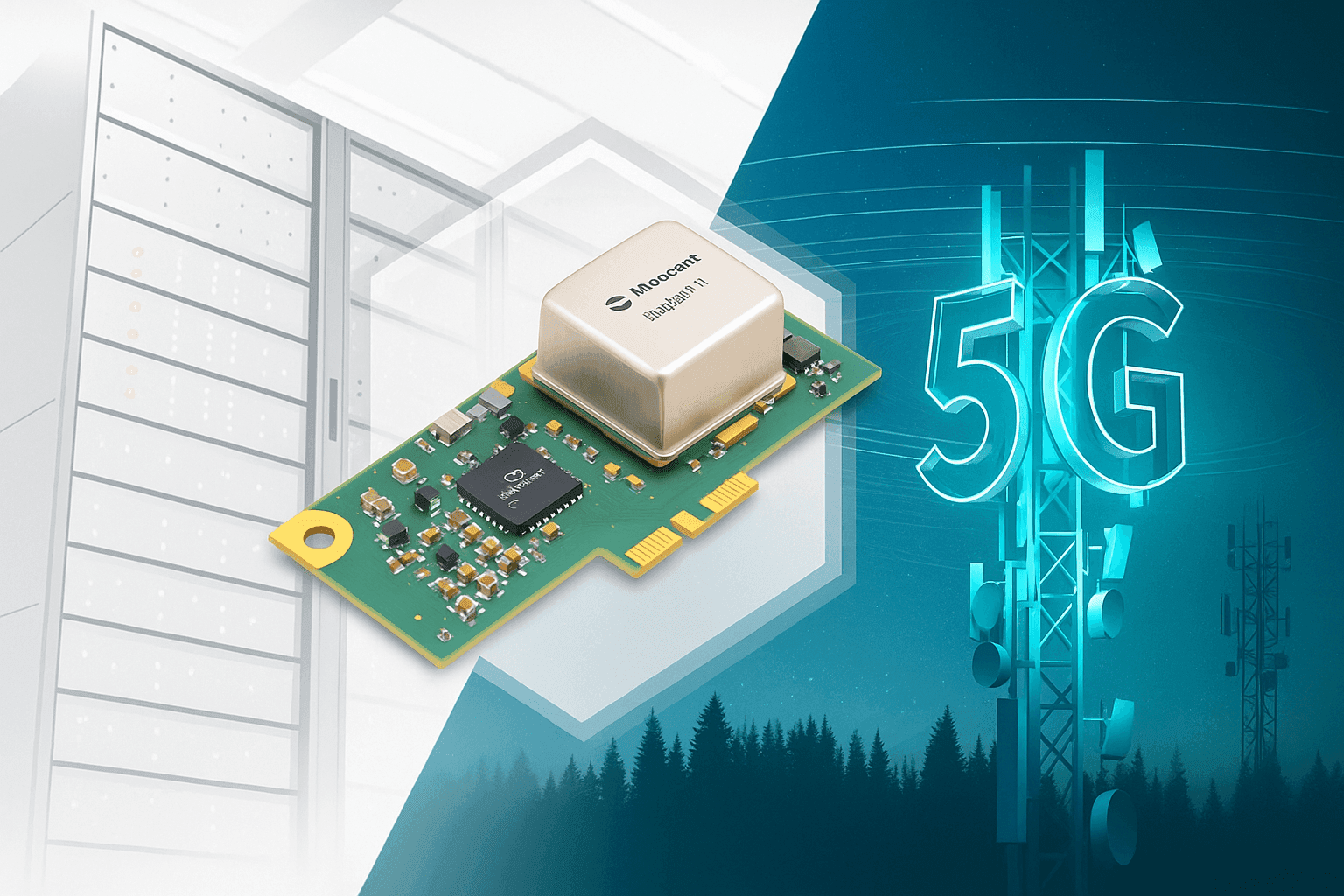
Microchip Technology has rolled out the MD-990-0011-B family of plug-in timing modules, aimed at delivering precise, ready-to-deploy synchronization for data center servers and 5G virtualized radio access network deployments. In practical terms, the MD-990-0011-B is a server timing module that provides a stable clock reference, helps systems lock to external timing sources, and supports the synchronization functions needed for real-time computing and distributed data workloads.
Built With Intel Server Platforms in Mind
Created alongside Intel, the MD-990-0011-B module is tailored to work cleanly with server platforms based on Intel Xeon 6 SoC devices. That gives original equipment manufacturer and ODM teams a more direct path when they design systems for cloud computing, virtualization, and modern access network infrastructure. From what I’ve seen, tightly aligned components like this often save far more integration time than the spec sheet alone suggests, especially when firmware, board design, and communication protocol support all have to line up.
Using Intel’s base vRAN architecture, the module helps maintain dependable synchronization with the low latency needed for artificial intelligence processing and other real-time applications. I tend to think about timing paths the same way I compare GIS layers: one clean reference source is useful, but the real value comes from how well every layer stays aligned under load.
Designed for Resilience Across Multiple Time Sources
Microchip engineered the module for the kind of reliability engineering, scalability, and high availability expected in cloud and network environments. The MD-990-0011-B can automatically choose and lock to several timing inputs, including GNSS, Synchronous Ethernet, and Precision Time Protocol. Here, locking means the module aligns its internal clock to one of those external references and keeps that timing stable as conditions change. That combination supports continuity when network conditions shift, whether the source is satellite navigation, Ethernet-based transport timing, or packet-based synchronization across a computer network.
Typical applications include:
- Data center servers
- Cloud computing platforms
- 5G virtualized radio access network deployments
- Real-time artificial intelligence workloads
- Network infrastructure that depends on precise synchronization
When I checked the feature set, the automatic source switching stood out. In a live data center or radio environment, that reduces risk and helps limit downtime when a preferred source drops away. It is similar to filtering noisy GPS traces: the system works best when it can detect drift quickly and settle on the most reliable reference without manual intervention.Reliable timing is one of those infrastructure details that only becomes visible when it fails, but in data centers and 5G networks it quietly shapes uptime, latency, and service quality every day.
Two Module Options and the Main Integrated Components
The MD-990-0011-B line comes in two versions. The MD-990-0011-BC01 is rated for up to eight hours of holdover, while the MD-990-0011-BA01 provides up to four hours. In this setting, holdover is the amount of time the module can keep delivering an accurate clock after its main reference input is lost.
| Model | Holdover Time |
|---|---|
| MD-990-0011-BC01 | Up to eight hours |
| MD-990-0011-BA01 | Up to four hours |
Both versions are described as plug-in modules, and the article does not provide physical dimensions or a specific connector standard. Based on the product description here, the relevant form-factor details are that they are designed as plug-in timing modules for server platforms rather than as discrete surface-mount timing parts.
Both modules bring several Microchip Technology building blocks into one integrated circuit-based package rather than forcing engineers to assemble the timing chain from separate parts:
- Synchronous Ethernet synthesizer (ZL80132B):Includes two independent digital phase-locked loop channels for more flexible, fault-tolerant synchronization control.
- Oven-controlled crystal oscillators (OX-22x):Support up to eight hours of holdover so the clock remains stable during GNSS loss or wider network disruption.
- MCP9808 temperature sensor:Provides monitoring support.
- 24LC024 EEPROM:Handles board configuration and related monitoring support.
- VC-820:Helps maintain low jitter performance and tighter frequency stability.
Other products featured alongside the MD-990-0011-B in this family are the two module variants themselves: the MD-990-0011-BC01 and the MD-990-0011-BA01.
Why the Single-Module Approach Matters
By combining the synthesizer, electronic oscillator resources, sensor monitoring, EEPROM support, and timing control into one plug-in module, Microchip simplifies server architecture and reduces overall design complexity. In my own review, that kind of modular design usually pays off in three places first:
- Faster installation
- Cleaner supply chain management
- Easier field replacement
A quick summary of the main benefits looks like this:
- Ready-to-deploy synchronization for server and 5G environments
- Automatic locking to multiple timing sources
- Holdover support during source loss
- Integrated timing components in a single module
- Simpler upgrades and maintenance
The result is a more straightforward path for upgrades and maintenance in cloud, 5G, and server environments where reliability, accuracy and precision, and scalability are closely tied to uptime. For operators managing dense data and radio access network deployments, a self-contained synchronization module can remove a fair amount of engineering friction while supporting future innovation in semiconductor-based platform design.
The article does not cite specific selection guides, application notes, or online design tools for choosing a timing product, so anyone evaluating this module would need to check Microchip’s timing product documentation and product-selection resources separately. In broader terms, Microchip’s timing portfolio typically includes related categories such as oscillators, clock generators, synchronizers, and phase-locked loop devices alongside modules like the MD-990-0011-B.


