
Greenerwave And Telespazio France Expand European Satcom Reach


European satellite communication capacity is getting a practical boost here, with Greenerwave and Telespazio France signing a strategic deal to roll out and sell Greenerwave SATCOM terminals across defense and government markets in Europe. SATCOM stands for satellite communications, and a SATCOM terminal is the equipment that connects users to a satellite network so voice or data can move when terrestrial links are limited or unavailable. The focus is fairly clear from the start: bring multi-orbit access to institutional users through equipment designed to stay energy-efficient, sovereign, and ready for demanding field conditions.
A Strategic Step for European Secure Connectivity
The agreement stands out as a meaningful step in bringing newer European technology into operational use. At its core, it is meant to improve access to sovereign and secure satellite services by combining the strengths of both companies. From what I’ve seen, that kind of pairing matters because communication systems usually work best when terminal design and service delivery line up like well-matched map layers.
In practical terms, Telespazio France will handle distribution of Greenerwave low-power SATCOM terminals built for GEO and LEO satellite networks. The rollout is aimed at priority users in government and defense, with coverage extending from France into wider Europe and the United Kingdom. That gives institutional customers more ways to move information over a communications satellite link while maintaining continuity in difficult settings, whether on land or at sea.
How the Partnership Will Be Applied
Telespazio France, known in Europe for high-value satellite services and applications, will bring these terminals into key public-sector and security environments. The hardware is designed around low energy use and multi-orbit communication, which should help agencies that need stable broadband access without adding unnecessary system burden. I read that as a fairly grounded deployment model, especially when users need a satellite path that remains available under pressure.
The collaboration also signals a shared push toward technology development and secure deployment at scale for institutional users. In a military or government setting, that usually means the details matter. Power efficiency and service continuity both have to align cleanly. Key features in this part of the market usually include rugged design and secure network access, and Greenerwave is clearly leaning into low-power operation with multi-orbit support.
SATCOM Basics That Help Explain the Deal
SATCOM terminals come in several forms depending on where they are used. Some are fixed units installed at permanent sites, while others are mobile systems fitted to vehicles or ships. There are also compact field terminals for rapid deployment, and airborne versions built for aircraft links. That spread of designs matters here because multi-orbit hardware is most useful when the same network approach can support more than one operating environment.
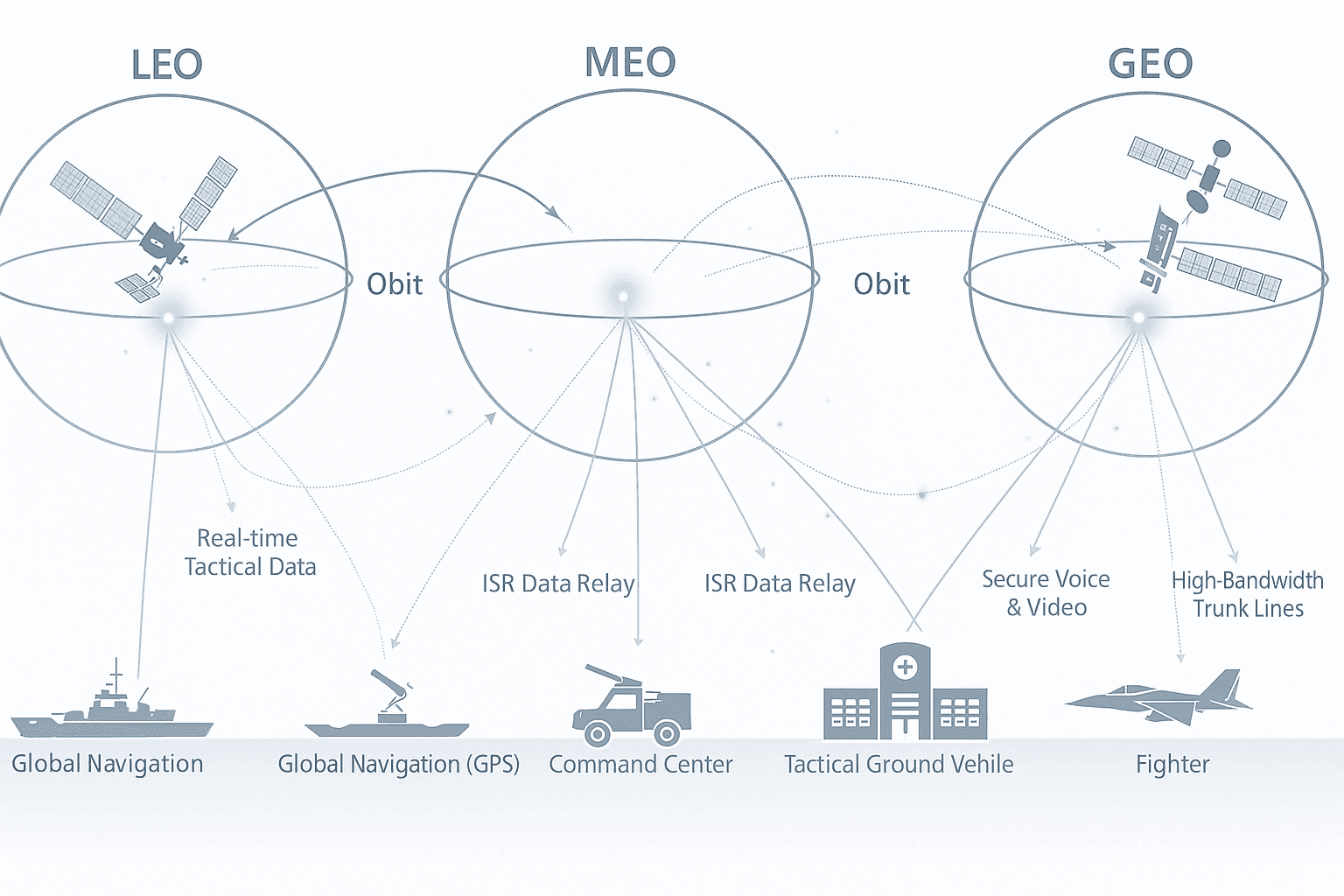
Common SATCOM bands also shape how these systems perform. Lower-frequency options such as L-band are valued for resilient links, while higher-capacity bands such as Ku-band and Ka-band are widely used when stronger broadband performance is needed. In simple terms, the terminal handles the signal path between the user and the satellite, and the band helps determine how that path behaves under real operating conditions.
SATCOM is not limited to state users. Civilians can use satellite communications as well, especially in remote connectivity and emergency support, though access to some defense-oriented services or protected frequencies is restricted. Typical applications range from government networks to maritime connectivity, with aviation and remote operations also relying on similar terminal technology.
Recent advances have pushed the category forward. Electronically steered antennas and multi-orbit support are getting more attention because they can reduce moving parts and make handoffs smoother. I looked at this like comparing routes on a live map - the more cleanly a terminal can shift between available paths, the more useful it becomes in the field.
The wider market includes established manufacturers such as Hughes and Thales, alongside specialist suppliers serving maritime or mobile deployments. That context helps frame this agreement: Greenerwave is entering a competitive area where lower power use and flexible orbit access are valuable differentiators.
What Telespazio France Sees in the Deal
Pierre Glatt, sales director at Telespazio France, said the partnership allows the company to add advanced antenna technology to its SATCOM portfolio and broaden the range of European-made systems offered to customers. He said the agreement improves Telespazio France’s ability to deliver flexible and high-performance connectivity suited to complex operating conditions.
He also said the move reinforces the company’s role as a trusted operator for critical communication services, using multi-orbit capabilities to help maintain SATCOM continuity for end users involved in essential missions. That continuity point is important. In satellite systems, much like checking GPS signal quality, reliability tends to matter most when the environment gets noisy. The same logic applies whether the end user is handling sensitive data in Europe or comparing sovereign infrastructure with systems long associated with the United States.


