
Taoglas Unveils Compact Antennas For Gnss, Cellular, And Wi-fi Devices


Taoglas has introduced the FXP30x and PC30x ranges of embedded combination antennas, built for compact electronics that need GNSS, cellular network, and Wi-Fi support in the same package. In practical terms, that gives design teams a way to handle several wireless functions with one antenna assembly instead of juggling separate parts. From what I’ve seen in embedded system design, cutting component count like this usually helps on more than one front: cleaner layout, faster assembly, and a shorter path from prototype to production.For compact devices, a combination antenna can do more than save space: it can reduce part count, simplify integration, and remove some of the small mechanical and RF complications that tend to slow a build.
For compact devices, a combination antenna can do more than save space: it can reduce part count, simplify integration, and remove some of the small mechanical and RF complications that tend to slow a build.
Two Series, Six Models, and a Shared Goal
The lineup covers six models split across two form factors: the FXP30x flexible electronics family based on a printed circuit board approach that can bend, and the PC30x rigid FR4 PCB family. Both are intended for space-limited devices and support GNSS, cellular, and Wi-Fi connectivity, with cellular frequency coverage published from 600 to 8000 hertz in the radio specifications. I looked through the product details the way I would compare GIS layers, checking whether the capabilities lined up across both groups, and the main pattern is clear: same core connectivity, different mechanical fit.
| Model Series | Form Factor | Key Features | Typical Applications |
|---|---|---|---|
| FXP30x | Flexible PCB | Bendable construction, thin profile, adhesive mounting, lower dependence on a ground plane | Telematics, wearables, industrial IoT devices, compact plastic or glass-mounted products |
| PC30x | Rigid FR4 PCB | Fixed structure, adhesive or plastic-screw mounting, more stable placement inside settled enclosure layouts | Personal computer peripherals, health care equipment, agriculture systems, embedded hardware with fixed internal geometry |
The main architectural difference is mechanical as much as electrical. The FXP30x design is meant to flex around tight or irregular internal spaces, while the PC30x version suits builds where the antenna position is already defined and a rigid board can be mounted cleanly. In practice, that means the flexible series helps when installers need to route around battery packs, housings, or display structures, while the rigid series is often easier to repeat in products with a settled enclosure and a fixed mounting point.
How the FXP30x Handles Tight Enclosures
The FXP30x series uses Taoglas polymer antenna technology and is aimed at applications where available space is awkward, shallow, or irregular. The design combines strong radiation efficiency, reduced dependence on a ground plane, and an ultra-thin profile that fits inside cramped housings. For devices made with plastic shells or mounted against glass, the peel-and-stick adhesive backing should simplify installation. In my own testing of compact hardware over the years, flexible parts often save time because they can route around internal obstacles much like a clean map route avoids blocked streets. That matters in electronics used in telematics, wearable computer platforms, industrial internet of things deployments, agriculture monitoring systems, and health care equipment where every millimeter of form factor design counts.
What Sets the PC30x Version Apart
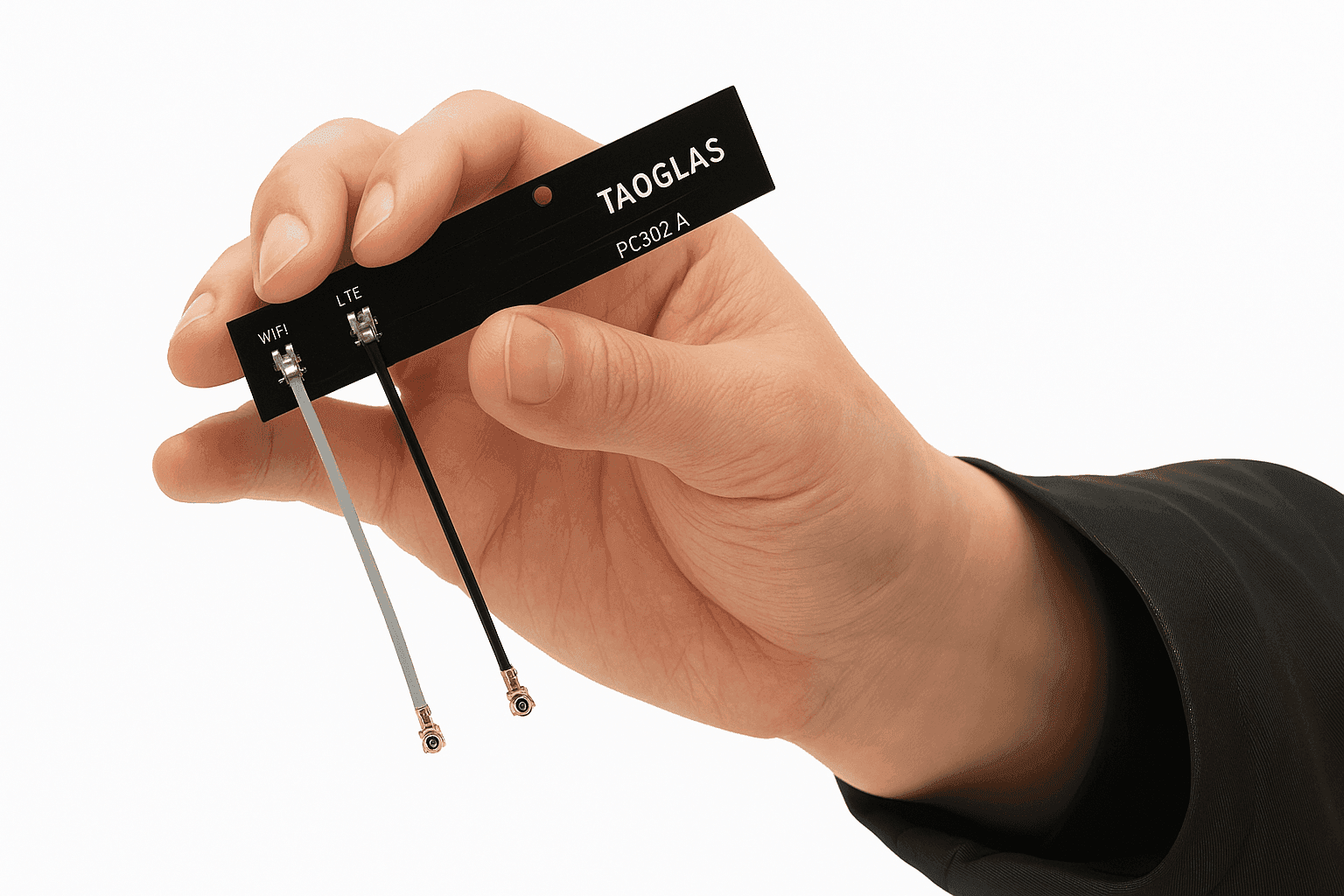
The PC30x line offers the same mix of GNSS, cellular, and Wi-Fi capability, but in a rigid antenna built on an FR-4 substrate. That makes it a more mechanically stable option for designs where the antenna can be fixed directly inside the enclosure. Depending on the construction of the device, mounting can be done with adhesive or with a plastic screw arrangement. This kind of setup is often easier to control in products where the internal geometry is already settled and there is less need for bending or contour fitting. For builders working with personal computer peripherals, health care equipment, agriculture systems, or other embedded hardware, that can make the radio integration process more predictable.
Model Variants Across Both Families
Taoglas describes the release as a six-model lineup across the FXP30x and PC30x families, but the material here does not name each individual part number variant. What is clear is that the variants are grouped by the same core radio combination and separated mainly by mechanical format, mounting method, and fit inside the enclosure. Within the flexible FXP30x family, the differentiators center on bendable construction and placement in tight spaces. Within the rigid PC30x family, the distinctions are tied more to fixed-board installation and enclosure stability. For exact model numbers, ordering codes, and any size or cable-length differences between variants, the product pages and datasheets are the right place to check.
Integration Details That Matter in Real Builds
Each antenna ships with a preassembled electrical cable and an I-PEX MHF I connector, which should reduce setup time during integration with wireless modules. Taoglas also uses different cable colors on variants that need longer runs, a small detail but a useful one. When I checked similar installs in the past, connector identification errors were often the kind of quiet problem that slowed a build by 10 or 15 minutes at a time. Color-coding does not change raw radio performance, but it does help teams make cleaner, faster connections when several leads are packed into a small enclosure.
Combination antennas also help beyond simple packaging. By consolidating GNSS, cellular, and Wi-Fi support into one antenna system, they can reduce the number of separate RF components, simplify cable management, and make internal layout easier to repeat from prototype to production. In compact devices, that shared footprint can also lower integration risk by reducing the number of placement conflicts inside the enclosure. From a reliability standpoint, fewer separate parts and fewer interconnect decisions usually mean fewer opportunities for installation mistakes.
Overall, these antennas are positioned as compact multi-radio components for products that rely on satellite navigation, cellular network access, and local wireless links in one device. That includes use cases such as:
- Telematics
- Agriculture monitoring
- Health care equipment
- Industrial IoT hardware
- Connected construction electronics
- Field electronics
They support multi-radio integration by combining those functions into a compact antenna platform with a shared installation footprint, which can simplify enclosure design and help engineers manage crowded internal layouts. The key value here is not just coverage across frequency bands such as L band and the ISM radio band, but also the way Taoglas has balanced radiation, mounting flexibility, and mechanical design so engineers can fit more capability into less space.
Where to Find More Product Information
For more detailed specifications, the official Taoglas website is the main place to look for the FXP30x and PC30x series product pages. Taoglas also provides datasheets and technical documentation for product evaluation, which is where engineers should expect to find exact model numbers, dimensional drawings, supported bands, cable options, and mounting details.


