


Bybit vs Coinbase: 2026 Exchange Comparison Guide


Curious about Bybit vs Coinbase in 2026? This head‑to‑head review maps out how each cryptocurrency exchange stacks up on products, fees, security, and regulations so you can choose the right platform for your crypto trading needs.
Overview: Coinbase and Bybit at a Glance
Coinbase operates across more than 100 countries and clears hundreds of billions in trading volume each quarter. Its core pitch centers on robust security, strict regulatory alignment, and an easy path for newcomers and institutions. Launched in 2012 and based in San Francisco, it was the first major crypto exchange to list shares on Nasdaq.
Bybit counts over 70 million users globally and ranks second by derivatives market share. Founded in 2018 with headquarters in Dubai, it is known for high maximum leverage up to 125x, ample liquidity, and a rapid cadence of perpetual listings and new tokens.
Comparison Snapshot:
| Feature | Coinbase | Bybit |
|---|---|---|
| Headquarters | San Francisco, United States | Dubai, United Arab Emirates |
| Company Type | Centralized exchange | Centralized exchange |
| Available Assets | 400+ cryptocurrencies and 300+ spot pairs | 1,900+ cryptocurrencies across spot, futures, and options |
| Regulation and Licensing | Licensed in the United States, United Kingdom, and European Union; MiCA‑compliant | Licenses in Kazakhstan, Cyprus, Georgia, and provisional approval in Dubai |
| Identity Verification | Yes | Yes |
| Staking Support | 10+ assets | 50+ assets via Earn and Launchpool |
| Availability in the United States | Yes (International Futures excluded) | No. Bybit is not legal for United States residents, and attempting to access it from the United States may violate applicable rules and the platform’s restrictions. |
| Total Users | About 100 million | 70 million+ |
Fees:
| Fee Type | Coinbase | Bybit |
|---|---|---|
| Spot Trading | 0.40–0.60% | 0.10% |
| Futures | Up to 0.60% | 0.02–0.055% |
Deposit and withdrawal methods:
| Deposit/Withdrawal Method | Coinbase | Bybit |
|---|---|---|
| Bank Transfer | Bank transfer (including Automated Clearing House), Single Euro Payments Area, Faster Payments, and Swift options where available | Single Euro Payments Area and Swift options where available; bank rails may route via payment partners depending on region |
| Cards | Debit/credit cards (fees can apply) | Debit/credit cards (fees can apply via providers) |
| PayPal | Supported for eligible regions | Not highlighted as a core method; availability depends on payment gateways |
| Peer-to-Peer | Not a primary on-ramp in this guide | Peer-to-peer marketplace available in supported regions |
| Payment Gateways | Not the main focus versus direct rails | Third‑party payment gateways supported |
| Crypto Withdrawals | Network fees passed through (no extra markup stated here) | Fixed withdrawal fees per asset (varies by coin) |
Overall, Coinbase tends to be the better default for beginners and long‑term investors who prioritize regulation, familiar fiat rails, and a lower‑friction user experience. Bybit is typically a better fit for experienced traders who want deeper derivatives markets, faster listings, and consistently lower trading fees (where it’s available).
Products: How Coinbase and Bybit Differ
Both Coinbase and Bybit provide extensive crypto services, but their focus diverges. Coinbase emphasizes clarity, compliance, and accessibility, while Bybit leans into advanced toolsets, derivatives depth, and crypto‑native functionality. In practice, that means Coinbase generally feels more guided and rules‑forward, while Bybit feels more trader‑centric with faster product iteration and more region‑by‑region access constraints.
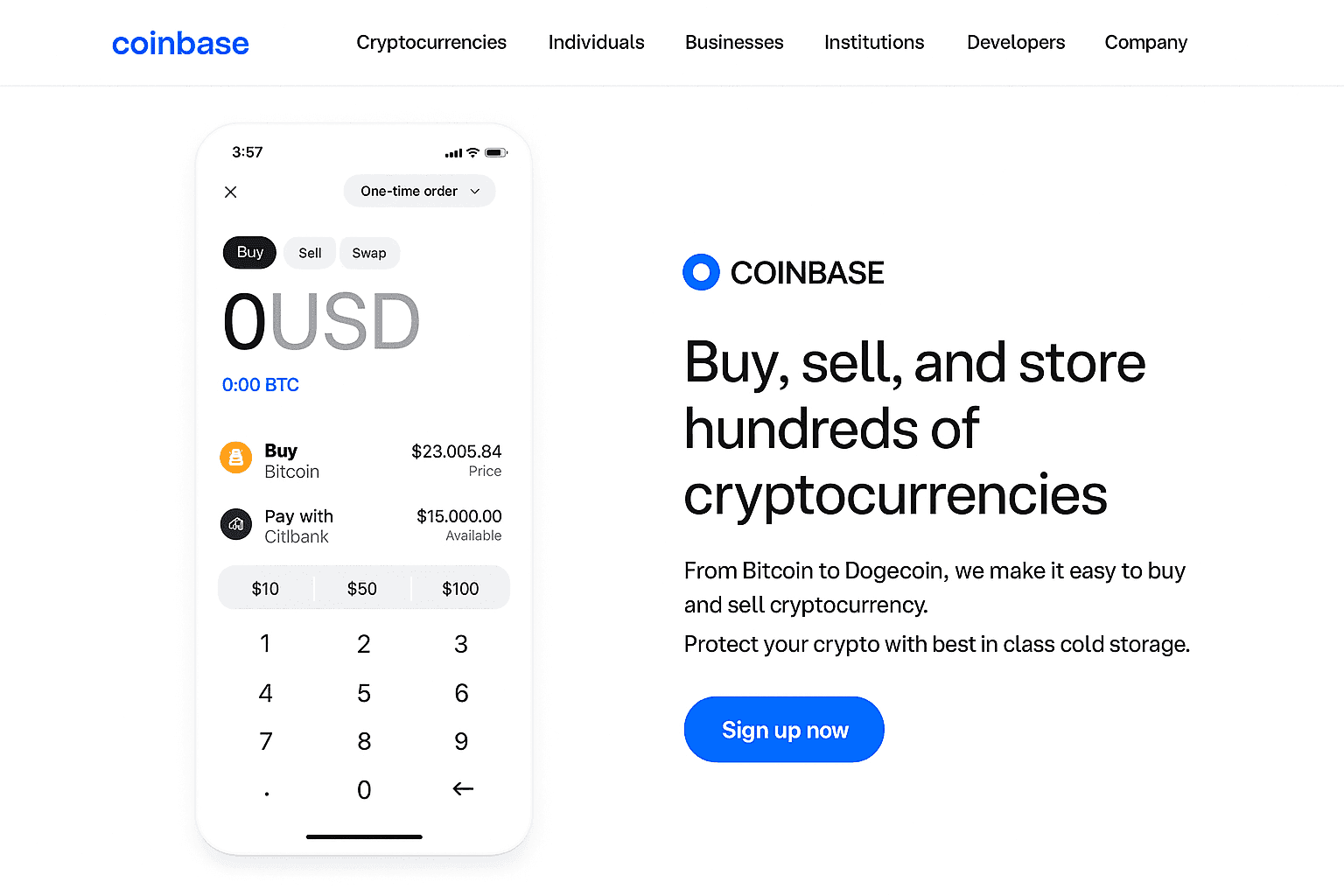
Coinbase Features
Coinbase packages a secure, streamlined toolkit that suits first‑time users and institutions alike. For beginners, Coinbase is usually the easier starting point thanks to its simpler onboarding, strong fiat connectivity, and a more conservative product lineup.
For most first-time buyers, the “best” exchange is the one that makes deposits, identity checks, and basic spot trades feel straightforward—complex derivatives can wait until the fundamentals are second nature.
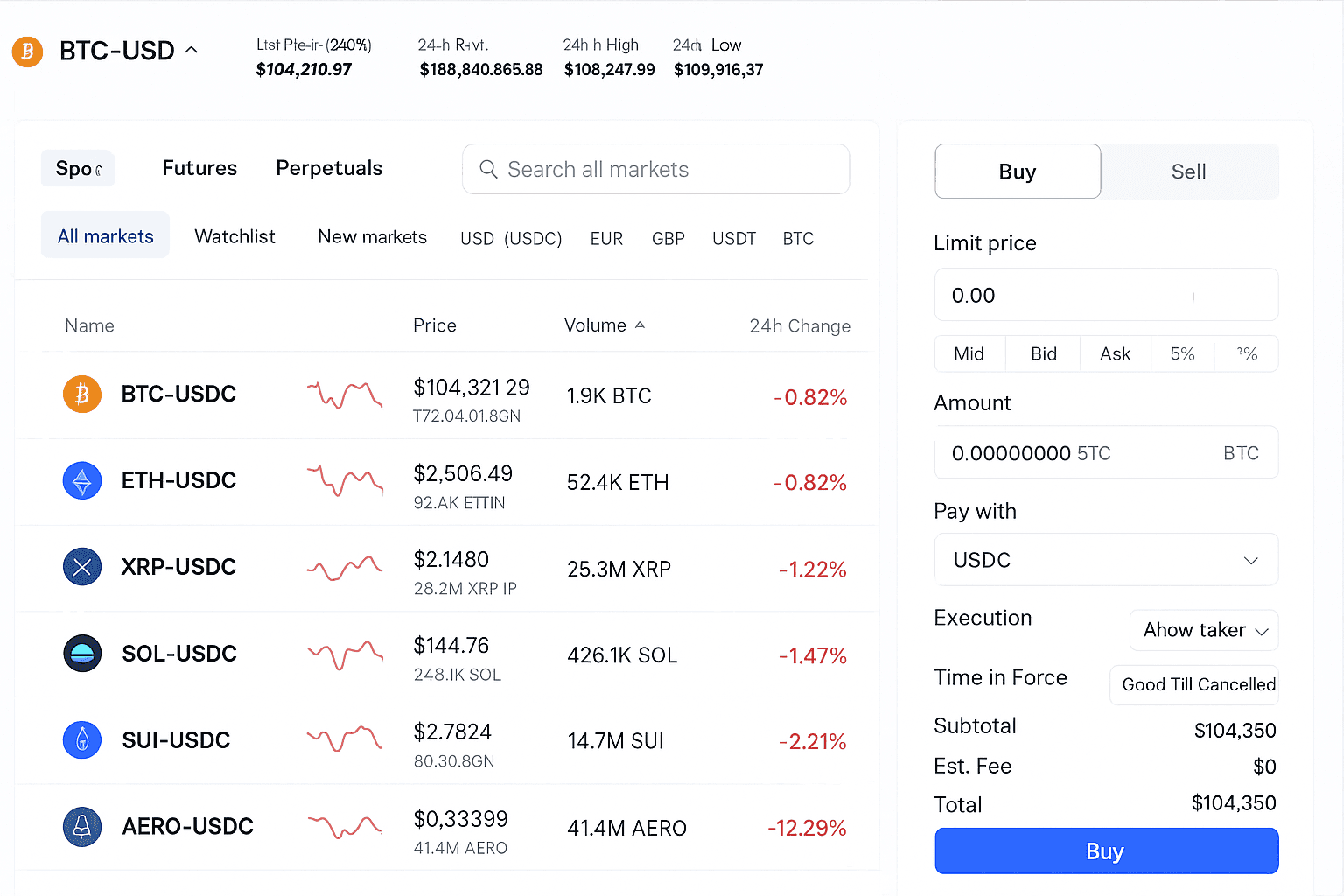
- Spot Trading: Trade hundreds of tokens via a beginner‑friendly interface or a professional terminal, with more than 300 pairs available.
- Perpetual Futures: BTC and ETH perpetuals are offered through the International Exchange, with conservative leverage and regional access limits.
- Coinbase Derivatives Exchange: A curated lineup of regulated futures, including nano Bitcoin contracts, tailored to institutions and qualified United States participants.
- Staking and Earn: Stake assets such as ETH, Ada, and Sol, and collect learn‑and‑earn rewards through education programs.
- Fiat Support: Fast on‑ and off‑ramps via Automated Clearing House, Single Euro Payments Area, Faster Payments, Swift, PayPal, and cards, covering major currencies like dollars and euros.
- Coinbase Wallet: A self‑custody wallet for NFTs and DeFi that connects seamlessly to your main Coinbase account.
- Coinbase Card: A Visa debit card that spends crypto by converting to fiat at checkout, with rewards such as Bitcoin cashback.Base (Layer 2): Coinbase’s Ethereum Layer 2 network for building and exploring on‑chain apps and dApps.
- Institutional Services: Coinbase Prime, institutional custody, and an audited venue trusted by major players, including BlackRock’s Bitcoin exchange-traded fund, Ibit.
Bybit Features
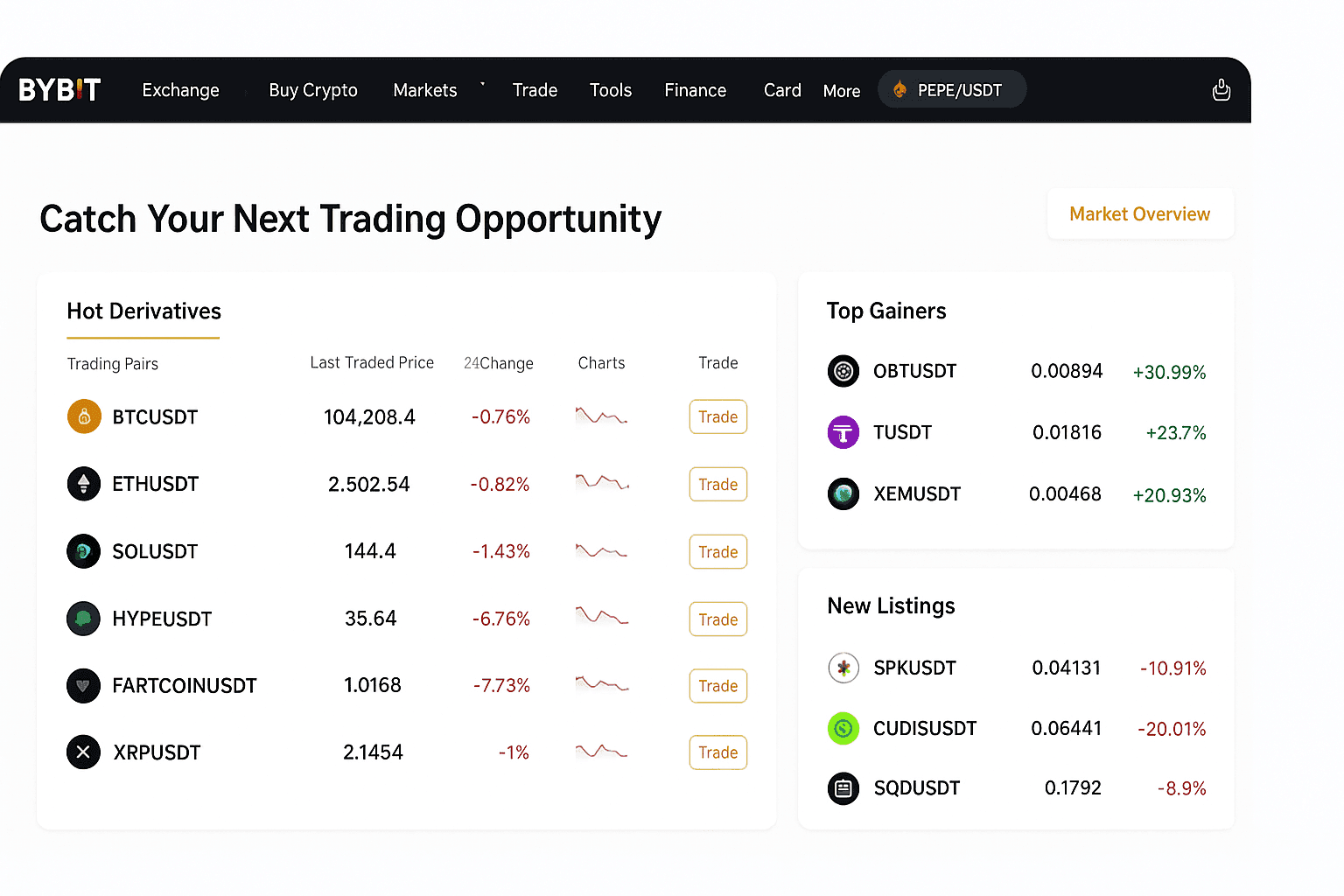
Bybit caters to sophisticated traders with a performance‑oriented suite for margin, derivatives, and Web3 use cases, and it generally rewards users who already know how to manage leverage, margin, and risk controls.
- Spot Trading: Broad token coverage with frequent additions via Launchpad and priority access to fresh listings.
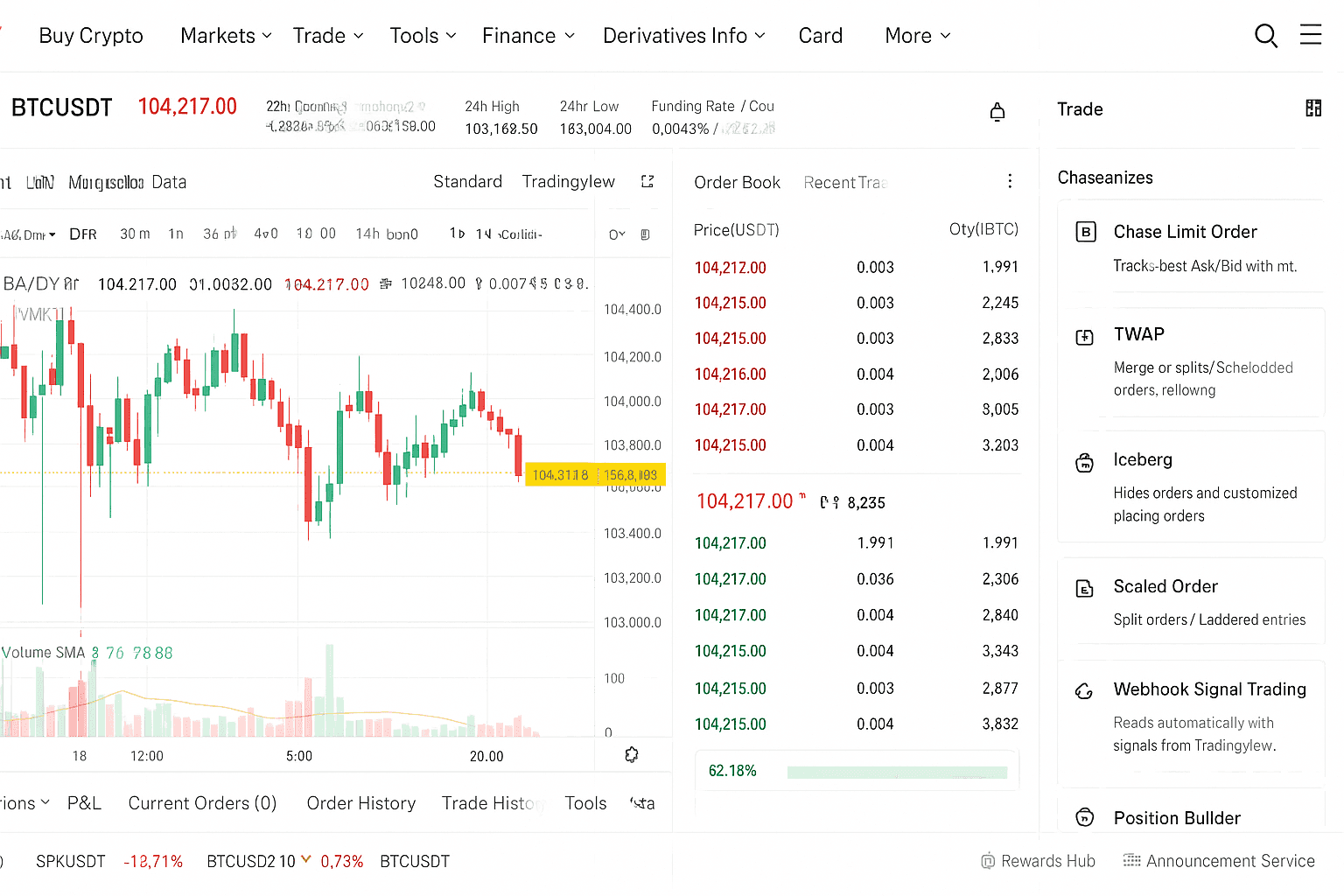
- Derivatives Breadth: Futures, inverse perpetuals, and usd-coin/tether‑margined contracts with leverage up to 125x and advanced order controls.
- Dual TP/SL Orders: Configure simultaneous take‑profit and stop‑loss targets on a single position for disciplined risk management.
- Copy Trading: Mirror trades from selected Master Traders, supported by detailed performance metrics and guardrails.
- Trading Bots: Built‑in grid, dollar‑cost averaging, and Martingale bots with customizable parameters and no external setup.
- Bybit Earn: Yield products such as dual‑asset investing, flexible staking, liquidity mining, and promotional high‑yield offers.
- Bybit Card: A MasterCard debit card in supported regions that enables spending directly from your exchange balance.
- Web3 Wallet: A smart‑contract, non‑custodial wallet attached to your main account for DeFi, staking, and NFT activity.
- Launchpad and Pre‑Market: Early token access through sales and pre‑listing markets that help discover price before public trading.
Futures Trading Compared
Bybit’s main draw is derivatives: perpetuals without expiry, quarterly futures, and usd-coin‑settled options for BTC and ETH. Leverage scales up to 125x with tiered reductions on larger positions. The platform supports tether and inverse perpetuals, plus tools such as cross‑margining and multi‑asset collateral.
Coinbase offers a narrower lineup, limiting futures to BTC and ETH perpetuals on a Bermuda‑regulated venue with a 5x leverage ceiling and no options or inverse products. A notable development is Coinbase’s plan to introduce Cftc‑compliant perpetuals for United States customers in 2025, potentially unlocking a sizable leveraged trader base.
Supported Cryptocurrencies
Coinbase lists several hundred assets and more than 300 spot pairs, prioritizing regulatory‑vetted tokens and established projects. The listings process is conservative and frequently omits newer, higher‑risk coins that do not satisfy internal or regional criteria.
Bybit provides exposure to 1,900+ cryptocurrencies, spanning trending altcoins, meme tokens, and early‑stage launches via Launchpad and pre‑market access. Its faster cadence appeals to traders looking for broader selection and earlier entry points.
Security and Safeguards
Both platforms prioritize asset safety, though their approaches reflect different regulatory environments and system designs.
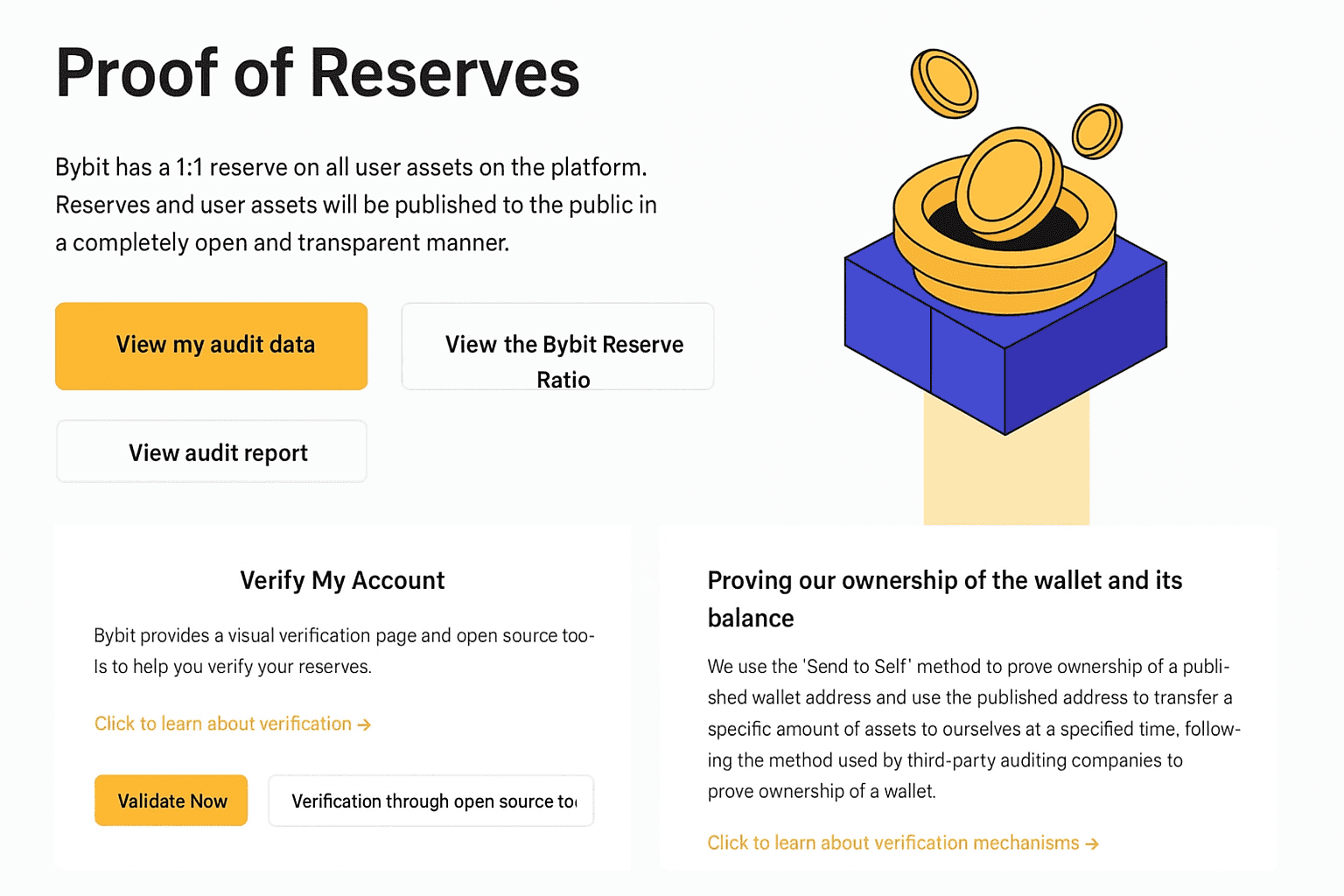
Coinbase stores approximately 98% of customer crypto in secure offline wallets and maintains crime insurance that covers theft. It is not Federal Deposit Insurance Corp.‑insured and does not cover user losses from individual account breaches. Bybit relies on multi‑signature cold storage with batched withdrawals and discloses proof‑of‑reserves through Merkle tree attestations.
From a compliance perspective, Coinbase operates under comprehensive oversight, enforces stringent identity verification and anti‑money‑laundering checks, and provides controls such as address allow‑listing, two‑factor authentication, and hardware security key support. Bybit also requires identity verification, blocks sanctioned regions, and layers protections like anti‑phishing codes, withdrawal delays, and a transparent insurance fund with auto‑deleveraging for derivatives markets.
As a summary judgment, Coinbase generally offers stronger regulation‑first safeguards and clearer recourse expectations, while Bybit’s protections skew toward trading‑system risk controls and proof‑of‑reserves transparency within a more limited licensing footprint.
Fees and Pricing
Costs can materially affect active traders. Coinbase and Bybit take different paths: Bybit optimizes for low execution fees, while Coinbase couples higher pricing with convenience and deep compliance. In most head‑to‑head cases, Bybit is cheaper for active and high‑volume traders, while Coinbase can make more sense for casual users who prioritize simplicity, familiar payment rails, and subscription-style perks.
Coinbase Fees
Coinbase applies volume‑based pricing geared to casual and compliance‑focused participants.
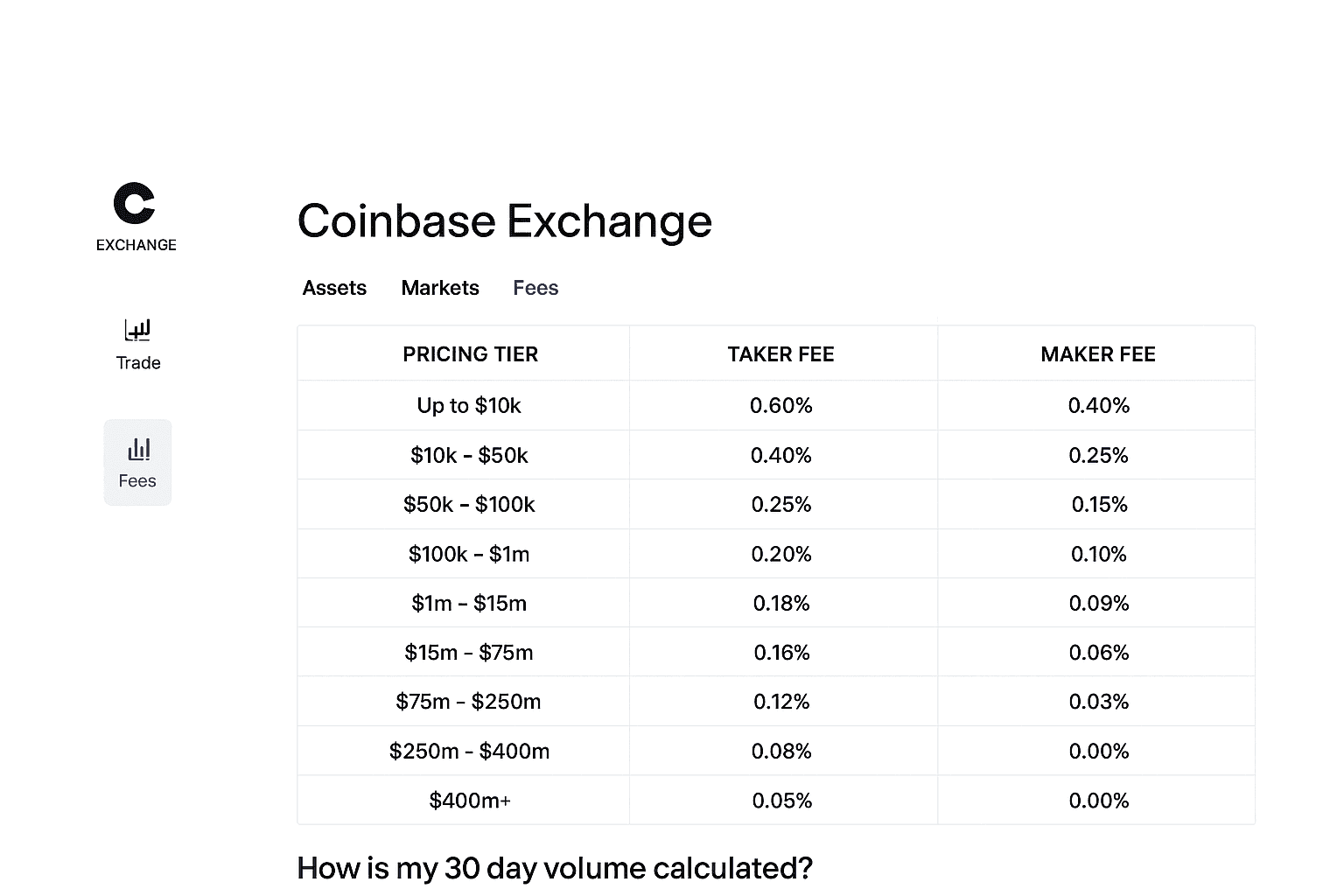
- Spot Trading Fees: Up to 0.60% taker and 0.40% maker for standard accounts, with discounts that step down at higher volumes.
- Futures Trading Fees: Broadly ranges from 0% to 0.60% by tier; most retail users should expect roughly 0.2–0.5% per trade outside of institutional programs.
- Crypto Withdrawals: Network fees are passed through without extra markup, often favorable for small transfers versus fixed‑fee models.
- Fiat Deposits and Withdrawals: Automated Clearing House (dollars), Single Euro Payments Area (€0.15), and Faster Payments (United Kingdom) are low cost or free; card payouts can be about 2%, and PayPal transfers are typically free.
- Vip and Loyalty: Coinbase One offers zero‑fee trading within limits for retail, and institutions may qualify for maker rebates or bespoke terms.
- Promotions: Occasional campaigns, such as fee‑free usd-coin pairs, offer short‑term relief, though headline fees remain above many rivals.
Bybit Fees
Bybit’s structure targets high‑volume traders with aggressive Vip discounts.
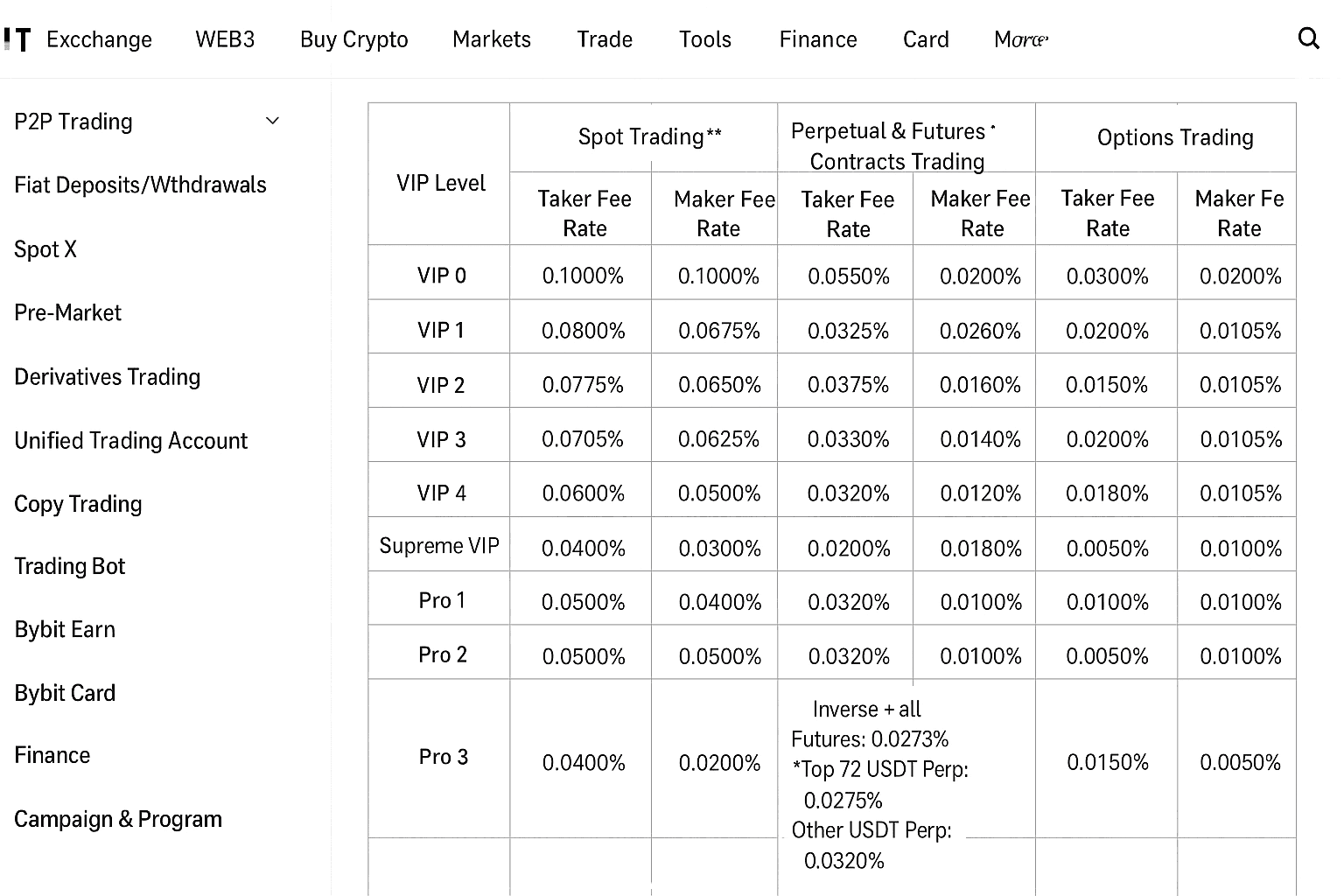
- Spot Trading Fees: Standard 0.10% maker/taker that falls quickly with volume, e.g., around 0.0675% maker at Vip 1 and as low as 0% at top tiers.
- Futures Trading Fees: Perpetuals start near 0.020% maker and 0.055% taker, with even lower rates on some inverse markets; top tiers can approach 0% on limit orders.
- Crypto Withdrawals: Fixed fees per asset, such as 0.0005 BTC, which favor larger withdrawals but may feel steep on small amounts.
- Fiat Handling: No platform fee on deposits, but third‑party processors or peer-to-peer can add roughly 1–3% depending on region and provider.
- Vip and Rewards: Entry to Vip starts around $1M in 30‑day volume and includes lower fees, account manager access, and platform perks.
- Promotions: Regular events, zero‑maker periods, competitions, and Vip trials help compress effective trading costs.
Regulatory Landscape
Coinbase limits access in Office of Foreign Assets Control‑sanctioned locations, including Russia, Iran, the United Arab Emirates, and parts of South Asia, while continuing to navigate scrutiny from the Securities and Exchange Commission. It holds approvals in major markets such as the United States (Fincen and Securities and Exchange Commission), United Kingdom (Financial Conduct Authority), and European Union (MiCA via Ireland), and serves customers in 100+ countries.
Using an exchange that restricts access in your country can create avoidable risk: accounts may be limited, funds can be delayed during compliance checks, and you may have little practical recourse if a dispute arises.
Bybit serves users in roughly 160 jurisdictions and maintains licenses in Kazakhstan, Cyprus, and Georgia, plus provisional approval in Dubai. Access is blocked in the United States, United Kingdom, European Union, and Singapore. The company is pursuing MiCA and Hong Kong permissions, but its current licensing remains regional and limited.
Final Thoughts
If you’re deciding between these two platforms, the most important variables are where you live, how advanced your trading is, and whether you want a regulation‑first venue or a derivatives‑first venue.
Pros and cons at a glance:
- Coinbase Pros: Broad mainstream accessibility, strong fiat rails, and an onboarding flow that tends to feel more beginner-friendly.
- Coinbase Cons: Higher headline trading fees, plus fewer derivatives products and fewer early-stage listings.
- Bybit Pros: Deep derivatives liquidity, frequent new markets, and a fee schedule that typically rewards active traders.
- Bybit Cons: Not available to United States residents, and its licensing coverage is narrower across some major jurisdictions.
Is Bybit a good exchange? For many experienced traders, it can be a reliable venue because it’s widely used, liquid in derivatives markets, and packed with trading tools. The trade-offs are usually less about basic functionality and more about practical factors like regional access restrictions, the support experience when problems arise, and how the platform behaves during extreme volatility (when execution, risk controls, and withdrawals matter most).
If you’re also comparing other top crypto exchanges, common alternatives include:
- Binance: Known for deep global liquidity and a broad product suite across spot, margin, and derivatives (availability varies by region).
- Kraken: Often picked for its security posture and straightforward trading experience, especially for fiat-connected users.
- OKX: Notable for its derivatives offering and wide range of trading tools for active market participants.
- Bitstamp: A long-running exchange that appeals to users who want a simpler, more traditional spot-focused venue.
- Gemini: Typically positioned around compliance-leaning operations and a beginner-oriented interface in supported markets.
Your choice hinges on risk appetite, trading style, and location. Many investors mix both: use Coinbase for stability and bank rails, and tap Bybit for flexibility, advanced orders, and derivatives access.


No comments yet. Be the first to share your thoughts.