


Largest Crypto Hedge Funds: 2026 Guide to Strategies, Risks, And Standout Managers


In a fast-moving crypto landscape where volatility meets invention, this crypto hedge funds list highlights the biggest crypto hedge funds, their methods, and risk controls, helping you weigh potential returns beyond routine trading on platforms such as Binance, Kraken, or other major exchanges.
Reviewing each manager’s approach, risk profile, and historical outcomes can deepen your understanding and build confidence as you navigate complex crypto investment opportunities.
Please remember that this roundup of leading funds reflects the consensus views of multiple crypto experts and commentators.
Crypto Hedge Funds List
As digital assets evolve, specialized managers have become influential market participants, giving investors structured access to a volatile yet promising segment of the crypto market. Below is a curated list designed for those researching prominent managers in 2026.
| Fund Name | Year Founded | Location | AUM (if available) | Key Strategies | Notable Features |
|---|---|---|---|---|---|
| Pantera Capital | Not stated | Not stated | Not stated | Discretionary liquid token investing (including DeFi) plus venture-style blockchain investing | Liquid Token Fund launched November 2017; $100,000 minimum; 2% management fee; 20% performance fee; Blockchain Fund minimum $1 million |
| BH Digital | Launched September 2021 | Global platform (locations not stated) | Commitments exceeding $1 billion (crypto-focused vehicle, August 2022) | Institutional multi-strategy digital asset platform, including staking, node operation, and governance participation | Backed by Brevan Howard Asset Management; team includes 15+ portfolio managers and 10+ data scientists and traders |
| Multicoin Capital | May 2017 | Not stated | Not stated | Thesis-driven token and equity investing across crypto infrastructure and applications | Focuses on forward-looking economic models and hands-on support for portfolio teams |
| Wave Digital Assets | 2018 | Los Angeles | More than $1 billion (reported) | Mix of venture capital, hedge fund strategies, fund administration, and private wealth services | SEC-registered investment adviser; emphasizes institutional processes with crypto-native insights |
| Morgan Creek Digital | Not stated | North Carolina (Morgan Creek Capital Management) | Not stated | Digital asset and early-stage investing; index-style exposure via a digital asset index fund | Offers institutional access with Bitwise Asset Management through the Digital Asset Index Fund |
| Systematic Alpha Cryptocurrency Arbitrage Master Fund | Began trading May 2022 | Not stated | Not stated | Pure arbitrage across venues, focusing on spot Bitcoin and other assets | Seeded by Bequant; emphasizes institutional-grade operations and due diligence processes |
| Off The Chain Capital | Not stated | Not stated | Not stated | Long-only, value-oriented blockchain investing with a focus on downside risk control | Targets mispriced assets, early-stage companies, and employee/early-investor liquidity opportunities |
| Pythagoras Investment Management | 2014 | New York City (with additional offices in Cambridge, Singapore, and Hong Kong) | Not stated | Data-driven research and proprietary trading algorithms aimed at short-term inefficiencies | Operates the Pythagoras Token Fund and related vehicles centered on crypto opportunities |
| BitBull Capital | 2017 | Not stated | Not stated | Diversified approach blending active trading with longer-term positioning | Provides fund management, research, and advisory services |
| BlockTower Capital | 2017 | Not stated | Not stated | Multi-strategy toolkit spanning digital assets and market structures | Launched by Ari Paul and Matthew Goetz; combines trading and research capabilities |
Latest Changelly Coupon Found:
Largest crypto hedge fund (in this guide).Based on the size figure explicitly mentioned above, Wave Digital Assets reports more than $1 billion in assets under management, making it the largest disclosed AUM figure referenced in this 2026 lineup.
The “big 3” (in this guide).Pantera Capital, BH Digital, and Multicoin Capital are often treated as the most prominent in a practical sense because they combine recognizable brand presence with institutional-grade infrastructure and durable, repeatable investment frameworks (liquid/token strategies, platform-style multi-strategy execution, and thesis-driven token/equity investing).
Five largest-scale managers (in this guide). Because many managers do not publish AUM, the most objective comparison available within this article relies on disclosed AUM/commitments and other explicit scale indicators stated above. On that basis, Wave Digital Assets (reported AUM), BH Digital (reported institutional commitments), Pantera Capital (multiple institutional-style vehicles and high minimums), Morgan Creek Digital (institutional access products), and Multicoin Capital (multi-year, thesis-driven deployment across tokens and equity) stand out as the largest-scale names discussed here.
These firms blend professional portfolio construction with blockchain-domain expertise to pursue competitive results. This is not financial advice, and speaking with a licensed adviser before allocating capital is recommended.
With that in mind, let’s explore the managers below, each known for a distinct thesis and track record.
Pantera Capital
Pantera Capital is frequently cited among top crypto managers, offering multiple investment paths that range from venture equity in blockchain technology to emerging tokens and liquid cryptocurrencies.
According to its materials, the Pantera Liquid Token Fund emphasizes DeFi and related digital asset opportunities using a discretionary strategy, typically holding a portfolio of 15 to 25 liquid tokens.
Launched in November 2017, the Liquid Token Fund requires a minimum commitment of $100,000, with a 2% management fee and a 20% performance fee.
Pantera also manages a Blockchain Fund that invests across venture equity, early-stage tokens, and tradable tokens, with a minimum investment of $1 million.
BH Digital
Brevan Howard Asset Management manages capital for global institutional investors, including sovereign wealth funds, corporations, and public pension plans, and appears regularly in lists of notable managers.
The firm invests across fixed income, FX, commodities, and equities. In September 2021, it launched BH Digital, its dedicated cryptocurrency and digital asset platform.
BH Digital’s team includes more than 15 portfolio managers, over 10 data scientists and traders, plus 20+ external blockchain engineers, combining market microstructure expertise with traditional asset management practices.
The group integrates crypto-native skill sets with established institutional processes to expand participation across the ecosystem.
Its remit includes support for blockchain development, communications, fundraising, compliance, and recruiting, alongside active involvement in staking, node operation, and network governance.
In August 2022, Brevan Howard secured commitments exceeding $1 billion from institutional investors for a crypto-focused vehicle, and in March 2023, it assumed control of a crypto hedge fund previously managed by Dragonfly Capital.
Multicoin Capital
Founded in May 2017, Multicoin Capital is a thesis-driven crypto hedge fund and venture investor that acquires project tokens and equity in blockchain companies.
Known for challenging industry conventions, the team develops forward-looking economic models, operating across the full stack—from infrastructure to applications—to help projects scale.
Beyond capital, Multicoin assists teams with strategy and execution, maintaining a clear thesis while building positions in tokens and equity across the crypto market.
Wave Digital Assets
Wave Digital Assets (often shortened to “Wave”) is an SEC-registered investment adviser combining venture capital, hedge fund strategies, fund administration, and private wealth services in the digital asset arena.
Established in 2018 in Los Angeles by seasoned crypto and financial services professionals, Wave integrates institutional processes with crypto-native insights.
This combination enables Wave to unify capital allocation discipline with emerging concepts, aiming to unlock the potential of digital assets for investors.
Wave reports managing more than $1 billion in assets under management and is recognized in the United States as a registered investment adviser.
Morgan Creek Digital
Morgan Creek Capital Management, based in North Carolina, provides investment solutions to institutions and qualified investors, including endowments, pension plans, foundations, and family offices.
The firm emphasizes diversification and the use of alternative strategies within traditional portfolios, including exposure to Bitcoin via specialized vehicles.
Morgan Creek Digital is the firm’s cryptocurrency-focused arm, allocating to early-stage blockchain and artificial intelligence companies as well as digital assets.
Together with Bitwise Asset Management, Morgan Creek offers institutional access through the Digital Asset Index Fund.
The index currently includes Bitcoin (BTC), Ethereum (ETH), Cardano (ADA), Polkadot (DOT), Avalanche (AVAX), Litecoin (LTC), Uniswap (UNI), Cosmos (ATOM), Bitcoin Cash (BCH), and Tezos (XTZ).
In December 2022, CEO Mark Yusko discussed his view that Bitcoin could one day rival gold, with a long-term price target of $250,000 per coin under that scenario.
Systematic Alpha Cryptocurrency Arbitrage Master Fund
The Systematic Alpha Cryptocurrency Arbitrage Master Fund began trading in May 2022, deploying a proprietary pure arbitrage strategy in digital assets and quickly appearing on industry shortlists.
Initial seeding came from Bequant, an institutional prime broker and exchange. Focusing on spot Bitcoin and other assets, the fund captures exchange-to-exchange pricing gaps.
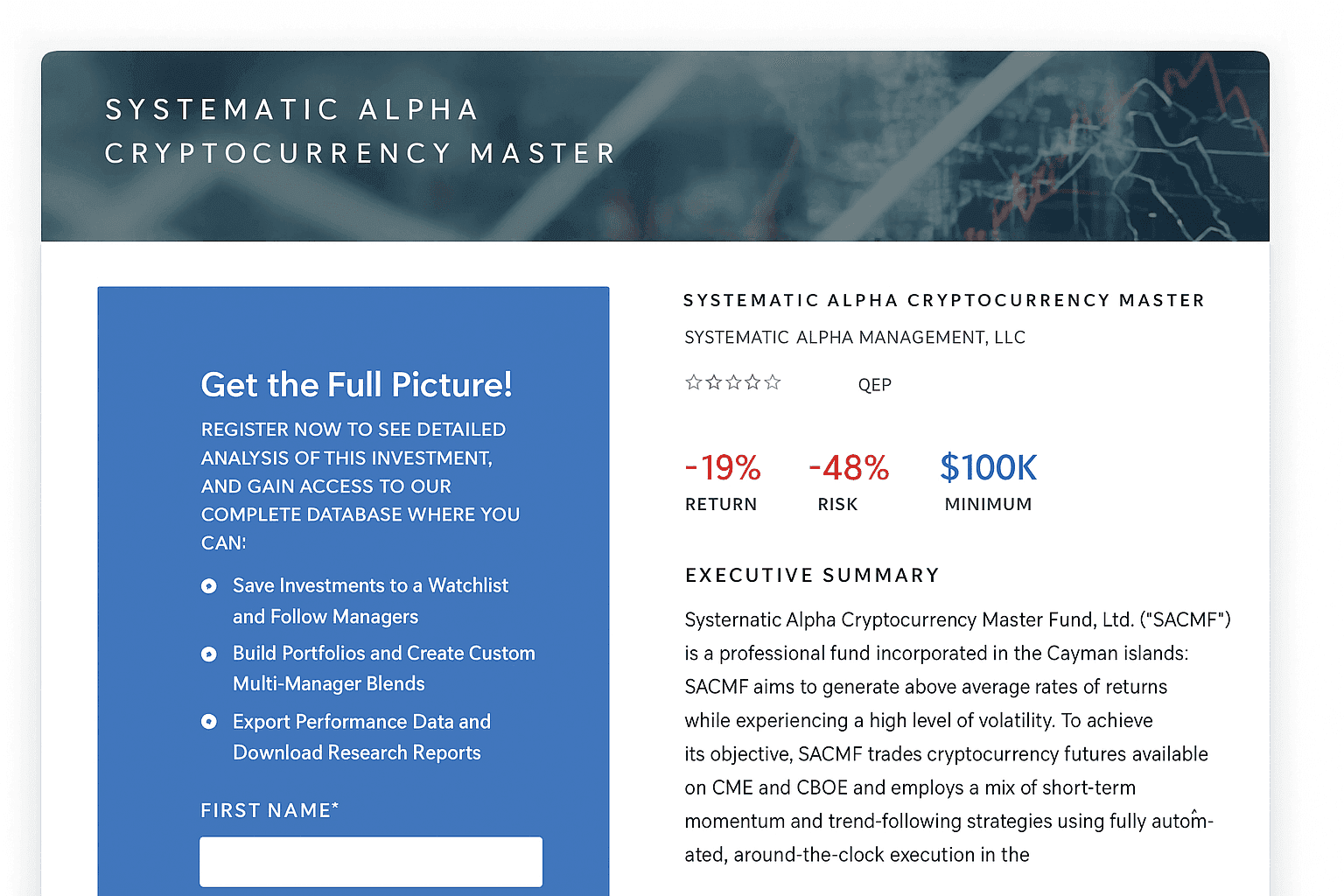
Arbitrage here means rapidly buying and selling the same instrument across venues to monetize temporary mispricings.
To meet institutional standards, the fund partners with leading service providers and emphasizes rigorous operations.
Its procedures passed an Operational Due Diligence review by a respected London-based specialist, signaling institutional readiness.
Off The Chain Capital
Off The Chain Capital, a well-known name in value-oriented blockchain investing, is associated with prominent investor Anthony Pompliano and applies principles popularized by Benjamin Graham and Warren Buffett.
The strategy frequently targets early-stage companies and tokens with strong fundamentals, real-world utility, and experienced teams.
Employing a long-only mandate with an emphasis on downside risk control, Off The Chain aims to capture upside while limiting drawdowns—an approach that appeals to family offices, endowments, and foundations.
The fund has ranked among strong performers, outpacing Bitcoin over five consecutive years while experiencing materially lower downside volatility than the asset.Across the past decade-plus, Bitcoin has often led all asset classes by risk-adjusted return. Our objective is to exceed Bitcoin’s performance while reducing volatility, and we have consistently worked toward that target. — Brian Estes, CEO and CIO, Off The Chain Capital.
For qualified purchasers, the portfolio includes exposure to major blockchain businesses such as Kraken and Binance, sourcing mispriced assets and facilitating liquidity for employees and early investors.
Pythagoras Investment Management
Founded in 2014 by Mitchell Dong, Pythagoras Investments is a notable hedge fund manager headquartered in New York City with additional offices in Cambridge, Singapore, and Hong Kong.
The firm oversees the Pythagoras Token Fund and Pythagoras Investment Management, both centered on cryptocurrency opportunities worldwide.
Pythagoras combines data-driven research, proprietary trading algorithms, and experienced traders to exploit short-term inefficiencies while managing portfolio risk.
BitBull Capital
BitBull Capital, founded in 2017 by Joe DiPasquale, is a cryptocurrency investment firm and hedge fund offering fund management, research, and advisory services.

The firm is recognized for a diversified approach across cryptocurrencies and tokens, blending active trading with longer-term positioning to manage risk and access the broader crypto market.
BlockTower Capital
BlockTower Capital, launched in 2017 by Ari Paul and Matthew Goetz, focuses on blockchain and digital asset investing, with capabilities in hedge fund management, trading, and research.
The team’s background in finance, technology, and crypto supports a multi-strategy toolkit that spans numerous digital assets and market structures.
Overall, crypto hedge funds represent a dynamic, diverse segment of digital asset investing. Each manager listed here brings different expertise and strategy design to match various investor objectives and risk tolerances.
With that snapshot of leading performers, let’s look under the hood at how these investment vehicles work.
Understanding Crypto Hedge Funds
Within cryptocurrencies and digital assets, hedge funds offer a structured path for investors to pursue opportunities. Because many lineups include both hedge funds and venture capital firms, terminology can blur—so what separates them?
A crypto hedge fund is a pooled investment vehicle where a professional manager invests client capital primarily in cryptocurrencies and related digital assets, typically charging management and performance fees. Crypto hedge funds operate like traditional hedge funds but focus solely on digital assets, using techniques such as quantitative trading, arbitrage, long–short exposures, and portfolio diversification.
Their aim is to deliver consistent results across bull and bear markets. Many rely on advanced trading systems and institutional risk management to target alpha in a volatile environment.
In practice, the flow often looks like this: Investors review offering documents and eligibility requirements, complete onboarding (including subscription paperwork and KYC/AML checks), and fund an account based on the vehicle’s terms. The manager then deploys capital according to the stated mandate (often using prime brokers, custodians, and exchanges for execution and settlement), tracks performance via NAV and reporting, and charges fees per the fund’s structure. Redemptions and profit distribution depend on lockups, redemption windows, and the fund’s accounting and valuation policies.
Common strategy buckets include market-neutral approaches (seeking to reduce directional exposure), directional strategies (taking long or long–short views based on thesis), arbitrage (capturing temporary price differences across venues or instruments), and systematic/quant strategies (using models and rules-based execution). Some managers also blend in venture-style exposure by holding longer-horizon token or equity positions alongside liquid trading.

Crypto venture capital firms, by contrast, allocate to early-stage startups and protocols, typically taking equity or token positions aimed at long-horizon growth rather than frequent trading.
These investors supply capital and guidance, helping founders build products and teams with the expectation that a subset of bets will drive outsized returns.
Another label you may see is a crypto asset management company, which can include both hedge fund and venture-style vehicles, or a hybrid of the two, to manage digital assets on behalf of clients.
Such firms may offer multiple structures, including index-style products, actively managed funds, or venture capital funds, depending on mandate and investor needs.
While no single global registry captures every manager, the total number of crypto hedge funds worldwide is commonly estimated in the hundreds, with the exact figure fluctuating as funds launch, merge, or close.
Regulation varies by jurisdiction, but crypto hedge funds are often treated similarly to other private fund managers, with added attention to custody, market integrity, and AML controls. In the United States, managers may register (or operate under exemptions) as investment advisers and typically implement compliance programs covering disclosures, custody arrangements, conflicts of interest, and investor eligibility. In other major hubs such as the United Kingdom, the European Union, Singapore, and Hong Kong, managers generally navigate local licensing or registration frameworks and maintain controls around KYC/AML, recordkeeping, risk management, and marketing restrictions.
Traditional (non-crypto-native) hedge funds do invest in crypto in many cases, most commonly by adding exposure through liquid instruments (such as spot positions, futures, or options), allocating to specialist managers, or trading relative-value opportunities where liquidity and risk controls meet their mandate.

In short, while “crypto hedge fund,” “crypto VC,” and “crypto asset manager” are sometimes used interchangeably, understanding their differences helps investors choose appropriate strategies.
By assembling a clear list, distinguishing mandates, and comparing risk controls, investors can align choices with objectives and risk tolerance in this evolving market.
Next, consider the key factors to evaluate before allocating capital to any crypto vehicle.
Factors to Consider Before Investing
Allocating to crypto—especially via a curated list of managers—can be compelling, but careful evaluation is essential before you commit funds.
Given the market’s rapid shifts, smart preparation reduces risk and improves the chance of meeting your goals. Weigh the following points when assessing hedge funds, venture capital firms, or related options:
- Before committing capital, investors should verify how risk is measured, how assets are custodied, and how withdrawals work under stress scenarios; those operational details often matter as much as the strategy itself.
- Risk Tolerance. Digital assets can be highly volatile. Gauge how much of your portfolio you are comfortable allocating to this high-risk, high-reward category.Investment Goals.
- Clarify whether you seek short-term gains, long-term compounding, or a blend. Different vehicles serve different horizons.
- Fund Reputation and Management.Examine the manager’s background, process, and crypto experience. A credible track record and capable team matter.Investment Strategy.
- Understand whether the fund uses arbitrage, quantitative models, long–short, or venture. Choose approaches that fit your objectives.
- Past Performance. While not predictive, historical results can reveal how the strategy behaved across varied markets.
- ransparency. Favor managers who clearly report holdings, performance, and fees. Openness fosters trust and accountability.

- Fees. Review management and performance fees, plus any additional costs, and compare them with the value delivered.
- Liquidity. Check lock-ups and redemption terms. Venture-style positions can be illiquid for extended periods.
- Market Research. Stay current on regulation, technology progress, and sentiment, as these forces can shift risk and return.
- Diversification. Spreading capital across strategies or managers may reduce drawdowns from idiosyncratic events.
- Exit Strategy. Define your plan in advance—time horizon, targets, and triggers—to avoid impulsive decisions.
- Regulatory Environment. Know the rules in your jurisdiction. Regulation affects access, custody, and investor protections.
- Due Diligence. Read offering documents, verify service providers, and consult professionals when needed.

- Security. Confirm robust cybersecurity, custody arrangements, and operational safeguards.
- Long-Term Vision. Evaluate the durability of the fund’s thesis and the technologies it backs.
- Size of the Hedge Fund. Larger managers may offer stability and resources; smaller ones can provide niche focus and agility.
- Transparency of Hedge Funds. Ensure you can see how risk is taken and managed across strategies and positions.
- Investor Protections. Look for oversight, reputable custodians, and independent audits to safeguard capital.
- Hedge Fund Fees. Weigh the fee load against historical delivery of returns and your own objectives.
Ultimately, investing through hedge funds, venture funds, or hybrid structures requires aligning your goals, risk appetite, and time horizon with a manager’s mandate.
Thorough research, disciplined due diligence, and awareness of market dynamics—paired with a current view of top managers—can help you make decisions that fit your plan.
Conclusions
This 2026 lineup spans a wide spectrum of strategies at the intersection of traditional portfolio design and digital asset innovation. Success with these opportunities rests on understanding each fund’s approach and carefully evaluating risk.
As the crypto market matures, investors should stay informed, adaptable, and diligent. Working with respected exchanges such as Binance, Kraken, and KuCoin can complement fund exposure, but lasting results require continual learning and prudent choices.
The material presented here is educational and should not be taken as financial, investment, or trading advice. The publisher does not recommend buying, selling, or holding any cryptocurrency. Consult a qualified financial adviser before making investment decisions.


No comments yet. Be the first to share your thoughts.