


My Funded Futures Review 2026 For a Funded Futures Prop Firm Payout
Low-cost entry tends to get attention fast, but the real question in any My Funded Futures review is simpler - can the firm hold up under scrutiny on rules, payouts, and day trading conditions. My Funded Futures stands out because it focuses on futures traders, uses simulated capital tied to major CME venues, and removes activation fees that many rivals still charge. The trade-off is a tighter rule set around evaluation consistency and specific news windows on some plans, so the value here depends on how disciplined your process is.
From what I saw while comparing the account pages and firm details, the structure is fairly easy to read after a few clicks. It took me only a short pass through the pricing and rules sections to see the core pattern: Flex leans toward lower entry friction, Rapid leans toward faster payout access, and Pro leans toward looser funded-stage constraints. That split matters because a futures contract account can look trader-friendly on the surface and still become awkward once drawdown logic starts moving underneath you.
My Funded Futures is generally presented as a trustworthy and legitimate prop firm, and the public-facing details support that view better than many thinly documented competitors. It has identifiable leadership, a stated US base, and known broker connections. It is still a prop evaluation business rather than a regulated futures broker, so there is no clear sign of direct regulatory oversight in the way traders would expect from a brokerage account. I also did not find any public statement saying trader funds are segregated or insured, which matters because challenge fees and payout claims do not carry the same protections as customer cash at a regulated broker. That does not remove risk, but it does make the operating map easier to read, a bit like checking a GPS layer that actually lines up with the road beneath it.

My Funded Futures Overview
The details below reflect information published by My Funded Futures, along with public disclosures and trader feedback available in 2026.
| Attribute | Details |
|---|---|
| Company Name | My Funded Futures |
| Legal Name | My Funded Futures LLC |
| Registration | linked to filings in Delaware and Texas in the United States |
| CEO | Matthew Leech |
| Headquarters | United States with support activity in Texas |
| Broker Access | Tradovate and Rithmic |
| Operating Since | 2023 |
| Account Sizes | available in the main range from $50,000 to $150,000 |
| Profit Split | 80% to 100%, with the first $10,000 kept in full |
| Challenge Models | Rapid, Flex and Pro |
| Payout Timing | as fast as 5 winning days on Core or Rapid, with bi-weekly availability on Pro |
| Payout Methods | Rise, crypto and bank wire |
| Platforms | Tradovate, NinjaTrader, Quantower and TradingView |
| Markets | CME and related US futures venues |
| Max Allocation | up to $600,000 in sim-funded capital |
| Scaling Ceiling | up to $1,000,000 |
| Trustpilot Score | 4.9 out of 5 as of 2026, based on more than 14,854 reviews |
Pros and Cons of Trading With My Funded Futures
There is a clear appeal here. My Funded Futures has built much of its reputation around zero activation fees and a generous payout structure. At the same time, the firm asks for tighter process control than a beginner may expect, especially during the evaluation phase.
- Pros - zero activation fees across plans
- Pros - favorable drawdown treatment on selected accounts
- Pros - strong early payout share, with the first $10,000 fully retained
- Pros - support for TradingView and NinjaTrader
- Cons - futures only, with no Forex or CFD access
- Cons - 50% consistency rule during evaluation
- Cons - Tier 1 news limits on Rapid and Pro
- Cons - different payout caps and buffer rules by plan
That balance makes sense for traders who already think in terms of risk first. If your day trading style is controlled and repetitive, the firm can look efficient. If your style relies on oversized bursts, the rules will feel restrictive very quickly.
Account Types Fees and Profit Split Explained
My Funded Futures splits its offering into Flex, Rapid and Pro accounts. Fees, drawdown treatment and payout timing all shift with the model you choose, so account selection here is more than a pricing decision. It affects how you absorb heat and how fast you can request withdrawals.
| Account Type | Key Features |
|---|---|
| Flex | lower-cost access with End-of-Day drawdown treatment |
| Rapid | faster payout path with real-time trailing drawdown |
| Pro | higher fee tier with End-of-Day drawdown and fewer funded-stage limits |
The profit target across these plans follows the same broad pattern, and the evaluation minimum stays at 2 trading days. The main difference is how the firm tracks loss tolerance and how quickly a trader can move from passing the challenge to receiving a payout.
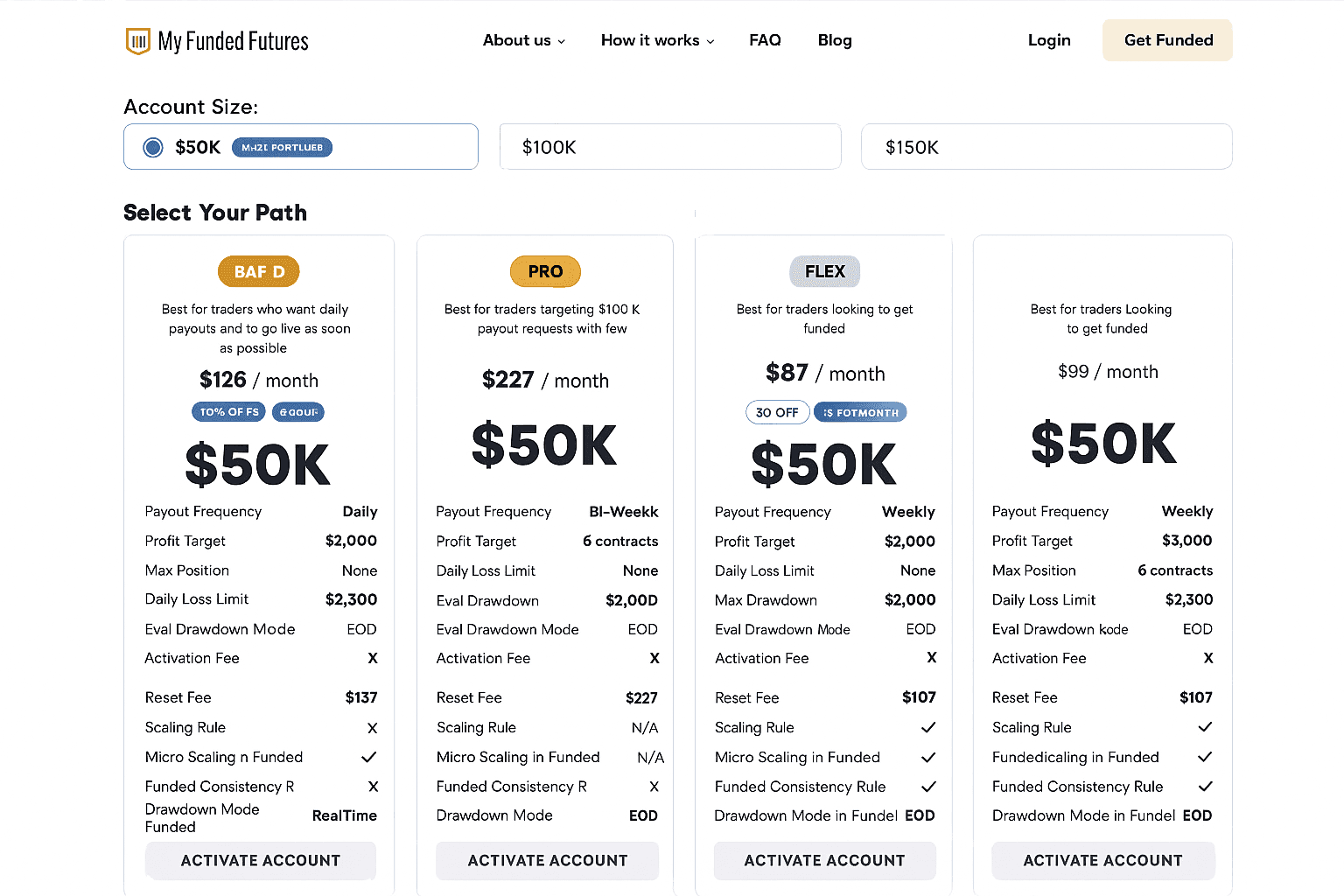
My Funded Futures Flex Account
The Flex account is the low-friction entry point. It is built for traders who want the lowest challenge fee and who value End-of-Day drawdown treatment during evaluation.
- $25,000 account - fee of $84 with a $1,500 target and $1,000 max loss
- $50,000 account - fee of $107 with a $3,000 target and $2,000 max loss
I can see why this plan gets attention. It is accessible, and it also permits Tier 1 news trading, which gives it more room than the Rapid or Pro path in volatile sessions.
My Funded Futures Rapid Account
Rapid is designed for traders who want a quicker route to withdrawals and who can handle a real-time trailing drawdown. That last point matters a lot. A strong unrealized move can lift the trailing floor under your account, and that can catch traders who assume the cushion behaves like End-of-Day logic.
- $50,000 account - fee of $157 with a $3,000 target
- $100,000 account - fee of $267 with a $6,000 target
- $150,000 account - fee of $347 with a $9,000 target
This model has the more aggressive intraday feel. It also offers larger contract limits, which helps active day trading systems, though the stricter news restrictions stay in place.
My Funded Futures Pro Account
The Pro account sits at the premium end of the range. It removes the daily payout cap and offers a path toward instant funding after a string of successful withdrawals.
- $50,000 account - fee of $227 with a $3,000 target
- $100,000 account - fee of $344 with a $6,000 target
- $150,000 account - fee of $477 with a $9,000 target
Its main advantage is at the funded stage. The consistency lock is gone there, which can make account management feel less rigid after evaluation is behind you.
There is also a published coupon code, TRUSTED, which is used for discounts on Flex, Rapid and Pro evaluations when active.
Our View on the Account Lineup
The account range is sensible once you look at it as a risk-routing system rather than a simple price sheet. Flex suits controlled traders who want a gentler structure. Rapid fits faster operators who understand trailing limits. Pro makes more sense for experienced traders who care about payout freedom after qualification.
Newer traders may struggle most with Rapid. That model can feel forgiving until an unrealized gain shifts the loss threshold upward and the account closes earlier than expected. I have seen that misunderstanding elsewhere too, and it is one of the more common prop firm evaluation mistakes.
Drawdown Rules and News Limits
My Funded Futures uses two different drawdown frameworks. Flex and Pro use End-of-Day drawdown, while Rapid uses a real-time trailing drawdown. That single distinction changes the account experience more than many traders realize.
With End-of-Day treatment, the loss floor updates at the close of the session, set at 5:00 PM EST. If your account moves into profit intraday and then settles back, the threshold does not lock in every unrealized peak the way a real-time trailing model does. On a practical level, that reduces the odds of being clipped by temporary intraday volatility.
Take a $50,000 account with a $2,000 loss limit. The floor begins at $48,000. If you float a gain during the day and finish flat, the End-of-Day model leaves the floor where it started. On a real-time trailing account, that same intraday high can raise the threshold and make future pullback room smaller. It is a bit like comparing filtered GPS tracks with raw data points. One gives you a cleaner route. The other reacts to every movement.
News policy also changes by model. Flex allows unrestricted news trading, including major scheduled events. Rapid and Pro restrict Tier 1 releases such as CPI or FOMC. Traders must stay out of those windows from 2 minutes before the event until 2 minutes after it.
That policy is one of the key risks and cons attached to the firm. Traders who build setups around major news bursts will find Flex more workable. Rapid and Pro are less flexible around those moments, even if they may suit other parts of the trading day. Another issue is enforcement. Breaching a drawdown rule or restricted-news rule can end an account immediately, and prop firms can update operating terms over time, so I would recheck the rule page before each new evaluation. Support speed matters too, especially if you need a ruling on a breach or payout status and the answer is not immediate.Understanding the rule set before paying for an evaluation matters more than the headline price. In prop trading, the account structure decides how much room you really have once the market starts moving.
Understanding the rule set before paying for an evaluation matters more than the headline price. In prop trading, the account structure decides how much room you really have once the market starts moving.
Trading Instruments at My Funded Futures
My Funded Futures keeps a fairly focused product map. The firm is built around major US futures exchanges and supports contracts tied to indexes, commodities and currencies. That narrower scope makes sense for a specialist prop firm, and it also helps execution consistency.
Available products include well-known index contracts such as NQ and ES, along with commodity contracts like GC and CL. Currency futures are also part of the lineup through standard exchange listings. In practice, that is enough market depth for many intraday systems without turning the platform into a cluttered catalog.
Instrument access may differ a bit by platform and account setup, though the core exchange coverage remains centered on CME-linked products. The firm also states typical commissions around $0.50 per side on Micros and $2.50 on Minis, which helps traders estimate real strategy cost under live-like conditions.
Spreads and Commissions
Execution cost matters more than a lot of marketing pages admit, especially for high-frequency day trading approaches. My Funded Futures uses a commission structure that resembles live exchange pricing closely enough to give traders a realistic read on net performance.
| Contract Type | Commission Per Side |
|---|---|
| Micro contracts | roughly $0.50 per side |
| Mini contracts | roughly $2.50 per side |
Those charges are deducted as trades are executed, so the account equity reflects them in real time. The absence of an activation fee helps on the front end, but ongoing commission drag remains the real operational cost. That is standard for a futures environment, and honestly I prefer seeing that cost exposed clearly rather than buried under a different label.
Trading Rules in 2026
The firm permits manual scalping and some semi-automated execution, which is good news for traders who operate with short holding periods. It does, however, prohibit swing trading because positions must be closed by 4:10 PM EST each day. Grid systems are also banned.
- Scalping - allowed
- Swing trading - prohibited because positions must be closed daily
- Grid trading - prohibited
- Trade copiers - allowed between a trader’s own My Funded Futures accounts
- News trading - open on Flex, restricted on Rapid and Pro during Tier 1 releases
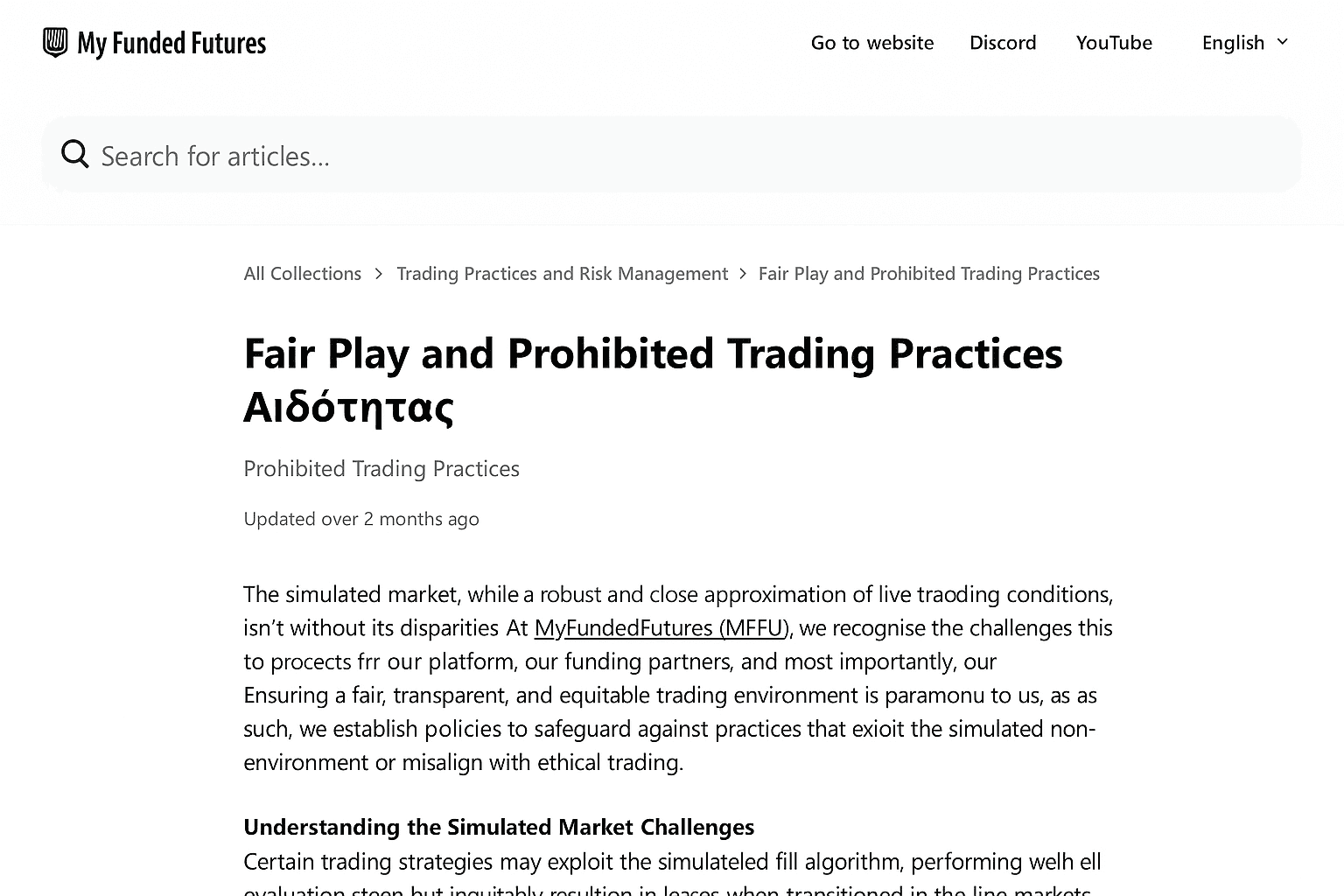
The prohibited behavior section is where the firm starts to look more serious than the usual generic prop page. Exploiting feed delays or simulator latency is forbidden. So is using opposite positions across separate accounts to work around drawdown rules. Account sharing also raises security flags, especially if sudden IP changes conflict with KYC or AML checks.
There is a practical distinction between softer platform limits and a hard breach. A softer case might simply prevent execution near restricted news. A hard breach involves drawdown failure or breaking the consistency requirement, which leads to immediate account termination.
Our Verdict on the Rules
The rules are readable, though they demand professional habits. From what I saw, My Funded Futures is better suited to controlled traders than to gamblers chasing one oversized day. The 50% consistency rule in the evaluation stage is the main filter, and it will frustrate anyone whose whole plan depends on landing one huge session.
Scaling Plan and Capital Growth
The scaling system is designed around steady performance. My Funded Futures says traders can build toward a maximum allocation of $1,000,000, but that path is tied to profit milestones and contract limit increases rather than instant jumps in size.
At the start, contract limits are relatively constrained on Flex and Rapid. As profits build, those limits rise. A common example is the $50,000 account, where reaching a set gain threshold can lift the Mini contract allowance. That method is fairly conservative, which I view as a positive. It keeps growth tied to demonstrated control instead of marketing language.
The evaluation consistency rule supports that design by filtering out lucky outlier days. Pro softens the structure somewhat by allowing more immediate contract access later on, though payout buffer requirements still apply.
Compared with some rival firms, this scaling approach is slower but cleaner. If you compare My Funded Futures with Topstep, the main difference is style. My Funded Futures leans hard on low activation friction and selected End-of-Day drawdown benefits, while Topstep has traditionally been recognized for its own structured funding path and broader brand familiarity. On fees, My Funded Futures usually competes by keeping entry costs lower on comparable evaluation sizes, while payout speed is often framed around 5 winning days on selected plans. The split also looks stronger early on because My Funded Futures advertises the first $10,000 at 100%, whereas Topstep has historically used a more standard split structure after qualification. Platform support is also a practical separator. My Funded Futures lists Tradovate, NinjaTrader, Quantower and TradingView, while Topstep is more closely associated with futures-focused platforms such as Tradovate and NinjaTrader. Traders choosing between them are usually comparing rule tolerance, platform preference, and how soon they want payout access.
Payment Methods and Payout Process
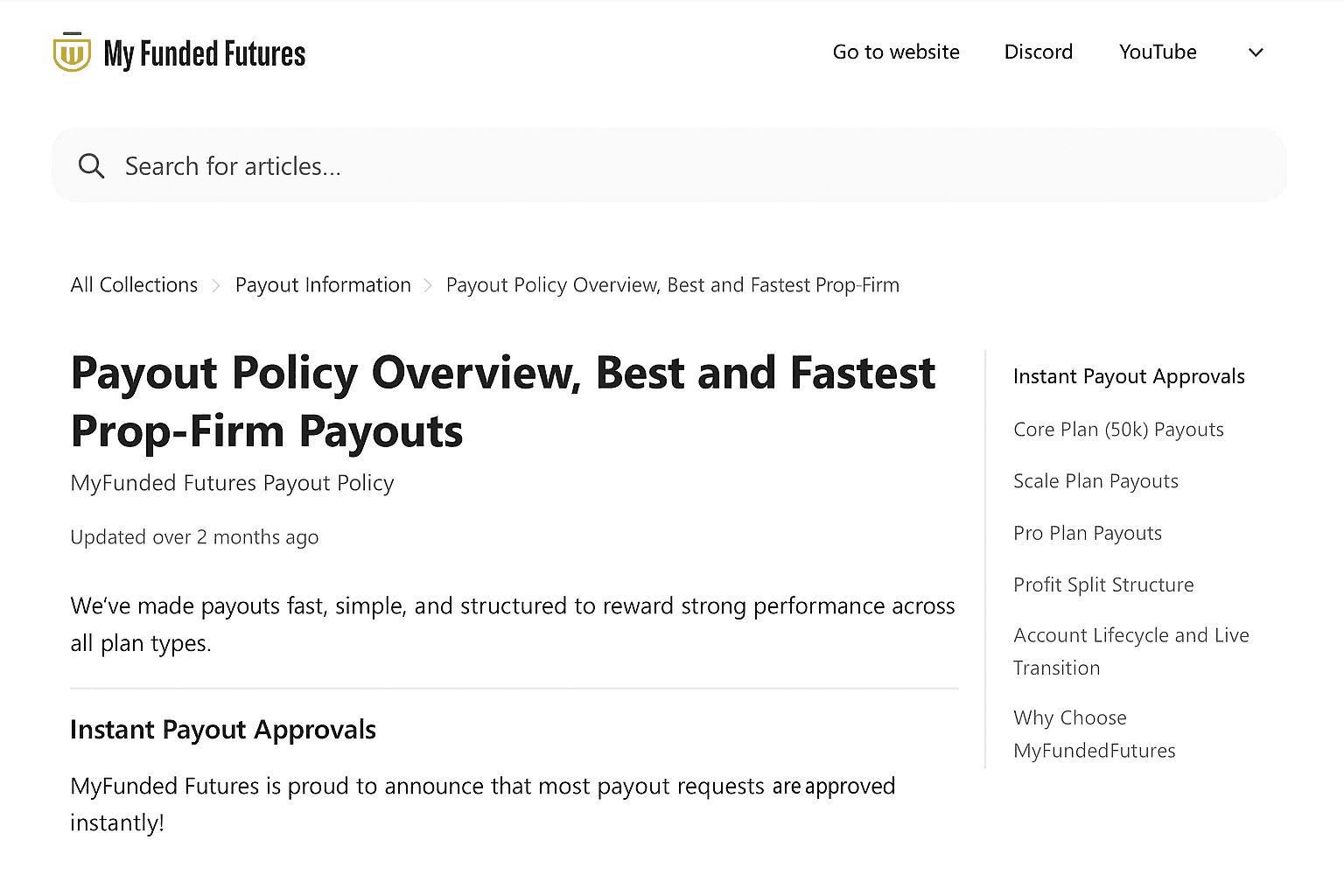
Reliable payouts are one of the biggest deciding factors in any prop firm, and My Funded Futures performs well on paper here. The firm has a reputation for fast processing, with requests often approved within 24 to 48 hours once eligibility conditions are met. That timetable is quick by industry standards.
For account purchases, the firm supports standard card payments and selected digital wallet options. On the payout side, Rise is the main distribution channel, with support for bank wire, crypto and ACH in qualifying regions.
The payout rules depend on the account model. Flex and Rapid require at least 5 winning days, and each of those days must meet a minimum daily profit threshold. Pro requires at least 14 trading days and a profit buffer before payouts are opened. Identity checks may also matter before funds are released, especially where KYC review or regional payment verification is required. The firm also uses plan-based caps and buffers, so the amount you can request is not the same on every account or every period. After that, the first $10,000 is paid at 100%, and the standard 80% split applies beyond it.
During my read-through, this was one of the more coherent parts of the whole setup. The payout logic is visible, the methods are recognizable, and the speed claims are reasonable enough to trust unless user reports change sharply.
Our View on Withdrawals
Yes, My Funded Futures appears to offer reliable payouts based on the published structure and public reputation around speed. The payout policy is also clearer than many competing firms. The main caution is simple - eligibility rules still matter, and they are tied closely to the account type you select.
Restricted Countries
My Funded Futures blocks participation from a long list of jurisdictions in order to stay aligned with international compliance rules. Because it operates from the United States, those restrictions are a material part of account eligibility and payout continuity.
The restricted list includes countries and territories such as Afghanistan, China, Cuba, Iran, Russia, Syria and Venezuela. It also includes a wide range of other jurisdictions across Africa, Europe and Asia. That list can change, so traders should verify current eligibility before purchasing a challenge.
This point is easy to overlook, but it matters. A prop firm account is only useful if your region remains valid under its terms. I tend to treat this kind of compliance check the same way I used to inspect coordinate references in GIS work - if the base layer is wrong, everything above it becomes unreliable.
Our Final Verdict on My Funded Futures
My Funded Futures is a legitimate and credible prop firm for futures traders who value low initial friction, transparent payout rules and account models that are clearly separated by drawdown behavior. The firm is especially attractive to disciplined day trading operators who can work within the 50% evaluation consistency rule.
The biggest strengths are easy to spot - zero activation fees, strong early payout terms and a meaningful scaling path. The main drawbacks are also clear - Rapid uses a stricter trailing structure, and major news restrictions apply on Rapid and Pro. Those are real limits, not footnotes.
Against firms like Topstep, My Funded Futures holds its ground by emphasizing cost efficiency and a futures-specific operating model. Traders who want a specialist prop firm with clear rules and reliable payout mechanics will likely find it worth serious consideration. Traders who need looser news access or a different evaluation feel may want to compare the rules side by side before committing.
FAQs
Is My Funded Futures a trustworthy and legitimate prop firm
Yes, it appears to be a legitimate operation with public leadership, a stated US presence, known platform integrations and a large base of public feedback. That does not remove all risk, though it does place the firm above many lightly documented competitors.
How do the drawdown rules work
Flex and Pro use End-of-Day drawdown, while Rapid uses a real-time trailing drawdown. That means Rapid reacts faster to intraday equity changes, which can make risk control more demanding.
Does My Funded Futures charge activation fees
No, the firm is known for charging no activation fees on its account plans.
Which account types are available
The main models are Flex, Rapid and Pro. Each one uses a different mix of drawdown handling and payout timing.
Can traders hold positions through news
Flex allows full news trading. Rapid and Pro restrict trading around Tier 1 releases, with a short blocked window before and after those events.
How does the profit split work
The first $10,000 in profits is paid at 100%. After that point, the standard split moves to 80% for the trader.
How fast are payouts
Published timelines indicate approval can happen within 24 to 48 hours once payout conditions are met. Actual eligibility depends on the specific account model.
Which platforms are supported
My Funded Futures supports Tradovate, NinjaTrader, Quantower and TradingView.
What is the current discount code
The active public code referenced in the article is TRUSTED, used when eligible promotions are running.
How does My Funded Futures compare with Topstep
My Funded Futures tends to appeal to traders who want zero activation fees and selective End-of-Day drawdown advantages. Topstep is a familiar alternative with its own structured process, so the better fit depends on how you handle evaluation rules and payout timing.


Exactly. More capital doesn't fix bad habits. Risk management and consistency matter regardless of where you trade.