


Cryptohopper Trading Bot Review For 2026
Cloud bots sound simple until you ask the practical question that matters most - does the system keep working when the market turns noisy? This Cryptohopper trading bot review gets straight to that point. Cryptohopper remains a real option in 2026 for traders who want cloud-based automation on major exchanges, but the fit depends heavily on how you trade, how much control you want, and how comfortable you are with a subscription business model.
Cryptohopper has been around since 2017 and is based in the Netherlands. The platform built its reputation as an accessible entry point into algorithmic trading for Cryptocurrency users who did not want to code or leave a local machine running all day. You connect an exchange through an API, load a strategy, and the bot handles execution in the cloud.
That design choice shapes everything. Cryptohopper is centered on the bot first, while a full terminal tends to focus on manual order handling and broader portfolio control across exchanges. I read that difference a bit like comparing a prepared route to an open GIS workspace. One gives you a clear path fast. The other gives you more room to inspect the terrain.
This article looks at the platform as it stands in 2026, including features, pricing, strengths, and limits. It also covers the extra questions people usually ask before opening an account, including whether Cryptohopper really works, what kind of starting balance is practical, and why claims about the most profitable crypto trading bot should always be treated carefully.
What Is Cryptohopper
Cryptohopper is a cloud-hosted automation platform built around bot execution on supported CEX venues. After linking your exchange with an API key, you can configure a strategy yourself or copy one created by someone else. The trades are then sent from the cloud, so your own device does not need to stay online.
The service was launched by Pim Feltkamp in 2017 and quickly found an audience among newer traders who wanted automation without writing scripts. That beginner-friendly angle still matters. Most of the setup happens through forms, toggles, and prebuilt logic instead of code.
A major part of the product identity is the marketplace. Strategy creators publish templates and signal services that other users can adopt inside their own Cryptohopper account. That lowers the learning barrier, though it also means your results may depend on assumptions you did not build yourself.
Key Features of Cryptohopper
Under the hood, Cryptohopper combines automation and exchange connectivity in one web dashboard. The platform keeps those layers manageable for newer users, and the layout is fairly easy to grasp after a few clicks.
- Automated Trading Bots
- Bot Marketplace
- Paper Trading
- Signal Subscriptions
- Exchange Integration
- Security Features
Automated Trading Bots
The core feature is the Cryptohopper bot engine. Bots run continuously in the cloud and can act on preset signals or rule-based entries. Users can adjust position sizing and risk controls before going live, which matters because automation without guardrails is rarely useful.
You can set up common bot logic without touching code. That is a meaningful plus for anyone interested in automation but still early in the learning curve. It also means the platform feels more like a managed framework than a developer tool.
Bot Marketplace
The marketplace is still one of Cryptohopper’s defining features. Designers publish ready-made bot setups, and users can copy them or subscribe to associated signals. Some are free, while others require separate payment.
This is one reason people speak positively about Cryptohopper. A lot of user feedback points to ease of use and customization. Some also like that it can reduce impulsive decision-making during volatility. Still, historical data on a template is only a partial map. It shows where a route worked before, not where the next storm will hit.
Paper Trading
Paper trading is available, and that makes the platform easier to test before exposing real money. You can watch how a bot behaves in changing market trend conditions and decide whether the logic still makes sense after a few sessions.
I generally like seeing this included because simulated mode reveals a lot of practical friction. In many tools, you notice within 10 or 15 minutes whether the workflow feels clear or awkward. Cryptohopper handles that part reasonably well.
Signal Subscriptions
Cryptohopper includes a signal ecosystem where outside providers send trade ideas that a bot can execute automatically. Some signals cost nothing, though many sit behind a paid subscription. That can be useful for traders who want external input, but it also adds another recurring cost layer.
Signal quality is uneven by nature. One provider may align well with your time horizon, while another may fail quickly when volatility rises. That is why I would treat signal services as data inputs, not as proof that a strategy is sound.
Exchange Integration
Cryptohopper connects with major exchanges through API access. If your routine is built around Binance or Coinbase, the experience is usually straightforward. The same goes for some other large venues such as KuCoin or HTX.
The limitation appears when your activity is spread more widely. Traders using a broader mix of exchanges may notice support gaps faster than expected, so checking current coverage before subscribing is important.
Security Features
On the security side, Cryptohopper supports multi-factor authentication and encrypted API key storage. The sensible setup is simple - create an API key with trading permission only and keep withdrawals disabled.
That follows normal cloud platform hygiene, though there is still third-party trust involved. Any service that holds exchange credentials sits on a sensitive layer of your setup, so the safest habit is to minimize permissions and review them regularly.
Cryptohopper Pricing in 2026
Cryptohopper uses tiered subscriptions. Higher plans generally unlock more capacity and more advanced options, especially around simultaneous positions or active bot use. Exact pricing shifts over time, so the live site is still the final source for current numbers.
The visible plan cost is only part of the picture. Paid signals and marketplace templates can push monthly spending higher than the headline tier suggests. I tend to think of this like route planning on a map. The main road looks simple, but the total distance changes once extra stops are added.
For a casual trader running a small setup, the cost may stay manageable. For someone stacking premium tools on top of the base plan, the monthly outlay can become hard to justify unless the workflow really earns its place. That cost stacking shows up repeatedly in user feedback and is worth taking seriously.
How Trading With Cryptohopper Works
The basic setup is fairly direct. You create an account, add exchange credentials through the dashboard, then choose a strategy. That may be a marketplace template or something you configure yourself. After that, you define the trade pair, allocate funds, and set controls such as stop loss or take profit.
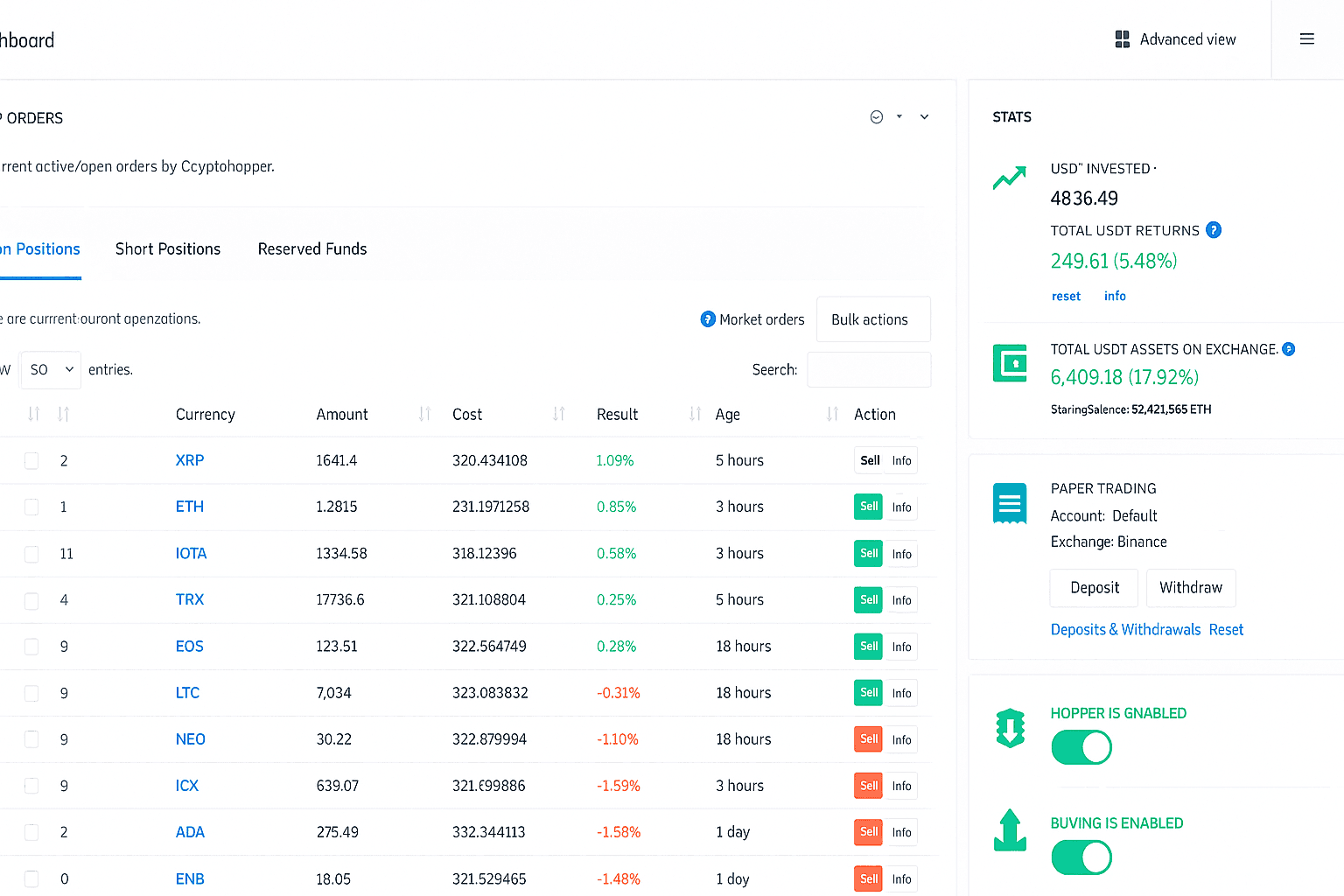
Once the configuration is active, the bot runs from the cloud. Monitoring happens through the web app or mobile app, and the platform keeps the process relatively light from a usability standpoint. During my review of the workflow, the handoff from setup to monitoring felt smooth enough after a few minutes of clicking through the panels.
Does Cryptohopper really work? In the narrow technical sense, yes. It can connect to supported exchanges, process bot rules, and execute orders through the API when conditions match. In user reports, the better experiences usually come from simple strategies on well-supported exchanges, while the weaker reports tend to appear during sharp volatility or when traders rely too heavily on copied templates without much testing. That pattern does not prove profitability, but it does show where the bot tends to behave as expected and where the weak spots show up faster.
Who Should Use Cryptohopper
Cryptohopper suits traders who want a hands-off system and are comfortable delegating execution to a cloud bot. It also fits people who mainly use one exchange or two and like the convenience of copying a prepared strategy instead of building one from scratch.
Beginners are often drawn to it because the infrastructure burden is low. You do not need to maintain a server or keep a laptop awake all night. The onboarding is easier than many algorithmic trading tools, and that alone explains part of its staying power.
The platform is less compelling for manual traders who rely on tight entries, rapid order changes, or a wider multi-exchange view. If your workflow depends on active chart reading and precise execution, a bot-first interface can feel limiting pretty quickly.
Cryptohopper Limits to Keep in Mind
The main limitation is the product philosophy. Cryptohopper is built around automation first, so manual trade control feels secondary. That is not a flaw in itself, though it narrows the audience.
Exchange breadth is another issue. Support is focused on larger CEX platforms, and that leaves holes for traders active on less common venues. Before paying for a plan, it is worth confirming that your preferred exchange is still supported and that the features you need are fully available there.
Reliability also deserves attention. During 2024 and 2025, some users reported outages during more volatile periods. For a cloud bot, that timing matters. If the platform is unavailable during sharp movement, the whole value proposition weakens because there is no local fallback handling the order flow.
Then there is pricing pressure. A base plan can look reasonable at first glance, but paid signals and marketplace add-ons may push the total much higher. Smaller accounts feel that weight sooner because platform fees consume a larger share of the working capital.
Pros and Cons
| Pros/Cons | Description |
|---|---|
| Pro | Cloud execution means your own computer does not need to stay on. |
| Pro | The marketplace makes copied automation easy to access. |
| Pro | Paper trading helps test a bot before going live. |
| Con | Manual trading tools feel lighter than a dedicated terminal. |
| Con | Costs can rise once paid signals are added. |
| Con | Performance depends heavily on uptime during volatility. |
The split is fairly clear. Cryptohopper is strongest when you want straightforward automation and are happy to work inside its framework. It becomes less attractive when you need more direct control or tighter cost discipline.
Cryptohopper vs Altrady
The comparison with Altrady matters because the two platforms are aimed at different working styles. Cryptohopper is centered on cloud bot automation. Altrady is built more like a trading terminal that includes automation as one layer inside a larger workspace.
That affects day-to-day use. With Cryptohopper, the typical path is to load a strategy and supervise it. With Altrady, the workflow leans harder into manual order handling, scanner use, and exchange-wide visibility. If you move between automation and direct execution in the same session, that difference is hard to miss.
Exchange coverage is another separator. Cryptohopper handles common venues well enough for many users. Altrady goes broader, which matters if your capital is split across multiple exchanges and you want one operational map instead of disconnected panels.
Manual order tools also tell the story. Cryptohopper was never really designed as a professional execution terminal, so its manual side remains lighter. Altrady is stronger if you want advanced order behavior while keeping bots available in the same environment.
Both platforms offer paper trading. Altrady also puts more emphasis on backtesting, which matters if you want to test your own logic against historical data instead of relying mainly on marketplace claims. If I had to summarize the distinction plainly, Cryptohopper is a bot platform first, while Altrady is a broader trade workspace with automation built in.
Is Cryptohopper Still Worth It in 2026
For a pure bot user, the answer can still be yes. If your exchange support is covered, your expectations are realistic, and you are comfortable with copied strategies or managed signals, Cryptohopper remains a capable service in 2026.
For more demanding traders, the answer is less generous. A lot of active users now expect stronger manual tools, broader exchange access, and cleaner validation features such as backtesting. The market has shifted, and bot-only platforms no longer feel like the default answer for everyone.Any bot can look impressive in a calm stretch. The real test is whether the rules still hold once volatility distorts the signal.
Any bot can look impressive in a calm stretch. The real test is whether the rules still hold once volatility distorts the signal.
That leads into another common question - which is the most profitable crypto trading bot? There is no honest universal answer. User discussions tend to mention different bots at different times, and the names change with the market cycle. Cryptohopper is usually judged more on ease of use than on any settled claim of superior profitability. From what I have seen, traders who talk about strong results usually tie them to a specific setup, while losing reports often trace back to weak signals or poor oversight.
What Users on This Page Say About Cryptohopper
The sentiment presented on this page is mixed, though it leans positive on usability. Users tend to like how easy Cryptohopper is to start with, especially if they want automation without coding. The marketplace and paper trading also come through as practical strengths.
The negative side is more about limits than legitimacy. Feedback repeatedly points to rising costs once paid signals are added, lighter manual tools, and concern about uptime during volatile periods. Put simply, the praise is usually about convenience, while the criticism is usually about control and reliability.
Best Alternative to Cryptohopper
For traders who have moved past a bot-only setup, Altrady stands out as the strongest alternative in this comparison. The platform is structured as a multi-exchange terminal first, which gives it more room for active trade management.
Its advantages are practical rather than flashy. You get wider exchange integration and stronger order controls. Bots are still there, but they sit inside a larger system instead of defining the whole product.
That balance matters. Some traders want automation available without handing the entire workflow to a marketplace template. If that sounds familiar, Altrady is likely the better fit.
Frequently Asked Questions
Is Cryptohopper Legit
Yes. Cryptohopper is a real company from the Netherlands with operating history going back to 2017. The platform has a visible user base and a long enough track record to be considered established. The more useful question is whether its structure matches your workflow.
Is Cryptohopper Safe
Cryptohopper follows standard cloud security practices, including multi-factor authentication and encrypted handling of API credentials. That makes it reasonably safe by industry standards, though any cloud platform using exchange access involves third-party risk. Limiting your API key permissions remains the most important safeguard.
How Much Does Cryptohopper Cost
The service uses tiered monthly plans. On top of that, some marketplace tools and signal feeds carry separate fees. The total cost can therefore be higher than the base plan suggests, especially for users who add premium services quickly.
What Is the Minimum Amount to Start With Cryptohopper
Cryptohopper itself does not work like an exchange wallet with a universal minimum deposit. The practical minimum depends on the connected exchange, the coin being traded, and the order size rules on that venue. A small starting amount is possible on some markets, but it still needs to be large enough to satisfy exchange minimums and leave room for the strategy to function properly.
Can You Use Cryptohopper and Altrady Together
Technically yes. In practice, most traders prefer one main platform so the workflow stays cleaner and subscription costs stay easier to manage. If your routine is mostly automated, Cryptohopper may be enough. If you want stronger manual control with automation available on demand, Altrady is the simpler long-term setup.
Conclusion
Cryptohopper still has a place in 2026. It delivers accessible automation, a strong marketplace, and a smoother entry point for users interested in bot-driven Cryptocurrency trading. The platform works best when your focus is cloud execution and your exchange coverage lines up with what it supports.
Its weaknesses are also easy to see. Manual trade handling is limited, reliability during fast market conditions has drawn concern, and the subscription business model can become more expensive once extra services are layered in.
From what I have seen, the larger shift in crypto software is toward unified terminals that combine automation with direct control. That model fits more real-world workflows because traders rarely use one method all the time. If you want only a cloud bot, Cryptohopper remains a valid choice. If you want a broader operating console with deeper control over data and execution, a platform like Altrady makes more sense.


Has anyone found any decent crypto communities recently? Not looking for magic signals, just something more organized.
I was looking through a few Telegram communities and found https://www.directionsmag.com/reviews/crypto-channels-telegram/elixir. What I liked about the concept is that it seems more focused on building a structured community rather than just posting random messages.
That's the difference. The format matters a lot. A community that explains its approach is usually easier to evaluate.