
Airbus Supports a New Coffee Canopy Mapping Initiative


Airbus Defence and Space has been appointed as the technical partner for the Coffee Canopy Partnership, a program focused on improving visibility across coffee-growing regions.
A Joint Effort to Map Coffee Landscapes
Spearheaded by JDE Peet's, whose portfolio includes the following brands, this ambitious collaboration is working to build the first open, large-scale map of coffee plantation areas worldwide.
- Douwe Egberts
- Senseo
- Tassimo
- Other major coffee brands
The goal is to strengthen supply chain transparency, advance sustainability in agriculture, and help reduce deforestation tied to coffee production.
The partnership also unites key traders and coffee roasting groups.
| Company Name | Role in Partnership |
|---|---|
| Louis Dreyfus Company | Partner |
| Sucden | Partner |
| Neumann Kaffee Gruppe | Partner |
| Touton | Partner |
| Sucafina | Partner |
| Tchibo | Partner |
It is backed by the Foreign, Commonwealth and Development Office of the United Kingdom and the Food and Agriculture Organization of the United Nations, reinforcing links between food systems, sustainable development, and forest protection across Africa.
Satellite Data and Artificial Intelligence in Action
Using Pleiades and more recent satellite imagery from Pleiades Neo, Airbus applies artificial intelligence to extensive data collections so coffee farms can be detected and tracked from space with unprecedented precision. This technology helps identify shade-grown coffee systems, agroforestry patterns, and complex plantation structures spread across diverse landscape conditions in East Africa.
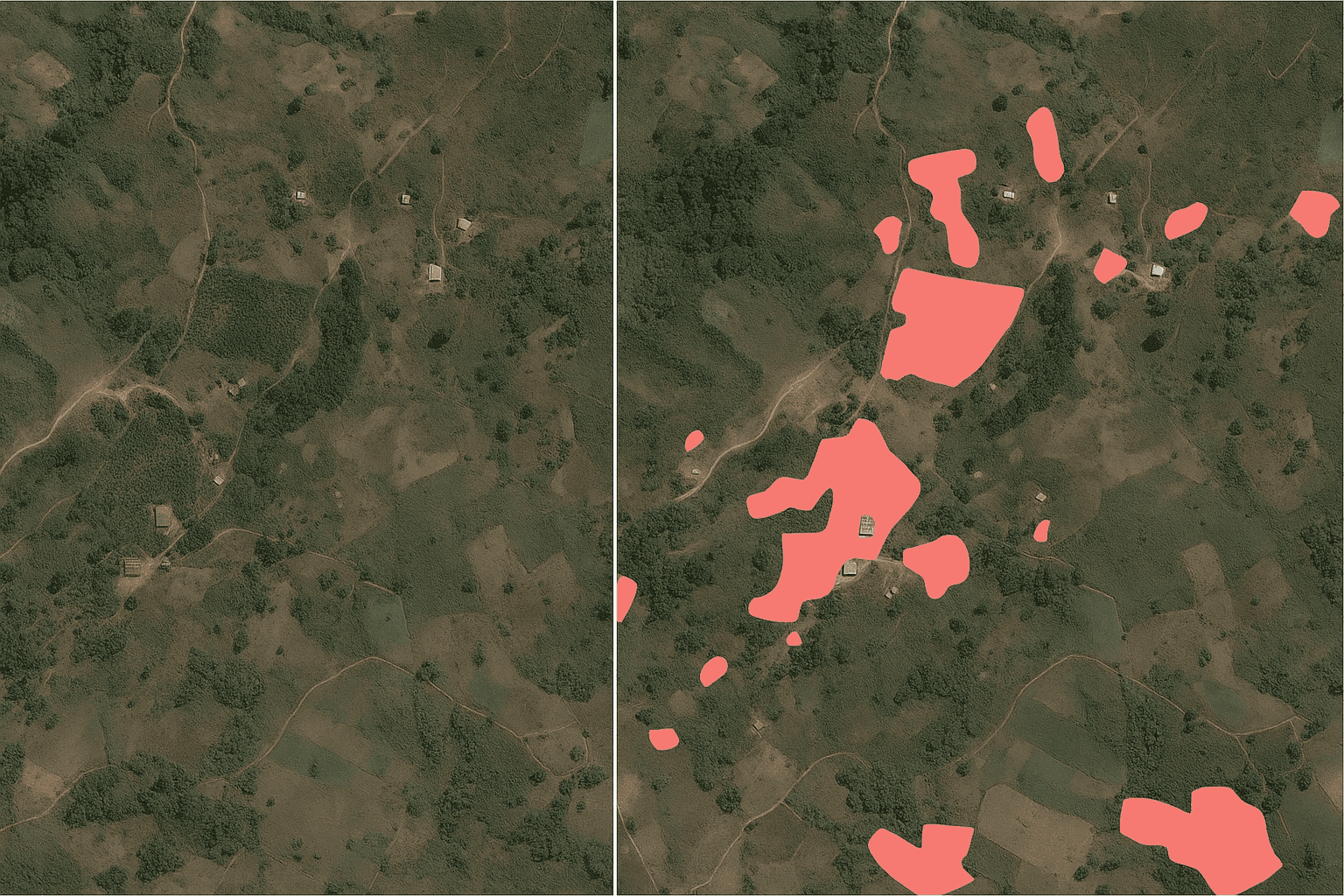
In coffee cultivation, agroforestry refers to growing coffee alongside trees and other vegetation rather than in a fully cleared field. Shade-grown coffee is closely related because the coffee plants are cultivated under a canopy of trees, making it one of the most common forms of coffee agroforestry. In practice, these systems can improve habitat for wildlife, support soil health, moderate temperature extremes, and help retain moisture, but they can also be harder to manage, require more local knowledge, and sometimes produce lower short-term yields than intensive sun-grown systems.
The approach has already been rolled out over more than 1.2 million km² in Africa, including areas relevant to Kenya, Uganda, Tanzania, Rwanda, Burundi, and Ethiopia. The resulting information can help governments, local communities, and the coffee industry evaluate risk, support smallholding livelihoods, improve market access, and guide climate change mitigation strategies through better forest and old-growth forest monitoring. Coffee farming can have mixed environmental effects: when production expands through forest clearing, it can reduce biodiversity and release stored carbon, but when farms maintain tree cover, they can support carbon sequestration in vegetation and soils while providing habitat for birds, insects, and other species. These outcomes depend heavily on how each farm is managed and how much natural vegetation remains in the wider landscape.
Why the Partnership Matters
By shifting attention from isolated corporate programs to a broader landscape model, the initiative aims to protect entire coffee-growing territories rather than only individual supply chain footprints. This can improve transparency behavior across the sector while supporting economics of coffee, forest protection, and more durable planning for coffee production.
The framework is intended as a practical sector collaboration rather than another certification model. Its emphasis is on shared action that can keep forest areas healthier over time, strengthen sustainability goals, and help prevent coffee-related deforestation. The project also highlights how Airbus expertise, developed in places such as Toulouse and across the European Union, can be adapted to agriculture challenges. While companies such as Nestlé, Keurig Dr Pepper, and Dr Pepper are not named as founding members, the initiative signals how scalable tools, from satellite analysis to rail transport modelling and other planning methods, may eventually support broader food and supply systems.Laurent Sagarra, VP Engagement at JDE Peet's, said the partnership is meant to replace scattered company-by-company forest efforts with coordinated work at the landscape level, encouraging all players in the coffee sector to participate in safeguarding growing regions and reducing long-term deforestation pressure.
With Airbus Defence and Space delivering the technical foundation and international partners including the United Nations and the Foreign, Commonwealth and Development Office contributing support, the Coffee Canopy Partnership is positioning data-driven mapping as a practical route toward sustainability, stronger supply chain resilience, and better outcomes for coffee farmers across East Africa and beyond.


