


Crypto Chart Patterns: How to Apply Them to Your Trading Strategy


Crypto chart patterns are recurring formations on a chart created by changes in cryptocurrency price over time. In technical analysis, these shapes help a trader assess a market trend, judge momentum, and estimate whether an asset may continue moving in the same direction, reverse, or pause in consolidation. They can appear on very short-term charts used for day trading as well as on daily or weekly data. Even so, no chart pattern can forecast the future with certainty, so context, news flow, and risk management still matter.
What Are Crypto Chart Patterns?
A crypto chart pattern is a recognizable structure that develops as buyers and sellers interact over time. These formations can be seen on nearly any chart interval, from five-minute views to long-term weekly setups. Because they reflect shifts in pressure, order flow, support and resistance, and trader behavior, they are often used to frame possible outcomes rather than guarantee them.
For a trader in finance, pattern recognition can help identify areas where price may trend, stall, or change direction. Still, past behavior is only historical data, not a promise of what comes next.
How Do Crypto Trading Chart Patterns Work?
These formations emerge when repeated buying and selling behavior leaves visible shapes on a candlestick chart. Whether viewed intraday or across several weeks, they can hint at changing sentiment, a weakening or strengthening market trend, and shifts in market liquidity. In many cases, they also reveal where pressure is building before a breakout or breakdown.
CFD traders often include chart pattern analysis inside a broader trading strategy instead of using it alone. A more complete approach may combine the chart with indicators, volume, and support and resistance levels. Platforms such as TradingView allow traders to study these setups on different timeframes, compare one asset with another, and review historical data for backtesting.
What Types of Crypto Trading Chart Patterns Are There?
Most crypto chart patterns fall into three broad categories: continuation patterns, reversal patterns, and bilateral patterns.
| Pattern Category | Description | Example Patterns |
|---|---|---|
| Continuation | Suggests the prevailing trend may pause and then continue. | Flags, pennants, ascending triangles |
| Reversal | Suggests the current trend may weaken and change direction. | Head and shoulders, double top, double bottom |
| Bilateral | Can break in either direction, so traders wait for confirmation. | Symmetrical triangles, some wedge formations |
Knowing which category may be developing can help you prepare a trade plan for multiple outcomes. Even so, volatility in the cryptocurrency market means no setup is perfect, and management of risk remains essential.
There is no single fixed number of crypto chart patterns. In practice, traders commonly focus on a core group of roughly 10 to 20 widely recognized patterns, but the exact number varies depending on how patterns are classified and which setups an individual trader chooses to include.
Examples of Well-Known Crypto Chart Patterns
These formations can appear across the digital-asset market, from Bitcoin to Ethereum and smaller altcoins. They are not unique to cryptocurrency, but 24-hour trading and elevated volatility in finance often make them easier to spot on a chart than in some traditional markets. Below are several classic examples often discussed in technical analysis.
Here are some familiar structures visible on charts for crypto assets such as BTC and ETH.
Head and Shoulders
The head and shoulders (chart pattern) is one of the best-known reversal setups. It usually suggests a change from bullish momentum to bearish momentum. The structure contains three peaks, with the center peak forming the head and the two outer peaks forming each shoulder. The lows between those peaks create the neckline, which traders often watch as a key support area.
When price breaks below the neckline, many traders view that move as confirmation. In crypto, however, volume confirmation can be less dependable than in some other markets.
The inverse version points to the opposite possibility: a move from bearish conditions toward a bullish phase. In that case, the chart shows three troughs, with the middle trough the deepest, and a move above the neckline may indicate the start of a new upswing.
ETH Head and Shoulders Example
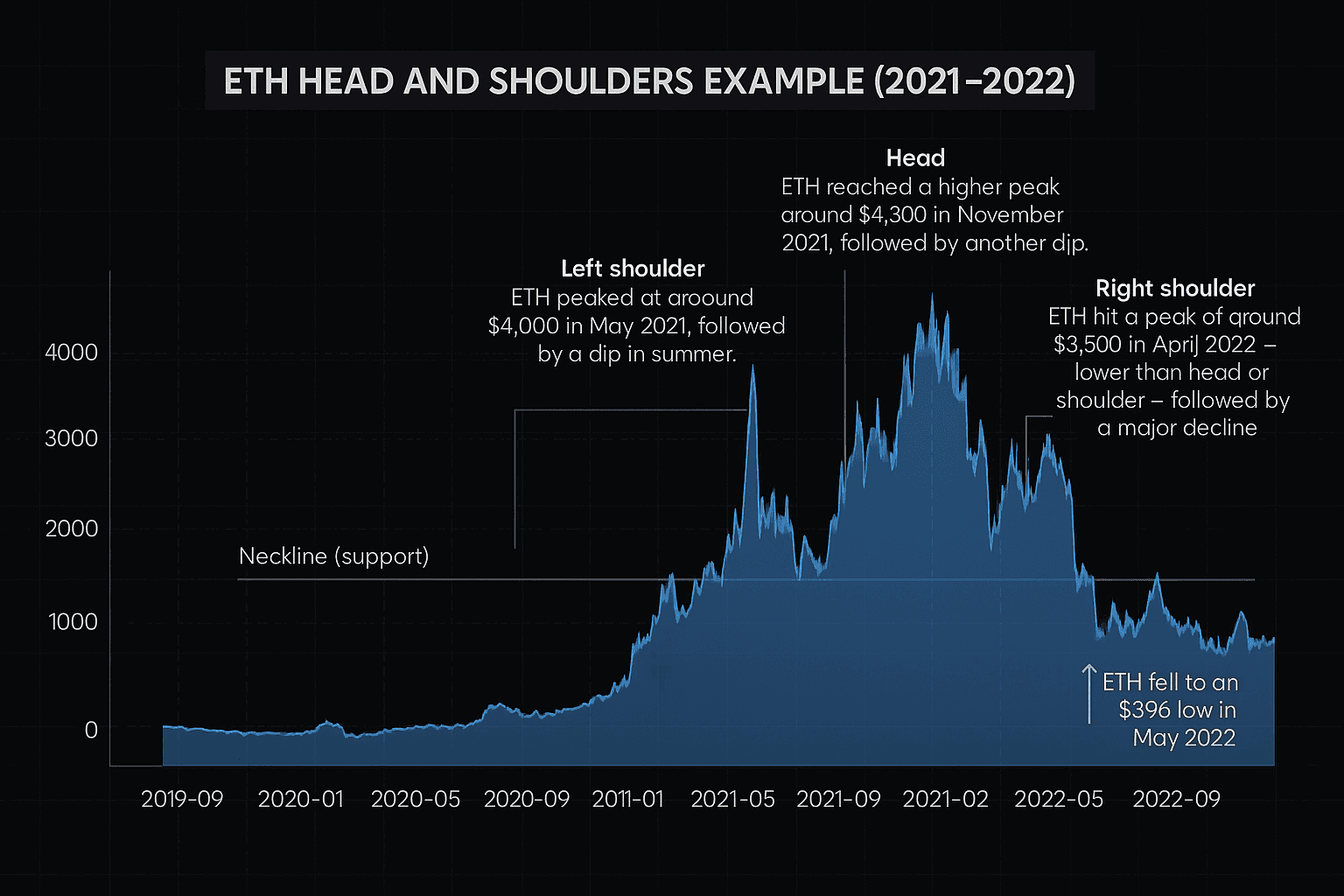
On Ethereum’s daily chart in 2021-2022, a large head and shoulders structure completed and was followed by a decline after price moved beneath the neckline.
The ETH setup unfolded in this sequence:
- Left shoulder: It formed in early 2021, when ETH reached highs near $4,000 in May.
- Head: The central peak appeared later in 2021, topping out around $4,800 in November.
- Right shoulder: This section developed from early to mid-2022 and showed highs broadly comparable with the left shoulder, around $3,500-$3,600.
- Neckline: Support was visible in the $1,750-$1,850 area and was tested repeatedly during 2021 and 2022.
- Breakdown: A confirmed move under $1,800 on strong activity appeared to validate the pattern, although the projected target mentioned in the original example was unusually large and should be treated with caution.
Double Top and Double Bottom
Double top and double bottom formations are commonly used to identify possible reversals near highs and lows. They can develop on short-term charts or on daily timeframes.
A double top often forms when price tests the same resistance area twice and then turns lower, creating an M-like shape. A double bottom is the opposite, producing a W-like structure after price rebounds twice from support. Some traders loosely compare the rounded nature of these formations with a double hull shape, although that is not a standard technical term.
For beginners, the double top and double bottom are often among the easiest patterns to learn because the structure is simple, the key support or resistance area is usually clear, and confirmation rules are more straightforward than in some complex formations. Many new traders also find flags useful once they are comfortable identifying a strong prior trend and a short consolidation.
SOL Double Bottom Example
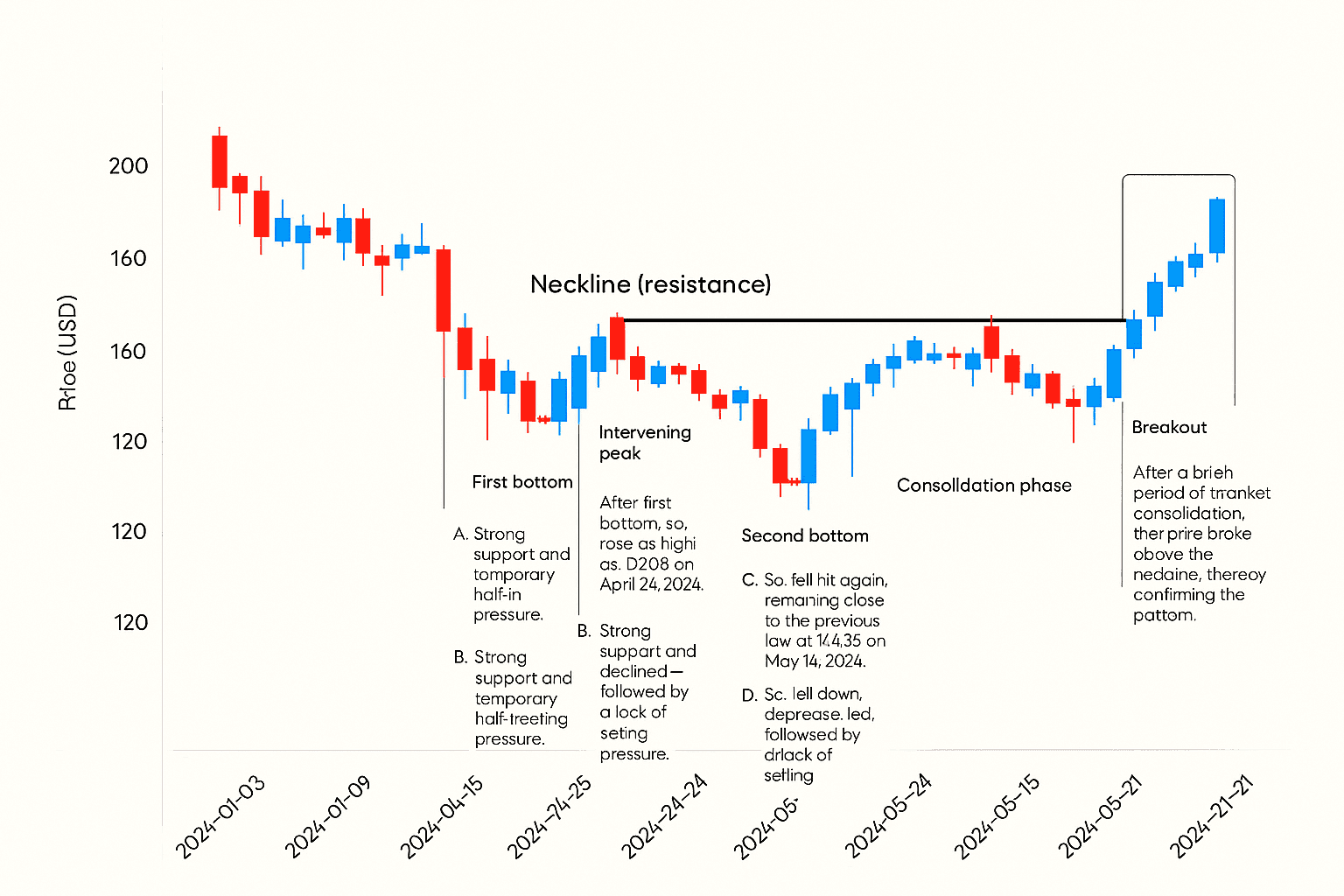
During April and May 2024, Solana formed a double bottom pattern in the following order:
- First bottom: In mid-April 2024, SOL fell to a low near $119.83.
- Intervening peak: A short rebound lifted price to $159.94 by late April.
- Second bottom: Support was tested again in early May near $119.38.
- Breakout: In the second half of May, SOL moved above the $160 resistance zone and confirmed the reversal before extending higher.
Triangles
Triangle formations are consolidation setups that often develop when the market lacks clear direction. They usually come in three forms:
- Ascending triangle: A flat upper boundary with rising lows, often interpreted as bullish.
- Descending triangle: A flat lower boundary with falling highs, often viewed as bearish.
- Symmetrical triangle: Two converging trendlines where the eventual move can break in either direction.
XRP Symmetrical Triangle Example
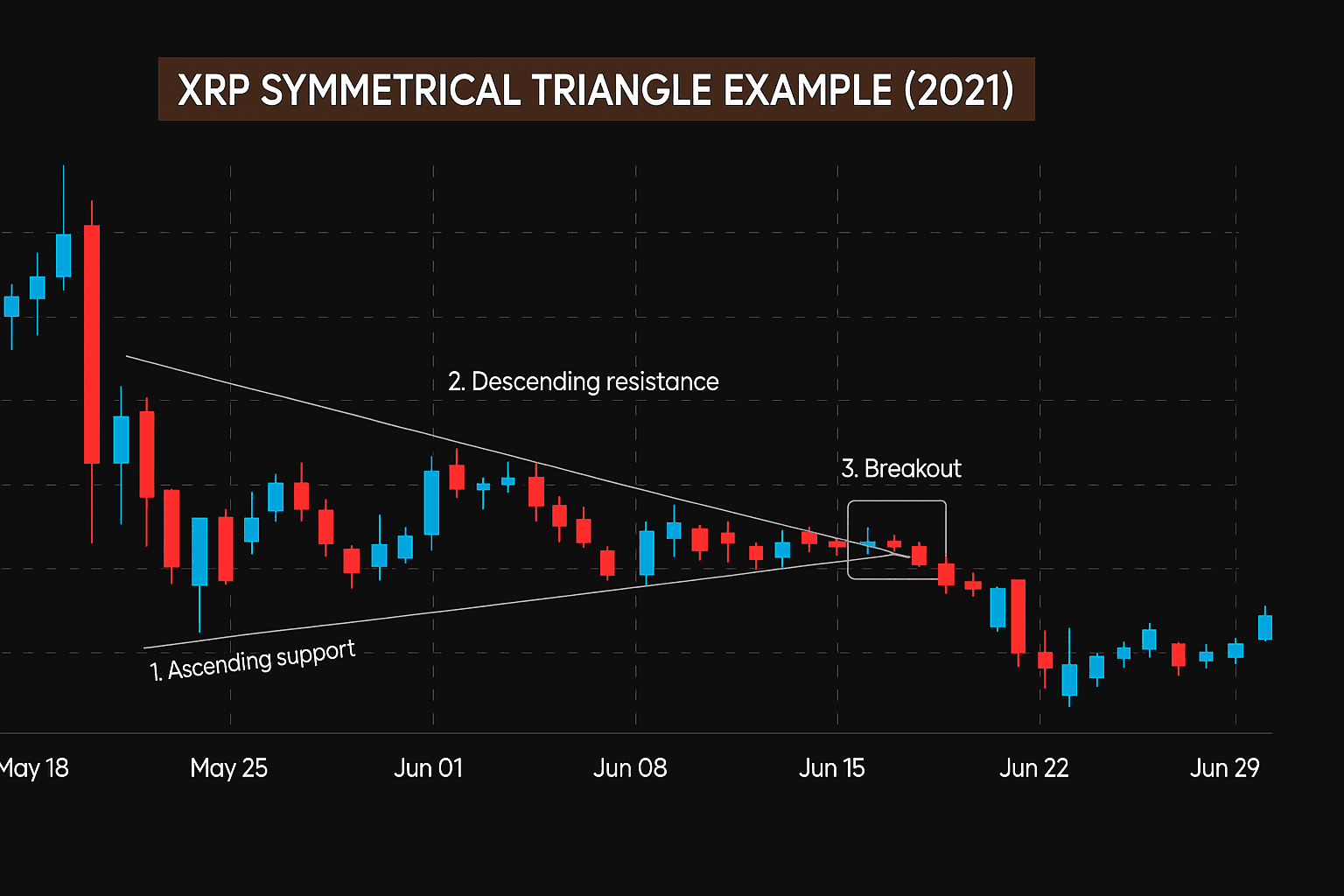
Between 16 May and 12 June 2021, XRP displayed the characteristics of a symmetrical triangle. The formation suggested shrinking volatility and increasing pressure as the two trendlines narrowed toward an apex.
- Triangle base: A series of higher lows formed at $0.65 on 23 May 2021, $0.76 on 24 May, $0.80 on 30 May, and $0.84 on 11 June.
- Descending resistance: Lower highs appeared at $1.61 on 16 May, $1.08 on 3 June, and $0.95 on 6 June.
- Apex: By 11-12 June, price had compressed tightly near $0.83-$0.84 as the triangle neared completion.
- Breakout or breakdown: A decisive move beyond that zone could have signaled the next trend, and the actual result was a breakdown around 16 June.
Flags and Pennants
Flags and pennants usually appear after a strong directional move. They mark a short pause before the prior trend potentially resumes. A flag normally looks like a small rectangle, while a pennant resembles a compact symmetrical triangle. In both cases, traders interpret the pause as consolidation rather than immediate reversal.
AVAX Bullish Flag Example
A classic bullish flag formed on AVAX in December 2021, suggesting continuation after a sharp upward move.
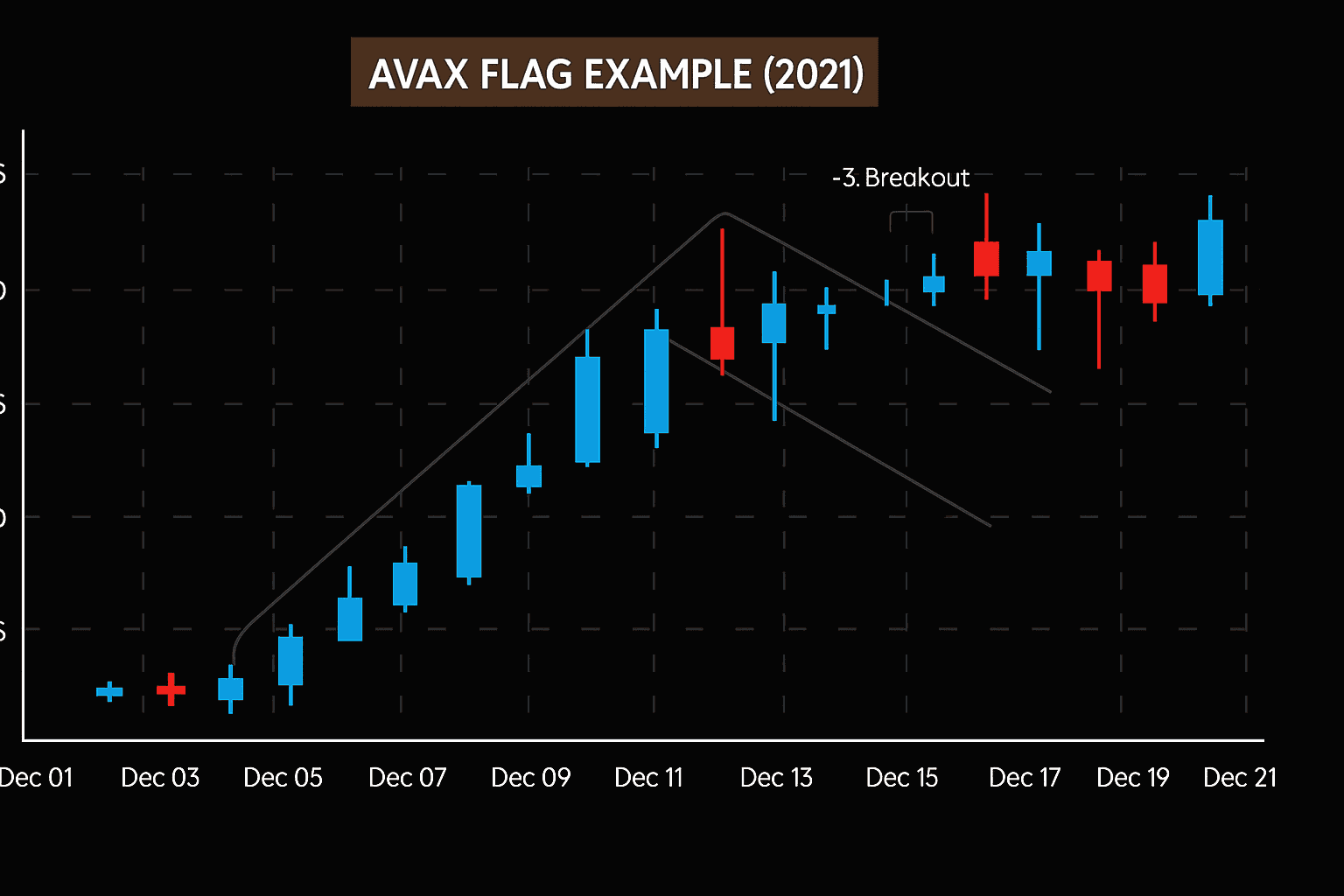
- Flagpole: AVAX advanced strongly between 4 December and 12 December 2021.
- Flag: From 12 December to 14 December, the market moved sideways in a tight rectangle just below recent highs.
- Breakout: On 15 December, price pushed above the consolidation area and confirmed the continuation setup.
Chart patterns are most useful when they are combined with confirmation tools and disciplined risk management rather than traded as standalone signals.
Our editorial team often notes that studying a wider set of classic formations can improve pattern recognition and decision-making.
How to Use Crypto Chart Patterns in Your CFD Trading Strategy
Crypto chart patterns can be part of CFD-based trading strategy design. They may provide entry or exit clues, but they are often more useful for mapping scenarios before placing an order on an exchange or through a broker. For example, a pattern can help define where a breakout may occur, where invalidation sits, and how much money is at risk if the move fails.
In practice, many traders combine the chart pattern with indicators, market context, and management rules. That can include setting stop-loss levels, measuring reward-to-risk ratios, and reviewing whether the setup still makes sense after major news events.
A practical way to identify and trade chart patterns is to follow a simple process. First, choose the timeframe that matches your strategy and mark the main support and resistance levels. Next, look for a recognizable structure such as a double bottom, triangle, or flag. Then wait for confirmation, which may include a neckline break, a trendline break, higher trading volume, or agreement from indicators such as RSI or MACD. After that, define entry, stop-loss, and target levels before the trade is opened. Finally, monitor whether the pattern remains valid and avoid forcing a trade if market conditions change.
Crypto Chart Patterns vs. Indicators: Key Differences
Both chart patterns and technical indicators are valuable tools, but they operate differently.
- Chart patterns: These are visual formations that repeat on a chart and may imply continuation or reversal.
- Indicators: These are mathematical calculations built from price, volume, or other data.
A double top and double bottom setup, for example, can suggest that momentum is fading at an extreme. Because the reading is visual, interpretation can differ between traders, especially when market liquidity is thin.
Common examples include RSI, MACD, and Bollinger Bands. They can help confirm a chart pattern, reveal overbought or oversold conditions, or show changes in momentum that are not obvious from price action alone.
In simple terms, patterns are shape-based, while indicators are formula-based. Used together, they can offer better context than either tool in isolation.
Our analysts generally find that combining indicators with chart structures improves discipline, especially in fast-moving crypto conditions.
Common Mistakes When Trading Crypto Chart Patterns
Although chart patterns can be useful, they work best when approached with discipline, patience, and strong risk controls. Several common errors can reduce their value.
- Pattern confirmation bias
- Using patterns in isolation
- Ignoring timeframe alignment
- Missing failed breakouts
- Weak risk management
- Chasing extended moves
- Failing to review results
Pattern Confirmation Bias
One of the most frequent mistakes is seeing a formation that is not actually there. In a highly volatile market, random swings can resemble a triangle, a rectangle, or even head and shoulders without meeting the usual criteria. Confirm trendlines, neckline levels, and other supporting evidence before acting.
Using Patterns in Isolation
Relying only on a visual setup can lead to weak trades. A chart pattern should be considered alongside technical analysis tools, broader context, and current news. This is especially important in altcoins, where low market liquidity can distort price action.
Ignoring Timeframe Alignment
A setup on a 15-minute chart may not match what appears on a daily chart. Day trading signals can fail when they run against the higher-timeframe market trend, so it is important to align the trade with the broader structure whenever possible.
Missing Failed Breakouts
Crypto markets often produce fake-outs, where price briefly moves beyond a boundary and then reverses sharply. Entering too early without confirmation from volume, support and resistance, or related indicators can raise risk substantially.
Weak Risk Management
No formation is foolproof. Without stop-loss planning, position sizing, and clear risk management rules, a single trade can cost more money than expected. Good management matters just as much as identifying the setup itself.
Chasing Extended Moves
Buying after a breakout has already traveled too far is another common error. When momentum starts to fade, late entries often offer less upside and greater downside.
Failing to Review Results
Without reviewing completed trades, it is hard to improve. Backtesting and post-trade analysis can show which setups work best for your trading strategy, how volatility affects outcomes, and where execution needs adjustment.
Pattern reliability is influenced by several factors, including timeframe, market liquidity, overall trend direction, nearby support and resistance, major news events, and whether volume confirms the move. Risk management can also go beyond stop-loss placement alone. Many traders use position sizing rules, limit total exposure across correlated trades, diversify where appropriate, and avoid overtrading during unclear market conditions.
As a side note, the word trough is sometimes encountered in other fields, such as trough (meteorology), but in chart work it refers to a low point in price rather than a weather system.
FAQ
What Are the Most Common Crypto Chart Patterns?
Frequently used formations include head and shoulders, double top and double bottom setups, wedges, pennants, flags, and the triangle family. These can appear in major assets like Bitcoin and Ethereum as well as in smaller markets. Their usefulness depends on context rather than on the shape alone.
Can Crypto Trading Chart Patterns Predict Prices?
No. They do not predict price with certainty. Instead, they highlight probabilities based on historical behavior and current market structure. External forces such as news, sudden changes in liquidity, and shifts in sentiment can all alter the outcome.
Are Chart Patterns Reliable in Volatile Crypto Markets?
They can be helpful, but volatility makes false signals more common. That is why many traders seek confirmation from indicators, volume, and support and resistance before entering a trade. Stronger risk management can also reduce damage when a setup fails.
What Tools Help Identify Crypto Trading Patterns?
Most traders use charting software such as TradingView or broker-provided platforms to study a chart, draw levels, and compare data across timeframes. Some tools offer automated pattern recognition, but manual review is still widely used because human judgment remains important.
Can I Make $100 a Day From Crypto?
It is possible in some market conditions, but it is not guaranteed and it involves meaningful risk. Whether a trader can make $100 a day depends on starting capital, experience, strategy quality, fees, market volatility, and risk tolerance. For newer traders, focusing on consistency and capital preservation is usually more realistic than aiming for a fixed daily profit target.
In summary, crypto chart patterns can help structure analysis, clarify market trend direction, and support better trade planning. They are most effective when combined with technical analysis, disciplined execution, and careful risk management rather than treated as a standalone shortcut.


No comments yet. Be the first to share your thoughts.