


US-based Crypto Coins to Watch in 2026


This guide spotlights nine crypto projects with substantial U.S. ties as friendlier policy signals and clearer oversight reshape the domestic digital asset market in 2026.
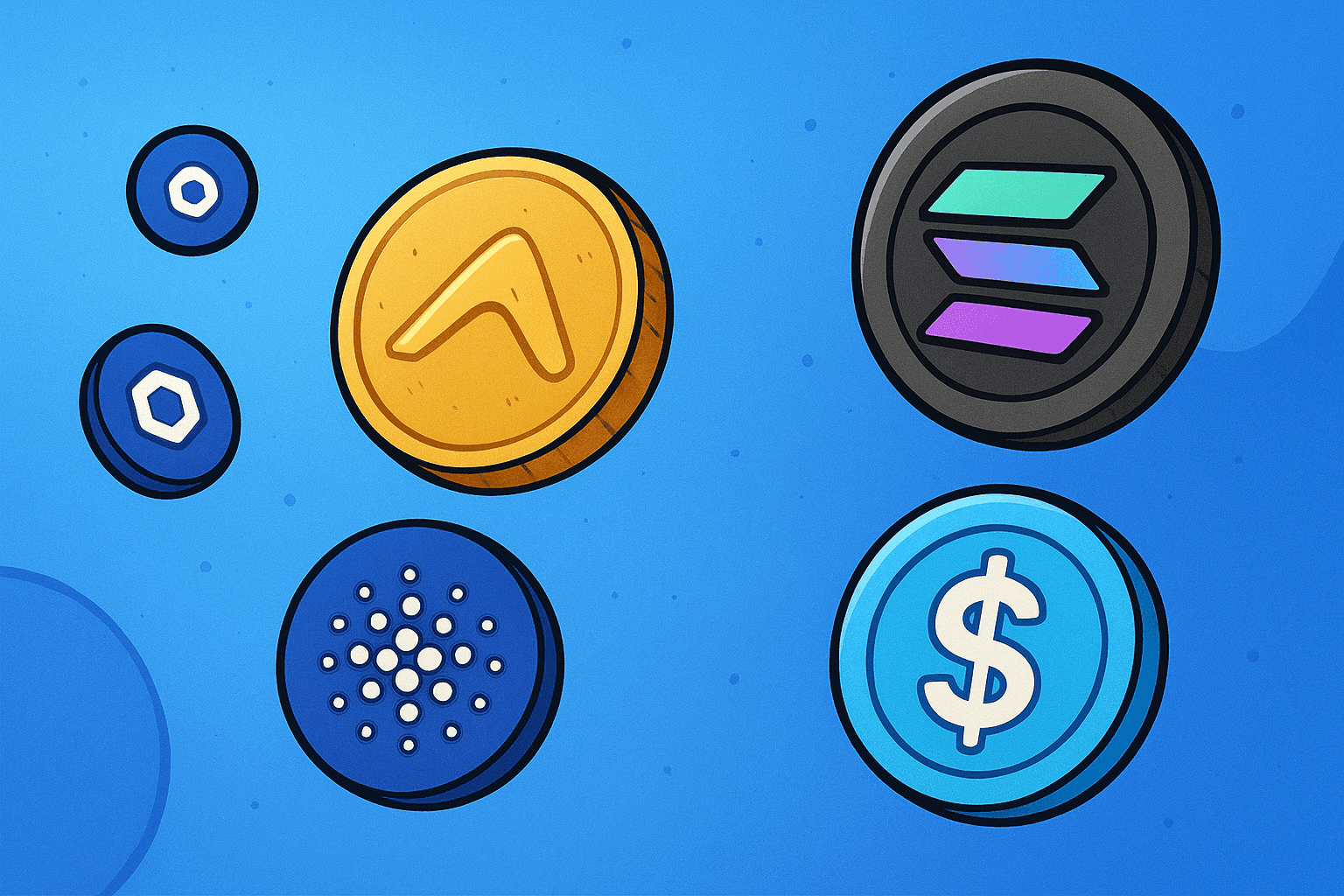
Supportive commentary on Bitcoin and broader cryptocurrencies from national leadership, paired with new efforts to clarify rules, suggests a potential inflection point for the U.S. digital asset ecosystem. Initiatives such as a Securities and Exchange Commission Crypto Task Force and a dedicated interagency Working Group aim to bring cohesive guidance that could expand participation by both retail users and institutions. In practice, these efforts tend to have the most direct impact on projects with U.S.-based operating teams, U.S. entities, and U.S. on-ramps, because clearer registration, custody, and compliance expectations can reduce friction with banking partners and institutional counterparties. Foreign projects can still benefit from clearer standards, but they may face additional hurdles around market access, disclosures, or enforcement when serving U.S. users.
For purposes of this guide, a cryptocurrency is treated as “U.S.-based” when the primary organization responsible for development and operations (such as a company, foundation, or core team) is headquartered or principally operated in the United States, or when the token’s issuer is a U.S.-regulated entity. Because most networks are global and decentralized to varying degrees, this is best understood as a “U.S.-anchored” profile rather than a guarantee of jurisdictional simplicity.When a project’s core operations are anchored in the United States, it often faces higher compliance expectations—but it can also benefit sooner from clearer rules, deeper capital markets, and broader institutional access.
Using that definition, the projects below—XRP, Solana, USD Coin, Avalanche, Sui, Stellar, Hedera, Litecoin, and NEAR Protocol—are commonly viewed as U.S.-based or U.S.-anchored because their core teams or operating organizations are primarily located in the United States.
Alongside these moves, statements indicating relief from capital gains taxes for domestically based crypto projects have stoked optimism around innovation and entrepreneurship, positioning the United States to compete among the most crypto-friendly jurisdictions. If capital gains relief were to materialize, the most immediate impact would typically be felt by liquid, widely traded assets with large U.S. investor participation—often the higher-volatility tokens where gains (and taxable events) are more common—while a dollar-pegged stablecoin like USD Coin is generally used more for transfers and settlement than appreciation. Potential advantages of buying U.S.-anchored crypto projects can include greater regulatory clarity, stronger investor protections, and easier integration with U.S. financial infrastructure; potential downsides can include heightened exposure to U.S. policy shifts, higher compliance costs that may affect product design, and less flexibility around privacy or permissioning.
With that backdrop, the following nine cryptocurrencies merit attention as the market evolves.
| Cryptocurrency | Launch Year | Founding Team/Company | Market Cap | Key Features | U.S.-Based (Yes/No) |
|---|---|---|---|---|---|
| XRP (Ripple) | 2012 | Jed McCaleb, Arthur Britto, and David Schwartz (XRP Ledger) | Above $148 billion | Rapid, low-cost cross-border settlement | Yes |
| Solana (SOL) | 2020 | Solana Labs | Exceeding $81 billion | High throughput and low transaction costs for dApps and NFTs | Yes |
| USD Coin (USDC) | 2018 | Center Consortium | Above $56 billion | Dollar-pegged stablecoin for exchange and settlement | Yes |
| Avalanche (AVAX) | 2020 | Emin Gün Sirer and the Ava Labs team | North of $9.8 billion | Programmable platform for DeFi and NFTs | Yes |
| Sui (SUI) | 2023 | Mysten Labs | Surpassed $9 billion | Move-based high-throughput Layer 1 with low-cost transactions | Yes |
| Stellar (XLM) | 2014 | Stellar Development Foundation | Approaching $10 billion | Bridge between crypto and fiat for global transfers | Yes |
| Hedera (HBAR) | 2018 | Hedera Hashgraph LLC | Above $8 billion | Hashgraph-based network with lower energy use | Yes |
| Litecoin (LTC) | 2011 | Charlie Lee | Above $9 billion | Fast confirmations and modest fees | Yes |
| NEAR Protocol (NEAR) | 2020 | Erik Trautman, Alex Skidanov, and Illia Polosukhin | Over $3.5 billion | Usability-focused Layer 1 with staking | Yes |
1. XRP (Ripple)
XRP is the native token of the XRP Ledger, launched in 2012 by Jed McCaleb, Arthur Britto, and David Schwartz. Unlike many cryptocurrencies, it was pre-mined with a hard cap of 100 billion units. Built for rapid, low-cost cross-border payments, it serves as a settlement asset within Ripple’s enterprise solutions. Thanks to efficiency and modest fees compared with BTC, XRP has grown into a leading asset with a market capitalization above $148 billion.
2. Solana (SOL)
Created by Solana Labs in 2020, Solana has emerged as a high-performance alternative to Ethereum for dApps and NFTs. Its appeal centers on throughput and low transaction costs, driving strong developer adoption and user growth. The network’s momentum has been reflected in a market cap exceeding $81 billion.
3. USD Coin (USDC)
USD Coin is a U.S. dollar–pegged stablecoin, originally introduced by Center Consortium in 2018. Operating across major blockchain networks, it offers price stability within a volatile crypto market, making it a popular medium of exchange and settlement asset. Its market cap is currently above $56 billion.
4. Avalanche (AVAX)
Avalanche, launched by Emin Gün Sirer and the Ava Labs team in 2020, is a programmable platform tailored for DeFi applications and NFTs. Enterprises often favor it for speed, scalability, and flexible architecture. AVAX, the native token, holds a market capitalization north of $9.8 billion.
5. Sui (SUI)
Sui, developed by Mysten Labs and launched in 2023, is an emerging high-throughput Layer 1 with substantial market potential. Built with the Move programming language, it targets ultra-fast, low-cost transactions; developers cite the ability to process roughly 300,000 transactions per second. SUI’s market cap has surpassed $9 billion.
6. Stellar (XLM)
Stellar, introduced by the Stellar Development Foundation in 2014, focuses on bridging crypto and fiat for global money movement. It enables swift, low-fee cross-border transfers and on-chain conversions. XLM, used to facilitate transactions on the network and available on exchanges, has a market cap approaching $10 billion.
7. Hedera (HBAR)
Hedera, initiated by Hedera Hashgraph LLC in 2018, operates on Hashgraph rather than a traditional blockchain, removing the need for mining and reducing energy usage. Its governing council includes major organizations such as Google, IBM, Boeing, and University College London. HBAR, used for network fees and as an investment asset, sits above $8 billion in market capitalization.
8. Litecoin (LTC)
Launched in 2011 by Charlie Lee using Bitcoin’s open-source code, Litecoin is often dubbed “silver” to Bitcoin’s “gold.” With an 84 million coin limit, it continues to remain relevant due to fast confirmation times and modest fees for cross-border transactions. Its market cap stands above $9 billion.
9. NEAR Protocol (NEAR)
NEAR Protocol is a Layer 1 platform launched in 2020 by Erik Trautman, Alex Skidanov, and Illia Polosukhin to simplify building dApps and Web3 experiences. Emphasizing usability and scalability, it has become a favorite among developers. NEAR’s market cap is over $3.5 billion, and the token is widely used for staking on the network.
Whether U.S.-anchored cryptocurrencies are a “good investment” depends on the same core factors that apply across the market: product-market fit, adoption, token economics, execution risk, and regulation. A U.S. footprint can be a tailwind if it unlocks clearer compliance pathways and institutional participation, but it can also concentrate policy and enforcement risk. As with any digital asset, volatility can be significant, and any tax treatment or regulatory relief discussed publicly should be treated as uncertain until implemented.
How Are U.S.-Based Crypto Coins Regulated?
Digital assets in the United States fall under both federal and state oversight. Here is how that plays out in practice.
Federal and State Regulation
At the federal level, multiple agencies share responsibilities:
- Securities and Exchange Commission (SEC): Regulates tokens classified as securities.
- Commodity Futures Trading Commission (CFTC): Supervises derivatives markets.
- Financial Crimes Enforcement Network (FinCEN): Enforces anti-money-laundering and counter-terrorist-financing requirements.
- Internal Revenue Service (IRS): Treats cryptocurrencies as property for tax purposes.
Beyond federal rules, issuers and exchanges must meet state obligations that can differ meaningfully in licensing approach, supervisory expectations, and what activities trigger registration.
- New York: BitLicense required for virtual currency businesses.
- District of Columbia: Licensing required.
- Delaware: Licensing required.
- Colorado: Licensing required.
- Alaska: Licensing required.
- Other states: Guidance evolving.
Ongoing Developments
Several initiatives could materially reshape the industry over the next few years:
- Executive Order: Pause on central bank digital currency, promote access, support stablecoins, establish Working Group. It does not name a single cryptocurrency the government will “use,” but it does signal interest in dollar-backed stablecoins and in studying a national digital asset reserve.
- Bitcoin Act of 2024: Federal Bitcoin reserve proposal. As a proposal, it would require congressional action to take effect.
- State Bitcoin reserve proposals: Pennsylvania, Wyoming, Texas, Ohio.SEC Crypto Task Force: Clearer rules, reduce ambiguity.
Questions about whether a U.S. president could implement tariffs on cryptocurrencies or eliminate taxes on U.S.-based crypto projects largely come down to legal authority and practical enforcement. Tariffs are typically designed for imported goods, which makes them difficult to apply cleanly to decentralized digital assets and peer-to-peer transfers. Likewise, eliminating or broadly changing capital gains taxes generally requires Congress, even if an administration can influence policy priorities, regulatory posture, and enforcement focus through executive direction.


No comments yet. Be the first to share your thoughts.